
Greylag Geese can be found in East Anglian wetlands year-round. While some populations travel long distances across Europe and Asia, the Greylags you see in southern and eastern England usually stay put. You can't tell if a goose on a Norfolk lake in winter is an Icelandic migrant just by looking at it.
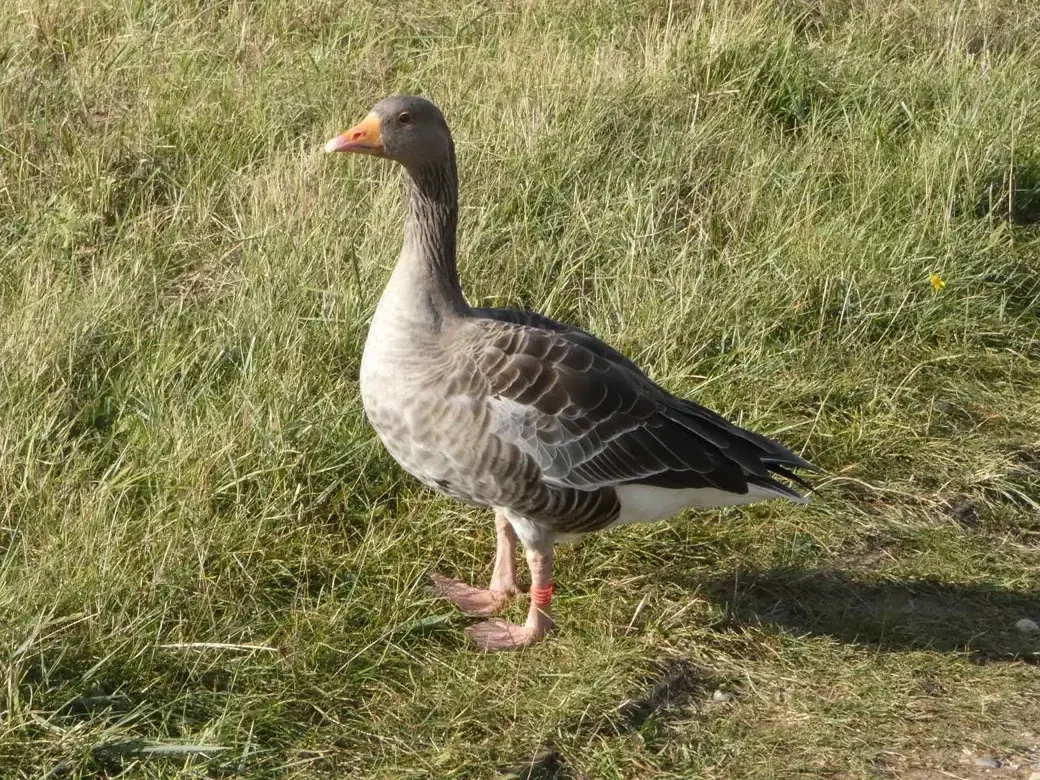
This side view shows the large bill, pink legs, and patterned grey wing. Photo by M. Hunt.
How to identify a Greylag Goose
A Greylag is a large, bulky grey goose with a strong orange bill and pinkish legs. Its body is fairly pale, and the folded wings show brown-grey feathers with lighter edges. A clear white patch marks the back. In flight, look for broad pale grey upper wings contrasting with darker flight feathers. Sometimes light, distance, or the bird’s position can hide these features, so it’s best to use a mix of clues instead of relying on just one.
Pink-footed Geese are smaller and more compact, with a shorter, mostly dark bill that has a pink band. They also have pink legs, so leg colour alone isn’t a reliable way to tell them apart from Greylags. Adult White-fronted Geese have a white patch around the base of the bill and dark bars on their bellies, but young birds might not have these marks yet. Canada Geese often share the same water with Greylags, but their black heads and necks with white chinstraps make them easy to tell apart.
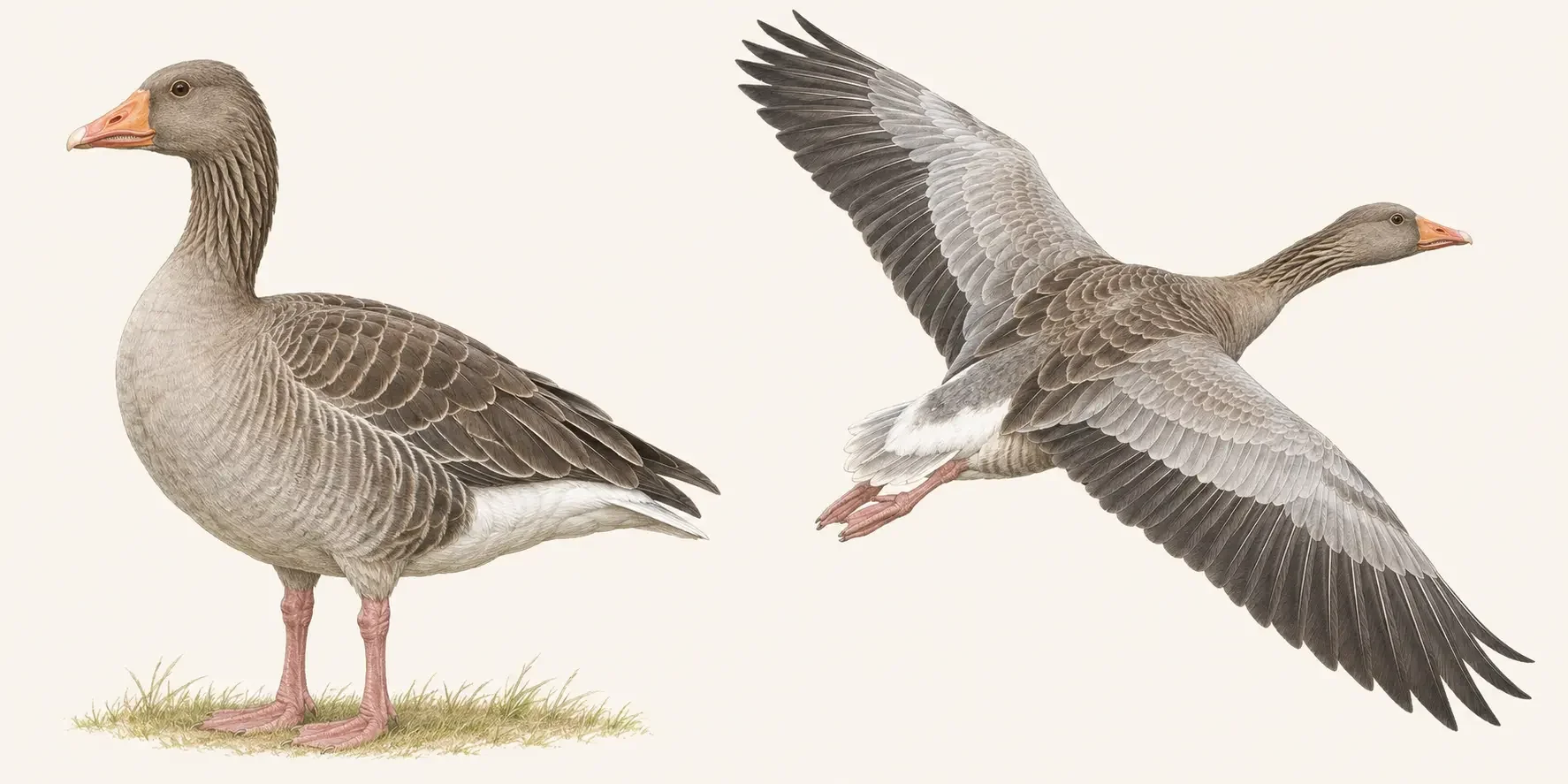
Greylag Goose on the ground and in flight. The pale upper wing is easiest to appreciate in flight. Illustration, not a photograph. Photo by M. Hunt.
Why are Greylags here all year?
Greylag Goose is native to Britain. The surviving native breeding population was historically concentrated in north-west Scotland and the Western Isles. Greylags released and re-established elsewhere spread across much of the country. As those birds and the Scottish population expanded, their ranges overlapped; the British and Irish resident birds are now treated together for monitoring purposes.
Around lowland England, Greylags breed on wetlands, lakes, rivers and former gravel pits. Outside the breeding season, they gather in groups and move between water and feeding areas. A flock growing larger in autumn need not mean birds have crossed an international border: local breeding success and movements within Britain can change numbers at a site.
East Anglia is a useful place to see the distinction. A lake or washland may hold familiar resident Greylags alongside other geese that have arrived from farther north. The birds are sharing a winter landscape, but they need not share a migration history.
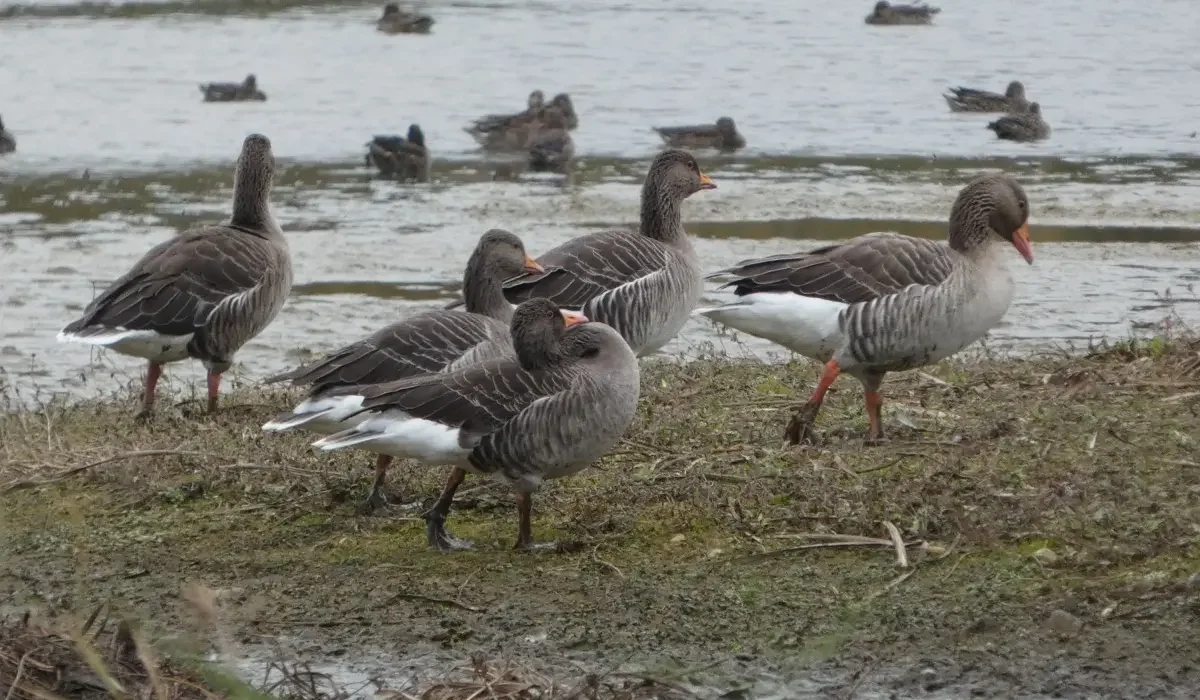
Greylags at a wetland edge. A photograph of a flock cannot establish where its members bred. Photo by M. Hunt.
Where do Greylag Geese migrate?
Greylags breed in Iceland and western Europe, and across much of northern and central Eurasia. Different populations follow different routes. Icelandic breeders travel to Britain and Ireland in autumn, now wintering principally in Scotland, particularly Orkney. Many birds breeding in Norway move through Denmark and Germany towards the Netherlands; some continue through France to Spain. Other continental populations have their own wintering areas. Across Asia, the species winters farther south and east.
No single European Greylag route exists, let alone one followed by every bird. Some north-west European breeders remain much closer to their nesting areas in winter. British and Irish resident birds may move within the country but are generally not part of the Icelandic or continental international migrations. Ringing, marked-bird resightings and coordinated counts reveal these population links; the appearance of an unmarked goose cannot.
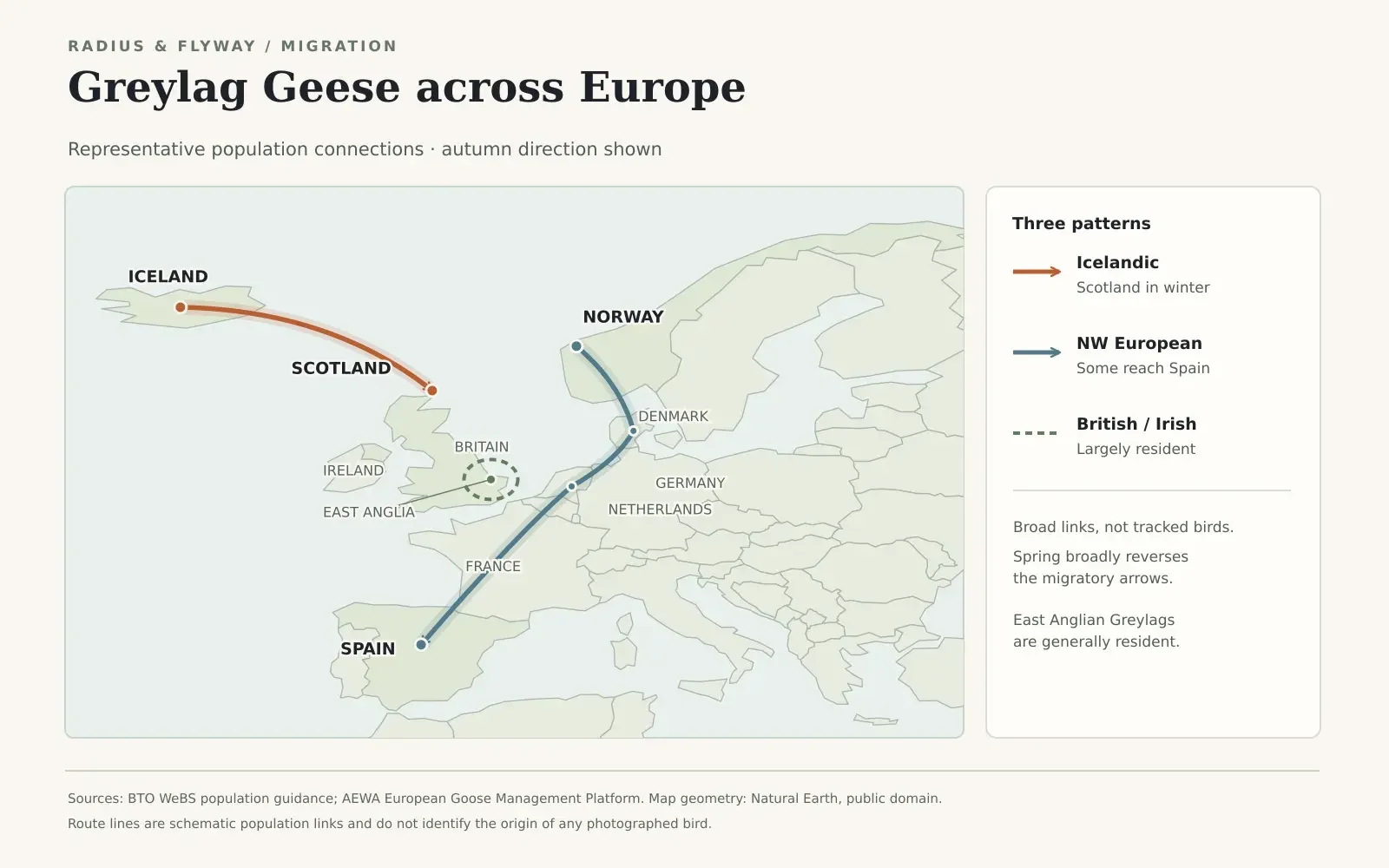
Representative Greylag population connections in Europe. Arrows show broad autumn links, not tracked journeys or the origin of the birds in these photographs. Map: Radius & Flyway, using public-domain Natural Earth geography.
How long do Greylag Geese live?
The British Trust for Ornithology gives eight years as the typical life expectancy of a Greylag that has reached breeding age; breeding usually begins at around three years. This is a useful answer to the common lifespan question, but it does not guarantee survival for an individual bird, and many young geese do not survive to breed.
Some Greylags live much longer. In a report with records up to 2024, the BTO listed a ringed Greylag that reached 20 years, one month, and 28 days. That’s a longevity record, not the average. A ring makes this possible because it links a bird’s later sighting to its earlier capture.
One of the photographed Greylags has a red leg ring. Its code is not legible in these images, so we cannot use it to establish the bird’s age or travels. The bird is still a good illustration of the difference between recognising a species and tracing an individual. For the wider picture of arrivals, departures and movements within Britain, see our month-by-month guide to bird migration. Our East Anglia birding guides cover the wetlands and other places where such comparisons can be made in the field.
Sources and further reading
BTO: Greylag Goose BirdFacts — British populations, distribution and typical lifespan.
BTO: Greylag Goose population treatment — resident and Icelandic population allocation.
BTO: Ring, Ring Ye Birds — Greylag longevity record through 2024.
AEWA European Goose Management Platform: Greylag Goose — north-west European movements.
WWT: Geese found in UK wetlands — identification characters.