

Why Blackcaps Now Spend Winter in Britain
By Radius & Flyway
The Observation
A male Eurasian Blackcap (Sylvia atricapilla) has spent several days defending the ivy beside my garden feeder. With his slate-grey plumage, neat black cap and sharp tacc-tacc alarm call, he repeatedly chases Blue Tits (Cyanistes caeruleus) and House Sparrows (Passer domesticus) from a nearby suet block before retreating into the cover of the foliage.
Forty years ago, that observation would have been remarkable. The Blackcap was widely regarded as one of Britain's summer visitors, arriving in spring to fill woodlands with its rich, fluting song before departing again in late summer. Seeing one in a British garden in January was unusual enough to warrant comment in local bird reports.
Today, wintering Blackcaps have become a familiar feature of many gardens across southern Britain. Their presence is no longer the question. The more interesting question is why they are here at all.
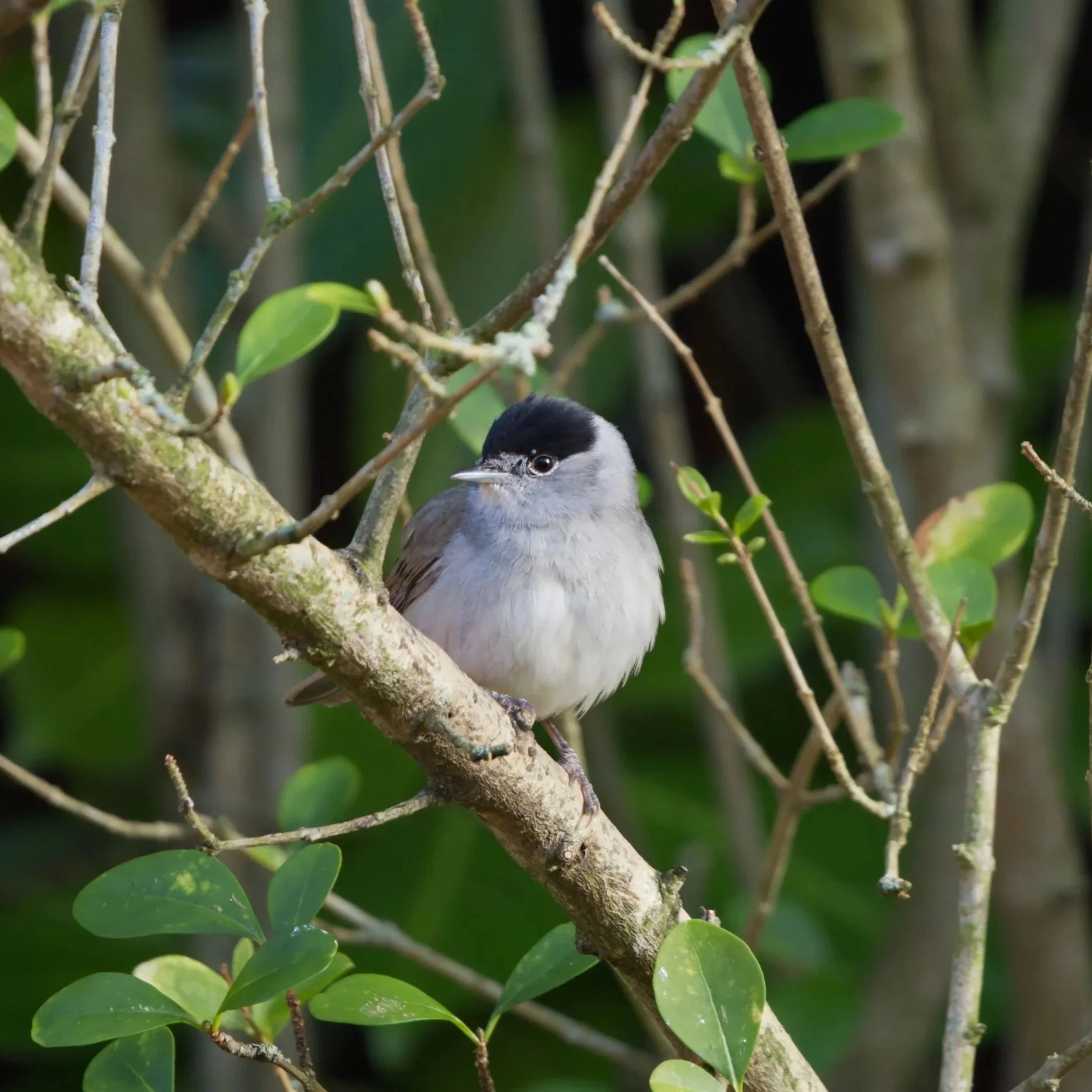
A male Eurasian Blackcap (Sylvia atricapilla)
The Question
Are the Blackcaps visiting our gardens in winter the same birds that breed in our local woodlands each summer, or are they part of a different population following an entirely new migratory strategy?
The Investigation
To answer that question, we need to look beyond individual garden sightings and examine evidence from bird-ringing studies across Europe.
For many years, ornithologists assumed that wintering Blackcaps in Britain were simply local breeding birds that delayed or abandoned their traditional autumn migration as winters became milder. It was a plausible explanation. If food remained available and temperatures rarely fell to lethal levels, why continue the long journey to Iberia or North Africa?
Ringing studies gradually told a different story.
Blackcaps caught in British gardens during winter were fitted with uniquely numbered metal rings. When some of these birds were later recovered or re-trapped during the breeding season, they were not found in Britain. Instead, most had returned to central Europe, particularly Germany, Austria and western Poland.
At the same time, ringing and colour-marking studies showed that the majority of Blackcaps breeding in Britain continued to leave in late summer, following the traditional south-west migration towards Spain, Portugal and Morocco.
Rather than a single population changing its behaviour, the evidence suggested that Britain was hosting a different wintering population altogether.
[Summer Breeding Population]/ \
(Breeds in UK / June) (Breeds in Central Europe / June)
/ \
Migrates Southwest Migrates Northwest
/ \
[Winters in Iberia / N. Africa] [Winters in UK Gardens / January]
The distinction is important. A Blackcap feeding beneath a British bird table in January is unlikely to be the same individual singing from a nearby woodland in May. Although there is some overlap, ringing studies show that these are largely separate migratory populations following different inherited routes.
The Evidence
Understanding where these birds came from solved only part of the puzzle. The next question was why a new migration route had evolved in the first place.
One of the most influential studies was led by Peter Berthold and colleagues at the Max Planck Institute for Ornithology. Their work explored whether migratory direction was learned from other birds or inherited genetically.
Migratory birds exhibit a behaviour known as Zugunruhe, or migratory restlessness. Even when raised in captivity, birds become active during the normal migration period and consistently orient themselves in the direction they would naturally travel.
Berthold's experiments produced a striking result. Young Blackcaps descended from birds wintering in Britain consistently oriented north-west, despite never having experienced migration themselves. Offspring from populations following the traditional south-west route oriented in that direction instead.
The work demonstrated that migratory direction has a strong genetic component. By selectively breeding birds showing north-west orientation, Berthold also showed that this behaviour could change remarkably quickly through natural selection, over only a few generations.
That still leaves an obvious question. What advantage does wintering in Britain offer?
Research published in Global Change Biology by Kate Plummer and colleagues examined more than two decades of observations from the BTO's Garden BirdWatch scheme alongside climate and land-use data. The study found that garden feeding had become one of the strongest predictors of where Blackcaps now spend the winter, acting alongside increasingly mild winters.
For a bird that traditionally travelled more than 1,500 kilometres to reach southern Europe, Britain represents a much shorter journey. Well-stocked gardens provide reliable, energy-rich food throughout the winter, while milder conditions reduce the risks once associated with remaining this far north.
[Milder British Winters] + [Garden Bird Feeding]│
▼
Improved Winter Survival
│
▼
Earlier Return to Central European Breeding Grounds
│
▼
Natural Selection Favours Northwest Migration
This shorter migration appears to confer two important advantages. Birds expend less energy reaching their wintering grounds and often return to central Europe earlier in spring. Earlier arrival can improve access to breeding territories and increase reproductive success, allowing the north-west migration strategy to spread through the population over successive generations.
The blackcap’s adaptability is reflected in its population metrics. Combined data from the BTO’s Common Birds Census (CBC) and the Breeding Bird Survey (BBS) show that the UK breeding population of blackcaps increased by an estimated 372% between 1967 and 2024, while its breeding distribution expanded by nearly 30%.
Blackcap Population Trends (UK, 1967–2024)===================================================
Breeding Population Increase: ▲ 372%
Breeding Range Expansion: ▲ 30%
Primary Growth Regions: Scotland & Northern Ireland
===================================================
This expansion is particularly pronounced in Scotland and Northern Ireland, where rising average spring temperatures have shifted the species' thermal boundaries. Earlier springs have advanced the average laying date of blackcaps by several days over the last three decades, permitting successful double-brooding (rearing two clutches in a single season) in regions where a short summer previously limited them to one.
However, habitat dynamics remain complex. Even with woodland regeneration and the expansion of suburban scrub, which provide abundant nesting sites, local breeding success can be heavily constrained by understory structure. In woodlands with high densities of deer—such as Reeves’ Muntjac (Muntiacus reevesi) or Fallow Deer (Dama dama)—excessive browsing of the shrub layer (especially bramble Rubus fruticosus and hazel Corylus avellana) strips away the low, dense cover that blackcaps require for nesting.
Reflection
The Blackcap's changing migration is reflected in its fortunes as a breeding bird. Since the late 1960s, Britain's breeding population has increased several-fold, while the species has continued to expand its range northwards, becoming increasingly common in Scotland and Northern Ireland.
Warmer springs are likely to have contributed to this success. Earlier breeding seasons allow Blackcaps to nest earlier, and in favourable years, some pairs can raise a second brood. At the same time, woodland regeneration, scrub development and suburban gardens have created additional nesting habitat across much of Britain.
Not every woodland, however, offers suitable breeding conditions.
Blackcaps nest low in dense shrubs, relying on tangled vegetation for concealment. In woodlands where deer populations have heavily browsed the understorey, much of this protective cover can disappear. Bramble, hazel and other shrubs are often reduced to open stems, leaving fewer secure nesting sites despite the presence of mature trees overhead.
It is a useful reminder that climate alone rarely explains changes in bird populations. Migration, habitat structure, food availability and land management all interact, sometimes reinforcing one another and sometimes pulling in different directions.
Practical Fieldcraft
The Blackcap's changing migration offers birders an opportunity to contribute useful observations. A few simple habits can add valuable information to long-term monitoring schemes while also improving your understanding of the species.
Watching the Seasonal Changeover
The most interesting periods are autumn and early spring.
Most British breeding Blackcaps have departed by late September, while continental birds begin appearing during October. Likewise, many wintering birds leave Britain during March, shortly before our breeding population starts returning from southern Europe.
Recording these first and last dates each year can reveal subtle changes in migration timing that become meaningful when combined with thousands of observations from across the country.
Feeding Winter Blackcaps
Unlike tits and finches, Blackcaps are not especially comfortable clinging to narrow mesh feeders. They prefer stable feeding surfaces and naturally sheltered positions. Suet, fat blocks, mealworms and halved apples placed on bird tables or broad feeders are readily accepted. Dense ivy, holly and evergreen shrubs nearby provide the cover they seek between feeding visits.
Planting for Birds Throughout the Year
Gardens become far more valuable when they provide both food and shelter.
Native shrubs such as Wild Privet (Ligustrum vulgare), Guelder Rose (Viburnum opulus), and mature Ivy (Hedera helix) offer nesting cover during the breeding season and berries through autumn and winter. Structurally diverse plantings often benefit many more species than single-species plantings.
Contributing to Citizen Science
If Blackcaps visit your garden, consider recording them through BirdTrack or the BTO's Garden BirdWatch scheme. Individual records may seem insignificant, but together they allow researchers to track changes in migration, distribution and the timing of seasonal movements across Britain.
A Wider Conservation Lesson
The Blackcap's story is often presented as an example of birds adapting successfully to climate change. In reality, it illustrates something more nuanced.
Blackcaps have prospered because they possess unusual flexibility. They readily switch from an insect-based summer diet to berries and supplementary food during winter. They breed in a wide range of habitats and adapt well to gardens and fragmented woodland. When environmental conditions changed, they already possessed the ecological traits needed to exploit new opportunities.
Many migratory birds do not.
Species such as the Wood Warbler (Phylloscopus sibilatrix) and Common Nightingale (Luscinia megarhynchos) depend on specialised habitats, precise migration schedules and seasonal peaks in insect abundance. Their options are far more limited when landscapes or climates change.
The Blackcap therefore represents both an encouraging success story and a useful contrast. Evolution can respond surprisingly quickly, but not every species has the same capacity to adapt.
For birders, that makes every winter Blackcap more than an unusual garden visitor. It is evidence that migration is not a fixed instinct passed unchanged from one generation to the next. It is a living process, continually shaped by climate, habitat and natural selection.
Watching a Blackcap feeding quietly beneath a bird table may seem an ordinary moment. In reality, it offers a rare opportunity to witness evolution unfolding within a human lifetime.
Sources
British Trust for Ornithology.BirdFacts: Eurasian Blackcap (Sylvia atricapilla).
A continually updated summary covering distribution, migration, breeding ecology, population trends and ringing recoveries.
https://www.bto.org/understanding-birds/birdfacts/blackcap
British Trust for Ornithology.Garden BirdWatch.
The long-running citizen science project that has provided much of the evidence underpinning research into Britain's wintering Blackcap population.