
The Close Pass: Why Swifts Fly at Nesting Walls
The common swift (Apus apus)
Young-looking Swifts repeatedly approached the walls of an established colony. It is uncertain whether they were looking for future nest sites or engaging in the behaviour known as “banging.”
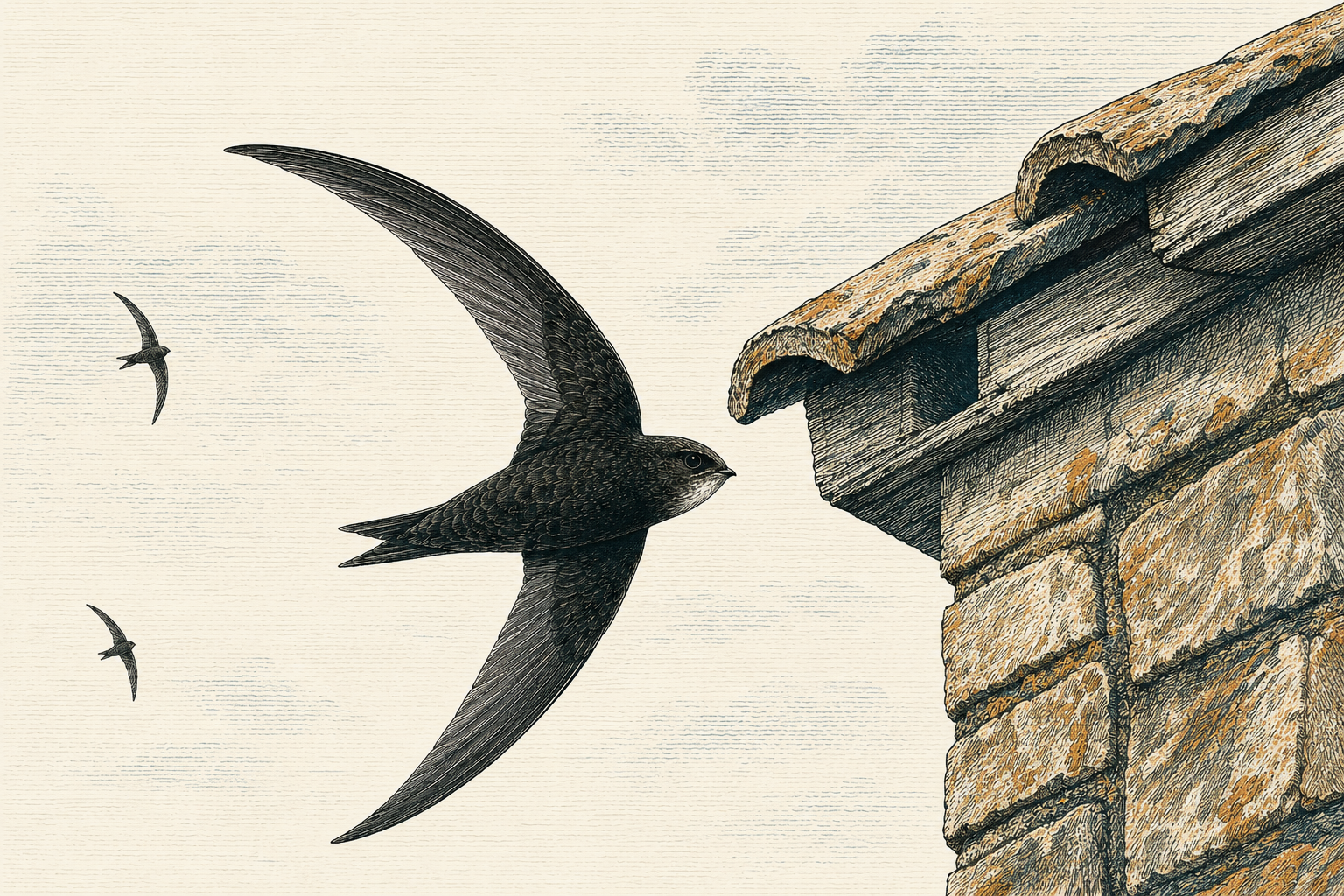
On 10th July, more than 30 Common Swifts gathered around a large house in Lithuania. Swifts had nested here for about ten years in narrow gaps between the walls and roof. Adult swifts were still entering known nest holes, whilst other birds raced past the eaves, screaming. From time to time, one bird broke away and turned towards the building. Some aimed at occupied entrances; others approached gaps where no pair was known to be nesting. Most veered away at the last second. A few briefly clung to the wall before dropping back into flight. Through binoculars, the birds making the closest approaches appeared younger in both plumage and behaviour. These individuals were likely one or two years old, rather than newly fledged. Their actions suggested they were testing the challenging approach to a nest hole, although their exact age could not be confirmed.
Young, but not newly fledged
Swift chicks remain in the nest for roughly 40 to 50 days. The first young normally leave in late July, depending on the weather and breeding date. On 5 July, that summer’s chicks at the house were very likely still inside, with adults returning to feed them.
The younger-looking birds outside were most likely pre-breeders: Swifts from previous summers that had returned but had not yet established a nest. Tracking data indicate that yearlings may visit several colonies, while older non-breeders spend more time at specific sites. Many Swifts do not breed until they are several years old. The identification of these birds as “one or two years old” remains an informed field judgement rather than a definitive determination.
Two distinct behaviours were observed.
One was the familiar screaming flight: groups of Swifts racing around the colony while calling. Both breeders and non-breeders may take part in these fast social flights, although their exact purpose remains uncertain.
The other activity was aimed at the building. Individual birds approached entrances and other gaps, slowed sharply, turned away or briefly touched the wall. Birds following them generally passed a little farther out.
The difference became clearer over the following days. The clinging and repeated wall approaches stopped, while the screaming flights continued at a lower intensity. The two behaviours overlapped, but they were not the same thing.
The difficult word: “banging”
Swift specialists often call close activity around nesting buildings “banging”, though the word is not used consistently. In one detailed study, a bird slowed almost to a stop near a building, often after another Swift entered a cavity or clung to the wall. Other birds sometimes followed its flight line.
That is similar to what was seen at the house: one bird made the tightest approach while followers passed slightly farther away. The occasional brief contacts with the wall also fit broader uses of the term. But it does not provide an answer. Banging has been recorded around occupied cavities, clinging birds and places that could not have held a nest. Suggested functions include prospecting, aggression, colony defence and responses to predators. No single explanation fits every close pass.
Were some birds prospecting?
Prospecting is the strongest explanation for at least part of the activity, especially where birds repeatedly inspected unused but suitable-looking gaps. An active colony tells a visiting Swift something useful: this building contains accessible cavities where other birds have bred, so repeated inspection points to possible future use.
A non-breeding bird moving between colonies might discover a future nest by following another bird towards the eaves or examining narrow openings. Some birds may have been searching for a cavity; others may have been responding to residents or simply joining a social flight whose purpose remains unclear.
The thought that these approaches serve as practice is appealing, but lacks sufficient evidence. Whilst the repeated manoeuvres required precise control, there is no direct indication that the birds were rehearsing future nest entries. Although the behaviour may resemble practice, current evidence more strongly supports prospecting and banging as explanations.
A colony’s hidden future
A Swift colony is more than the nests occupied that summer. Around its breeding pairs may be younger birds examining empty cavities and their approach routes.
Those gaps, and the clear air in front of them, may be part of the colony’s future. Breeding Swifts are strongly faithful to their nest sites: a 15-year RSPB study found that 94 per cent of returning birds used the same site again. Yet a hidden entrance can be sealed, or its approach blocked by scaffolding without builders or owners realising it is in use.
Protecting known nest holes and their approaches matters most. Swift bricks can also provide permanent cavities in suitable new buildings. They cannot replace the history of an established colony, but they can give future prospectors somewhere to settle.
The close pass
Assigning a name to the behaviour did not resolve its underlying purpose. The wall approaches closely resembled banging, while visits to unused gaps were consistent with prospecting. The notion of deliberate landing practice remains an impression rather than a substantiated explanation. The interpretation of the gathering evolved. The house served not only as a nesting site for established pairs, but also, for several days, as a focal point for young-looking non-breeders attracted to its entrances and empty gaps.
Subsequently, the close approaches ceased while the screaming flights persisted. Future observations of Swifts racing around familiar rooflines should focus on which gaps individual birds prefer, the proximity of their approaches, and whether they return. These behaviours may indicate the start of the colony’s next phase.
Sources and further reading
G. Oloś, “Is ‘banging’ an antipredator behaviour in Common Swift?”, Ornis Fennica, 2017.
Marius Karlonas, “Ką daryti radus čiurlio jauniklį”, LRT, 2026.
RSPB, “Swifts really are loyal to their nesting site”, 2026.