

Bird Migration by Ian Newton review: a clear introduction for birders
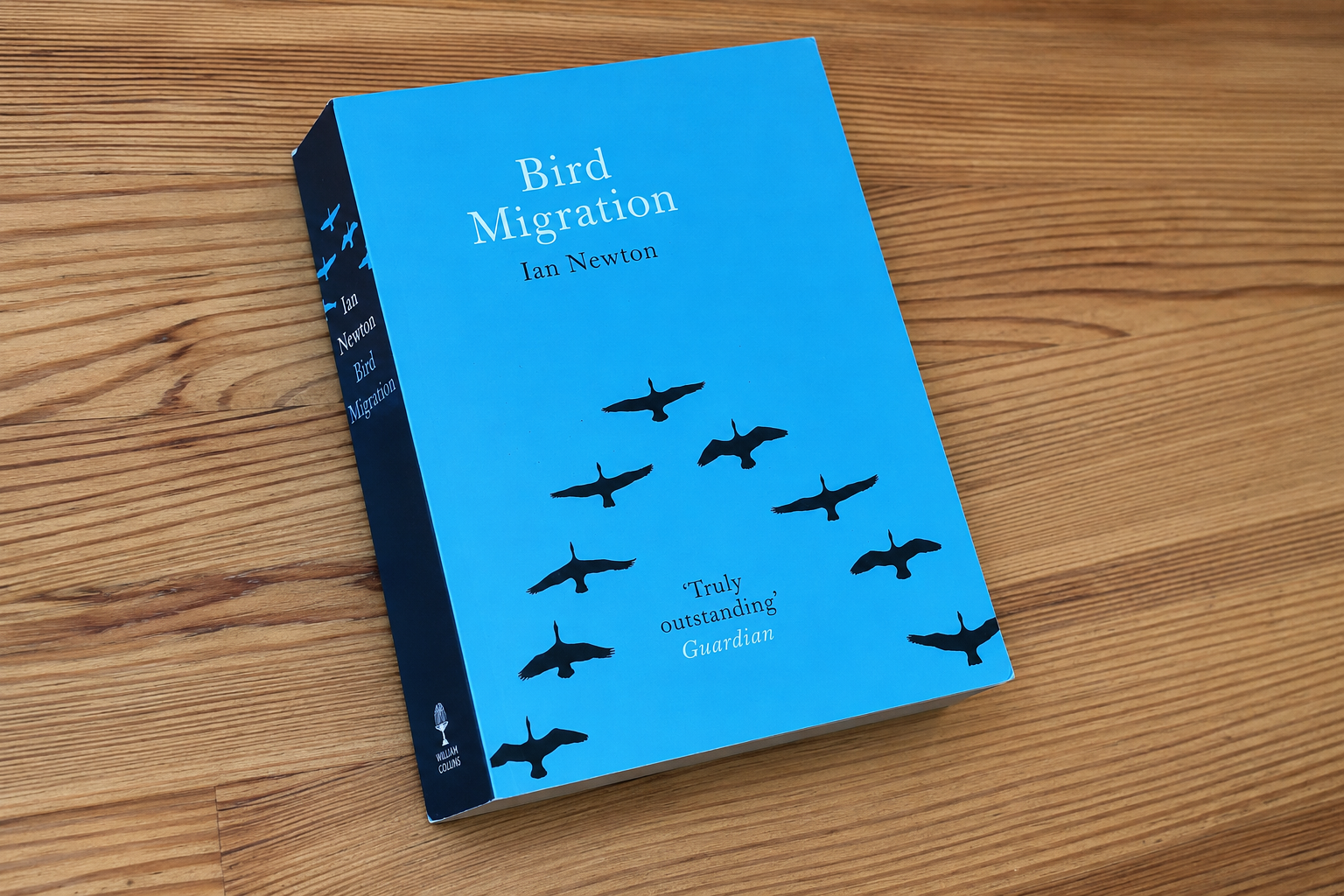
Ian Newton’s Bird Migration is a substantial but approachable introduction to the patterns and processes behind avian movement.
Ian Newton’s New Naturalist book explains how and why birds migrate, but it doesn’t read like a textbook. The 2020 paperback is still a great place for birders to start if they want to understand the movements they see outdoors.
Book details
Author: Ian Newton
Title: Bird Migration
Series: Collins New Naturalist Library, no. 113
Edition reviewed: William Collins paperback, 2020; a reissue of the work first published in 2010
Length: 598 pages
ISBN: 9780008398545
Best for: Birders who want an accessible but serious introduction to the science of migration
Is Bird Migration worth reading?
Yes. If you already notice the patterns of spring arrivals, autumn movements, and winter returns, Bird Migration helps explain what causes them. Ian Newton covers the physiology, timing, weather, navigation, evolution, and ecology of migration, and he presents the evidence in a way that any dedicated birder can follow without needing special training.
I found the book interesting, clear, and easier to read than its length suggests. Specialists agreed with this view when the book first came out. A detailed review in British Birds praised Newton for making a huge amount of research accessible to non-academic readers. The review said the book belongs on the shelf of anyone interested in the “hows” and “whys” of migration.
This isn’t a quick seasonal guide or just a list of amazing journeys. Instead, it gives you a useful framework for understanding why birds move, how they manage these movements, and why migration happens in so many different ways.
What does the book cover?
The book has 25 chapters, grouped into four main sections. Newton starts by looking at the different types of bird movement, how scientists study them, and the main patterns found in Britain and Ireland. He then explains the process itself: when birds leave, how they get and use energy, how weather affects them, and how they find their way.
Later chapters look at how migration evolved, how migratory behaviour changes, and how bird movements connect to geography and ecology. Topics like vagrancy, dispersal, irruptions, and nomadism are covered along with the more familiar trips between breeding and non-breeding areas.
That wide scope is important. Migration might seem simple when shown as an arrow on a map, but birds don’t all follow neat, fixed routes. Even birds of the same species can behave differently depending on their age, sex, experience, or the conditions they face. Some movements are regular, while others depend on food, weather, or population pressure. Newton helps readers see these differences while still understanding the bigger picture.
The focus on Britain and Ireland makes the early chapters feel familiar. While global examples add perspective, the book stays connected to the arrivals, departures, and events that shape birding in these islands.
Why the book works
Newton’s main strength is his clear writing. He tackles tough topics but doesn’t make them sound harder than they are. He introduces questions about fuel, orientation, or timing step by step, using evidence to show what we know and where there are still questions.
Navigation is a good example. The book doesn’t just give one simple answer and move on. It looks at the different clues birds use and the experiments that helped researchers figure them out. Newton uses this same approach when talking about weather, migration strategies, and vagrancy. He explains the different ideas, weighs the evidence, and points out what scientists still don’t know.
This gives the book a rare balance. It covers more than a story-driven popular book, but it’s much easier to read than a specialist reference. The science is solid, but the writing is clear and to the point. I almost never felt that Newton was showing off his knowledge; instead, he uses it to make things clearer.
The book is also rewarding to read in short sections. Reading it all the way through gives you a broad understanding, but you can also return to individual chapters after seeing a migration, a coastal fall, or an unexpected arrival to answer specific questions.
What it adds to birding
The book won’t tell you exactly where to go next weekend or which date is best for spotting a certain migrant. Instead, its value is in changing how you understand what you see.
A wader feeding busily on an estuary might be building up energy for the next part of a long journey. A sudden arrival of migrants is linked to weather, geography, and the choices individual birds make. Seeing an unexpected species can raise questions about orientation, displacement, or how flexible migration programs are.
This deeper context makes everyday observations more interesting. It also shows why breeding areas, stopover sites, and non-breeding grounds are all parts of one connected system. For readers who want to learn about current routes, maps, and seasonal details later, the book gives the biological foundation that a flyway guide can build on.
Who is this book for?
Bird Migration is especially well suited to:
birders who know the seasonal pattern and want to understand the biology behind it;
readers moving from field guides and reserve accounts into ornithology;
anyone planning to explore flyways, stopover ecology or migration research in greater depth; and
naturalists who want serious science in a clear, non-academic style.
This book isn’t the best choice if you want a portable field guide, a month-by-month migration calendar, a regional route atlas, or the latest information on tracking technology. Those are topics for other books, not shortcomings of this one.
Verdict
Bird Migration is easy to recommend. It takes a topic that could get complicated fast and makes it understandable without losing its depth. Newton’s calm, clear writing lets the evidence speak for itself, and the focus on Britain and Ireland gives local birders a familiar entry point into a global subject.
The book is now best read as a foundation rather than the last word on migration research, but it’s still a very strong starting point. Its lasting value comes from the connections it draws: between weather and movement, fuel and distance, stopovers and survival, and the choices of individual birds and movements across continents.
For a birder who wants to move beyond knowing that birds migrate and begin to understand how migration works, this is an excellent place to start.
Sources and further reading
Ian Newton, Bird Migration, Collins New Naturalist Library no. 113; 2020 William Collins paperback reissue, ISBN 9780008398545.
Alexander C. Lees, “Bird Migration by Ian Newton”, British Birds 103 (2010).
British Trust for Ornithology, Migration research.
UN Environment Programme, Eurasian-African Bird Migration Atlas.
Academic Press, The Migration Ecology of Birds, second edition.
Review basis: The assessment of readability and interest reflects the reviewer’s experience of the 2020 paperback. The book’s scope, publication history, specialist reception and later research context were checked against the publisher, British Birds, BTO, UNEP and Academic Press.
Information checked: 31 July 2026.