

Hawke Frontier ED X 8×25 binoculars review
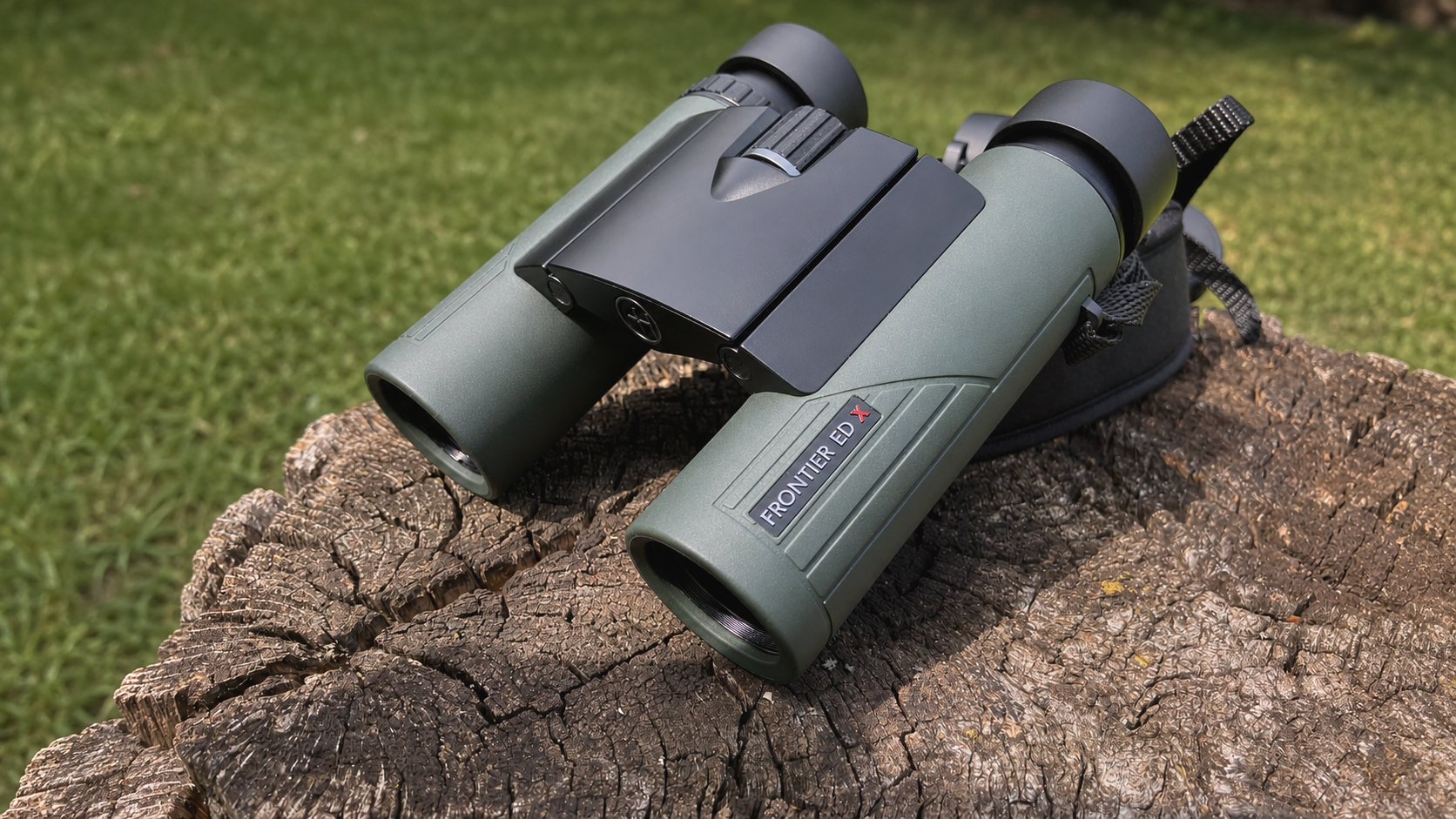
The double-hinge Frontier ED X folds small, but careful interpupillary adjustment and eye placement are important.
This binocular is truly light and compact, offering sharp, accurate colour if you take a moment to set it up properly.
Early verdict: This is a great option for birders who want to carry as little weight as possible but still enjoy a bright, wide view. The main trade-off is not sharpness, but how easy it is to use.
Testing basis
I based this review on my own pair, which I used for a month in good daylight, as the light faded, and during two heavy rain showers. I also compared them informally with some familiar non-ED 8×30 binoculars in good light. My comparison was practical, not scientific, so my judgment is about real-world use, not a claim about all 8×30 models.
I did not measure light transmission, resolution, or chromatic aberration in a lab. I also have not tested the binoculars in deep twilight, submerged them for waterproofing, or used them long enough to judge long-term durability. The rain exposure was a helpful check in normal field conditions, but not a formal waterproofing test.
Key specifications
- Magnification and objective
- 8×25
- Weight
- 310 g
- Field of view
- 140 m at 1,000 m (8°)
- Exit pupil
- 3.1 mm
- Eye relief
- 16 mm
- Interpupillary distance
- 35–73 mm
- Close focus
- 2 m
- Construction
- Double-hinge magnesium-alloy chassis
Source: Hawke Optics
A small binocular that still gives a serious view
The first thing I noticed is that there is very little optical compromise in good light. The view is sharp, colours look natural, and the binocular shows plenty of detail without feeling like just a basic compact. In my informal comparisons, it performed about as well as the non-ED 8×30 binoculars I know well.
This does not mean that 25 mm objectives are the same as 30 mm, or that ED glass is always better than non-ED glass. What I can say is that in normal daylight, this compact binocular gave me a view that did not feel like a big downgrade.
Hawke says the good optical performance comes from extra-low-dispersion glass, fully multi-coated lenses, and dielectric, phase-corrected BAK-4 roof prisms. These are technical specs, not field results. What I noticed is that colour and sharpness have been consistently good.
The wide field matters
Hawke lists a field of view of 140 meters at 1,000 meters, or 8 degrees. This is wide for an 8×25 and helps the binocular feel more open than many other compact models. For birding, it makes it easier to find a moving bird and keep some of the surrounding habitat in view, instead of feeling like you are looking through a tunnel.
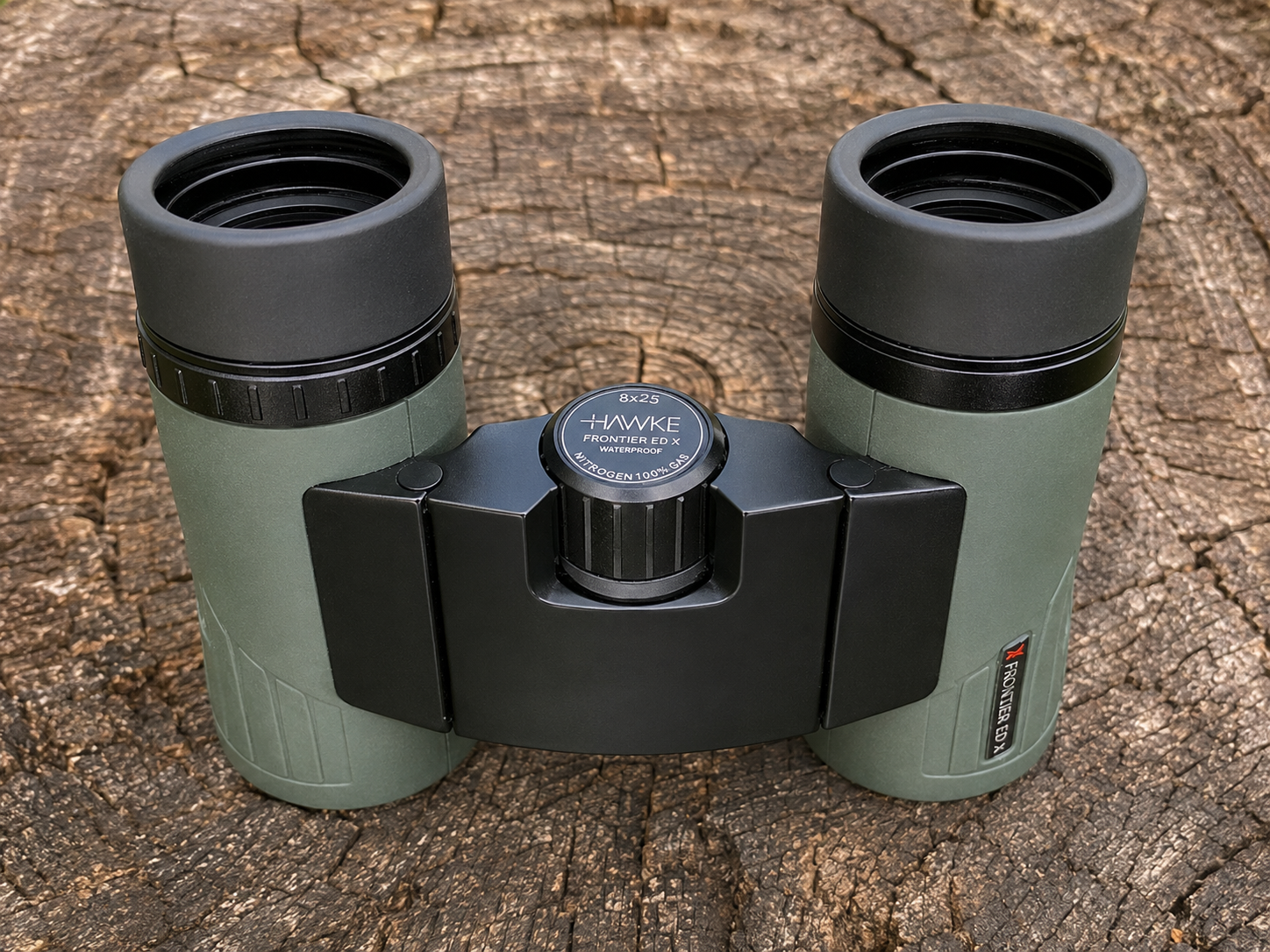
Green Hawke Frontier ED X 8×25 compact binoculars showing focus wheel
Handling: easy to carry, less automatic to set up
Weighing 310 grams, the Frontier ED X feels very light in use. It is easy to hold, and the double hinge lets you fold it into a truly compact shape. Focusing has been simple and precise during regular birding.
The compact size does come with a trade-off. The interpupillary distance is easy to adjust, but you need to set it carefully. I also have to position my eyes more precisely than with many larger binoculars to get the full view.
This makes sense from an optical point of view. An 8×25 has a 3.1 mm exit pupil, so the area you can look through is smaller than with an 8×30 or 8×42. A larger exit pupil usually gives your eyes more room for small positioning errors and lets in more light in dim conditions. Once the Hawke is set up correctly, though, the view is very good.
What happens as the light fades?
I found the binoculars perfectly usable in fading light. That is worth saying because small objectives are sometimes dismissed too quickly. Good coatings and a well-executed optical design still matter, and in ordinary daylight the eye may not be able to use the full exit pupil of a larger binocular anyway.
There is still a physical limit. The 3.1 mm exit pupil cannot provide as much reserve as the larger exit pupil of an 8×30, 8×32, or 8×42 when your own pupil gets bigger in low light. In my experience, these binoculars are capable as the light fades, but they are not low-light specialists. I did not test them in deep dusk or compare them to larger binoculars in controlled twilight.
Build, strap and supplied protection
After a month of use, the binoculars feel well made. The hinges, focusing, and overall finish have not given me any problems, though a month is not long enough to judge long-term durability. They handled two very heavy rain showers without any waterproofing issues. Hawke says the binoculars have a magnesium-alloy chassis and are nitrogen-purged, waterproof, and fog-proof. Based on my experience, I feel confident using them in normal wet weather, but I did not do a full immersion test.
The carrying case, objective caps, and rain guard that come with the binoculars offer good protection, and the neck strap is comfortable. Everything in the package feels well thought out, which is important for a compact binocular that will probably spend time folded up in a bag or jacket.
Who will get the most from it?
The Frontier ED X 8×25 is best for birders who walk long distances, travel light, or just do not like carrying a heavy binocular around their neck. It is also a good choice for anyone who wants a compact model without giving up good colour, sharpness, or a wide field of view in normal daylight. It could also work well as a backup to a camera or spotting scope, giving you quick binocular views without adding much weight to your gear.
This binocular is less suited for people who mostly bird at dawn, late dusk, or in dark woods, or for those who want the easiest possible eye placement. If you wear glasses, you should try the 16 mm eye relief yourself, since how well it works depends on your face, glasses, and the eyecup design, not just the number.
Verdict
The Hawke Frontier ED X 8×25 makes a strong case for being a serious compact binocular. It is very light, sharp, and has pleasing colour, with a wide view and good handling for everyday use. In good light, it compared well with the non-ED 8×30 binoculars I know, and it stayed useful as the light faded.
The trade-off for this compact size is that you need to set it up carefully and get your eye position right, and it does not perform as well in low light as larger models. For birders who understand this and want something lightweight, it is a binocular to recommend.
Disclosure and source note
Testing disclosure: this review is based on the author’s own pair, used for one month and exposed to two very heavy rain showers without a problem. No laboratory or immersion testing, or long-term durability assessment, was performed.
Hawke Optics: Frontier ED X 8×25 product page — Product specifications, construction, accessories and manufacturer warranty claim.
ZEISS: The viewing behaviour of binoculars — Exit-pupil definition and its relevance to low-light viewing and eye placement.