

Beyond the Bug Hotel: Do Bug Hotels Really Work?
Bug hotels can provide shelter or nesting space for some invertebrates, but they are not a general solution to insect decline. Their value depends on what they are designed for, how they are sited and maintained, and whether the surrounding garden supplies food and natural nesting places.
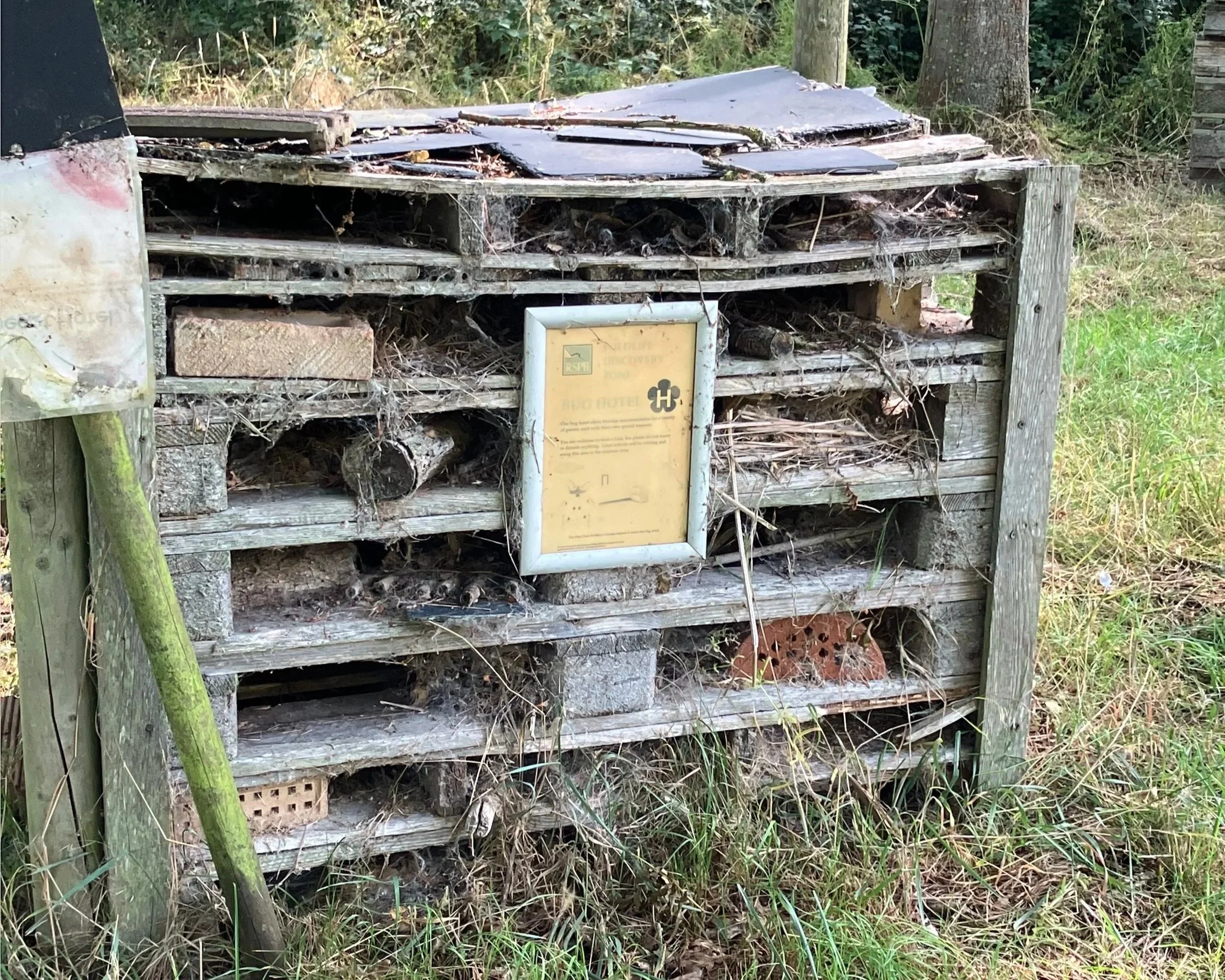
A mixed-material bug hotel at Fen Drayton Lakes. Structures like this differ from the cavity-nest hotels tested in the Toronto study. Photo by Radius and Flyway
At Fen Drayton Lakes, a large structure beside the path made me stop. Stacked pallets held logs, bricks and stems beneath a tiled roof. It was one of the largest bug hotels I had seen, but its size did not answer the important question: what could it provide that the surrounding habitat did not?
The answer is more limited than the label suggests. A well-designed hotel can be useful to particular animals, and it can make their nesting behaviour easier to watch. It does not replace flowering plants, bare ground, dead wood, leaf litter or the other resources on which insects depend.
Bug hotels and bee hotels are not the same thing
“Bug hotel” is used for at least two different structures. A large pallet stack filled with bark, sticks, leaves, bricks and logs is a mixed refuge. Its compartments may offer cool, damp shelter for woodlice and other ground-living invertebrates, or dry crevices in which animals can hide. The RSPB’s minibeast-hotel guidance makes the central point: different residents require different conditions.
A cavity-nesting bee hotel has a narrower purpose. It imitates hollow stems and beetle-bored holes used by some solitary bees and wasps. A female bee provisions a line of brood cells with pollen, lays an egg in each and seals the cells with mud, leaves or other material. Solitary wasps use similar cavities, though they provision their nests with animal prey.
Around four in five British bee species nest in the ground rather than in above-ground tubes. A bee hotel therefore serves only part of the bee fauna. That is not a reason to dismiss it, but it is a reason to describe its purpose accurately.
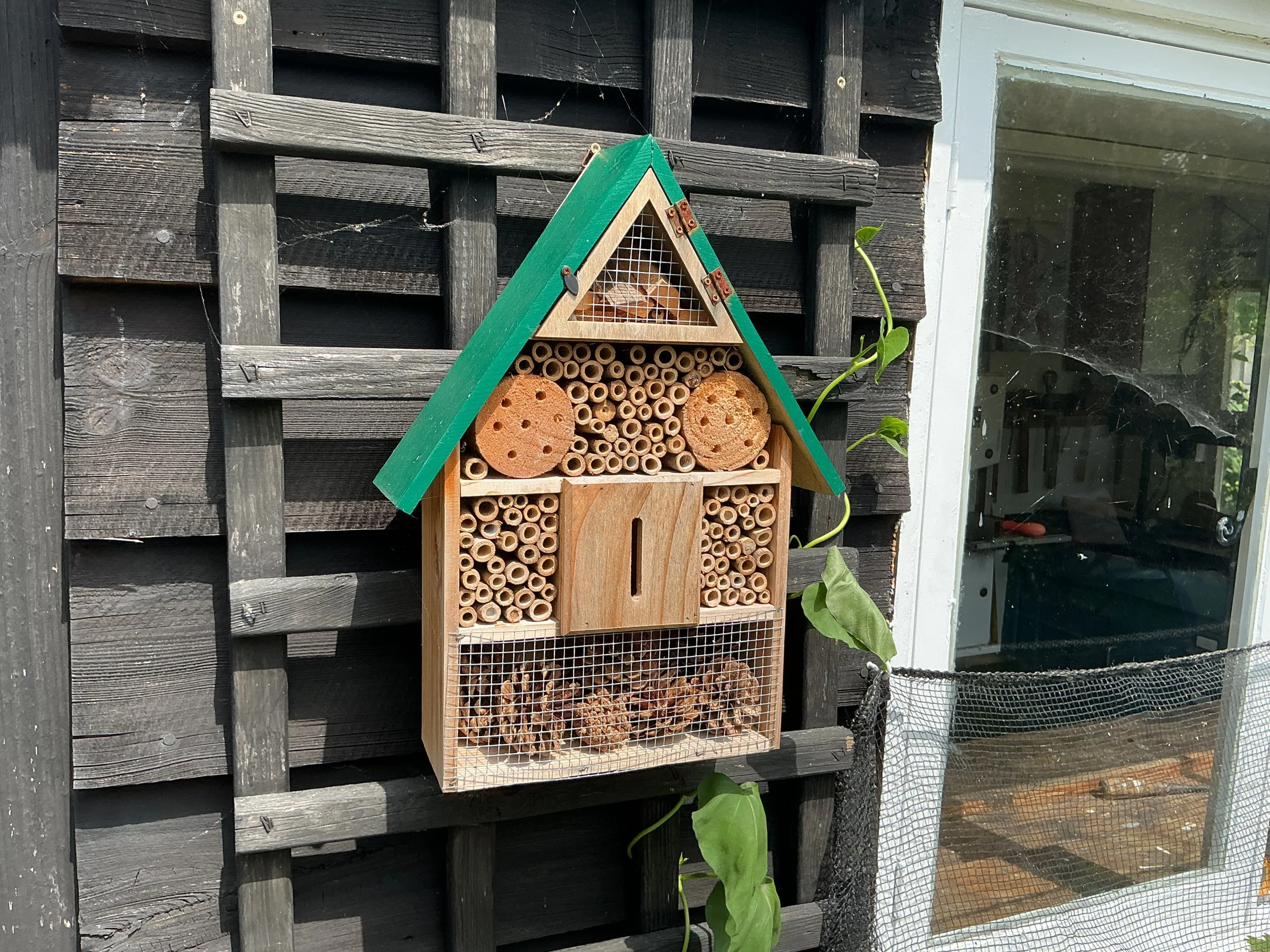
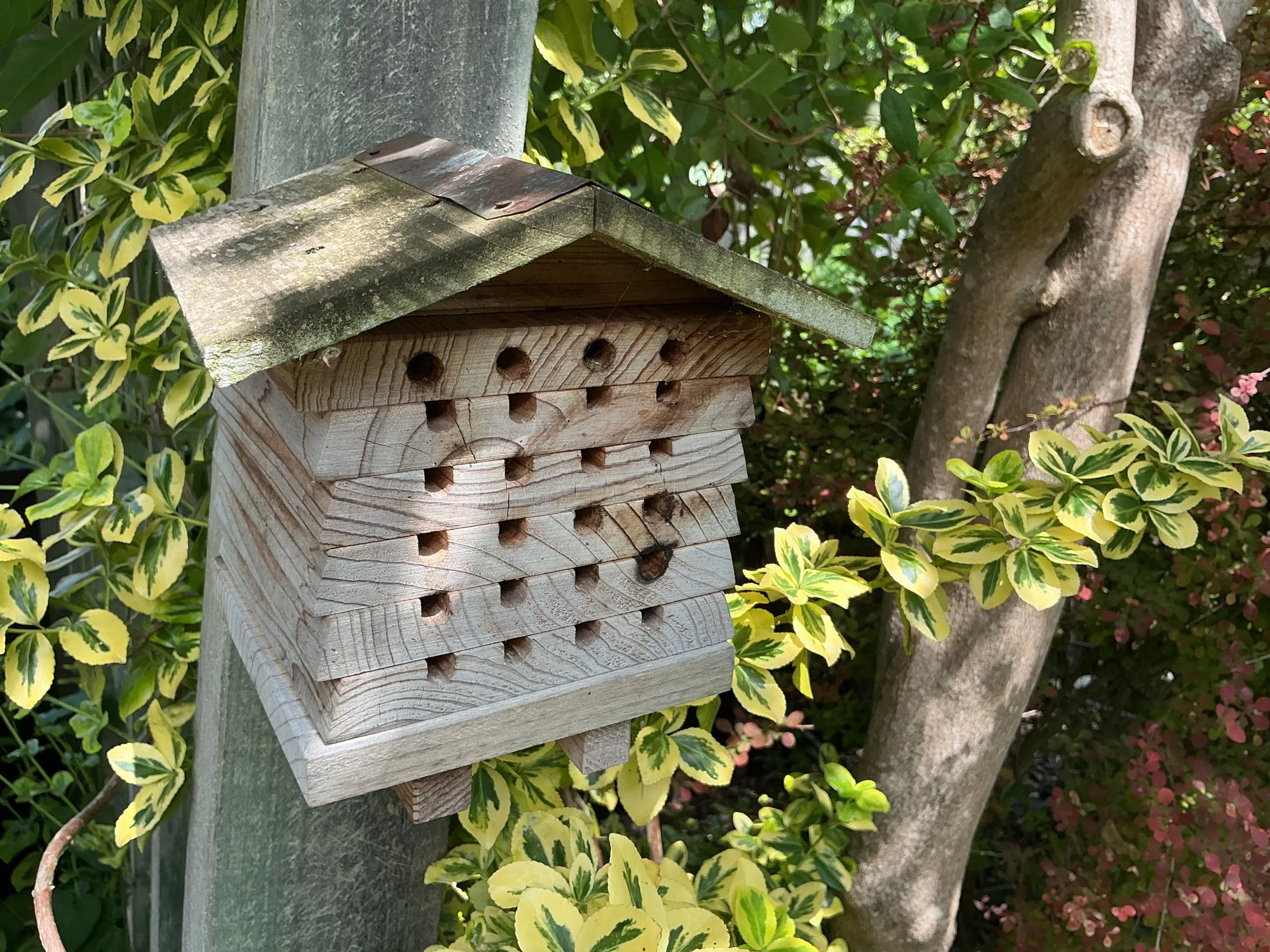
A compact mixed-material insect hotel and a drilled-block bee hotel. Photos by Radius & Flyway.
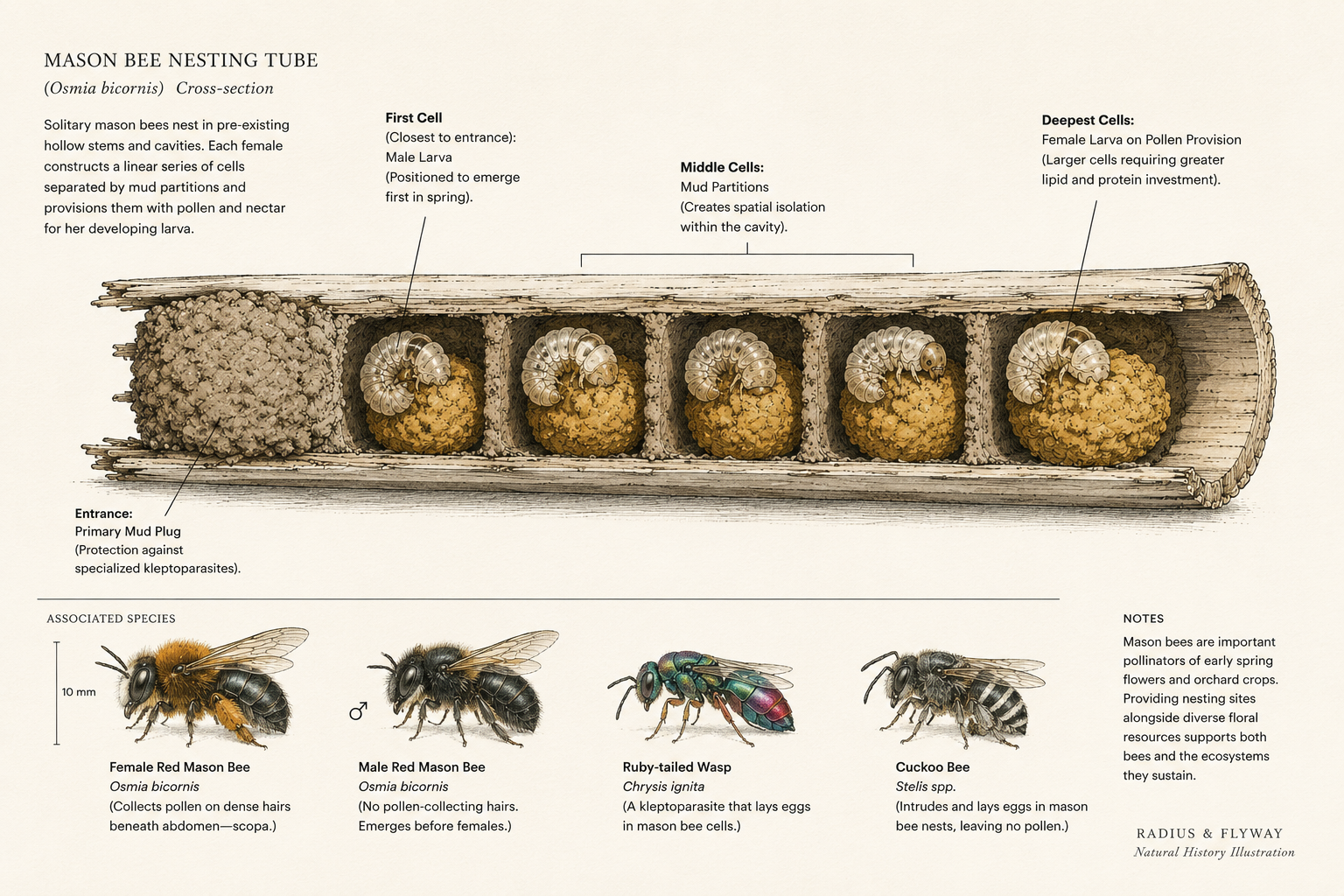
A simplified Red Mason Bee nest. Mud partitions separate provisioned brood cells; male offspring are generally nearer the entrance and females deeper in the tube. Illustration by Radius & Flyway.
What the Toronto study actually tested
The research most often cited in arguments about bee hotels was conducted in Toronto by J. Scott MacIvor and Laurence Packer. The researchers installed 200 standardised hotels in each of three years from 2011 to 2013. They recovered usable data from 574 of the 600 hotel-years.
Each study hotel contained 30 cardboard nesting tubes: ten tubes at each of three diameters, all 15 centimetres long, mounted inside a PVC pipe. These were controlled cavity-nest devices, not large pallet stacks containing a mixture of materials.
The results resist a simple verdict. Native and introduced bees did not differ significantly in the number of sites occupied or in their relative abundance. Native wasps were the largest single group, accounting for 37.8% of all bees and wasps reared, and they occupied nearly three-quarters of the hotels in each year. Native bees also experienced more parasitism than introduced bees.
None of this means that wasps were unwanted occupants. Many solitary wasps hunt aphids, caterpillars and other invertebrates to feed their larvae. A structure used by wasps has not failed merely because its label says “bee hotel”.
The study also did not compare hotel nests with natural nests or with matched sites where no hotel was provided. It therefore cannot tell us whether the devices increased wild-bee populations, nor whether they produced more parasitism than the bees would otherwise have experienced. The authors raised the possibility that badly designed hotels could act as population sinks by concentrating nests in unsuitable conditions, but they did not demonstrate that outcome. Their conclusion was a call for better evidence, design and management, not a finding that every bee hotel is harmful.
Design for the animals you intend to support
A cavity-nesting bee hotel should be treated as managed nesting equipment. Guidance from the RSPB, Buglife and the Bumblebee Conservation Trust converges on the main requirements: a secure position in sun, shelter from rain, an overhanging roof and deep, dry nesting cavities. The tubes or drilled holes should have smooth entrances, a closed back and a range of diameters suited to British cavity-nesting species. Removable or replaceable tubes make responsible maintenance possible.
Leave occupied tubes undisturbed through the nesting season. Old material should not be cleared merely because a calendar says it is time: larvae or adults may still be inside. Buglife’s current guidance advises replacing used tubes in late spring and leaving any doubtful old tubes in a sunny place where their occupants can emerge without the cavities being reused. Damp, mould, splinters and an insecure box are more immediate design problems than a lack of decorative compartments.
A mixed-material refuge needs different decisions. Cool, damp material may suit woodlice, while a cavity-nesting bee section needs warmth and protection from wet weather. Trying to give every compartment the same aspect can work against one group or the other. In many gardens, separate small features are easier to site and maintain than one large hotel intended for everything.
Habitat matters more than the feature
There is no defensible universal ranking in which a pond, hedge, log pile or bee hotel always has the same value. Each supplies a different missing resource. A pond creates aquatic habitat. Flowering plants provide pollen and nectar across the season. Bare or sparsely vegetated soil gives ground-nesting bees somewhere to excavate. Dead wood supports fungi and wood-dependent invertebrates, while old beetle holes can later become natural nesting cavities. Leaf litter and hollow stems provide cover and overwintering sites.
The useful question is therefore not which feature wins, but what the garden lacks. A sunny garden rich in flowers may still be short of nesting ground. A heavily paved garden may need soil and vegetation before it needs a box of tubes. Where woody prunings are available, an RSPB dead hedge or a small brash pile can retain decaying material without pretending to serve every species.
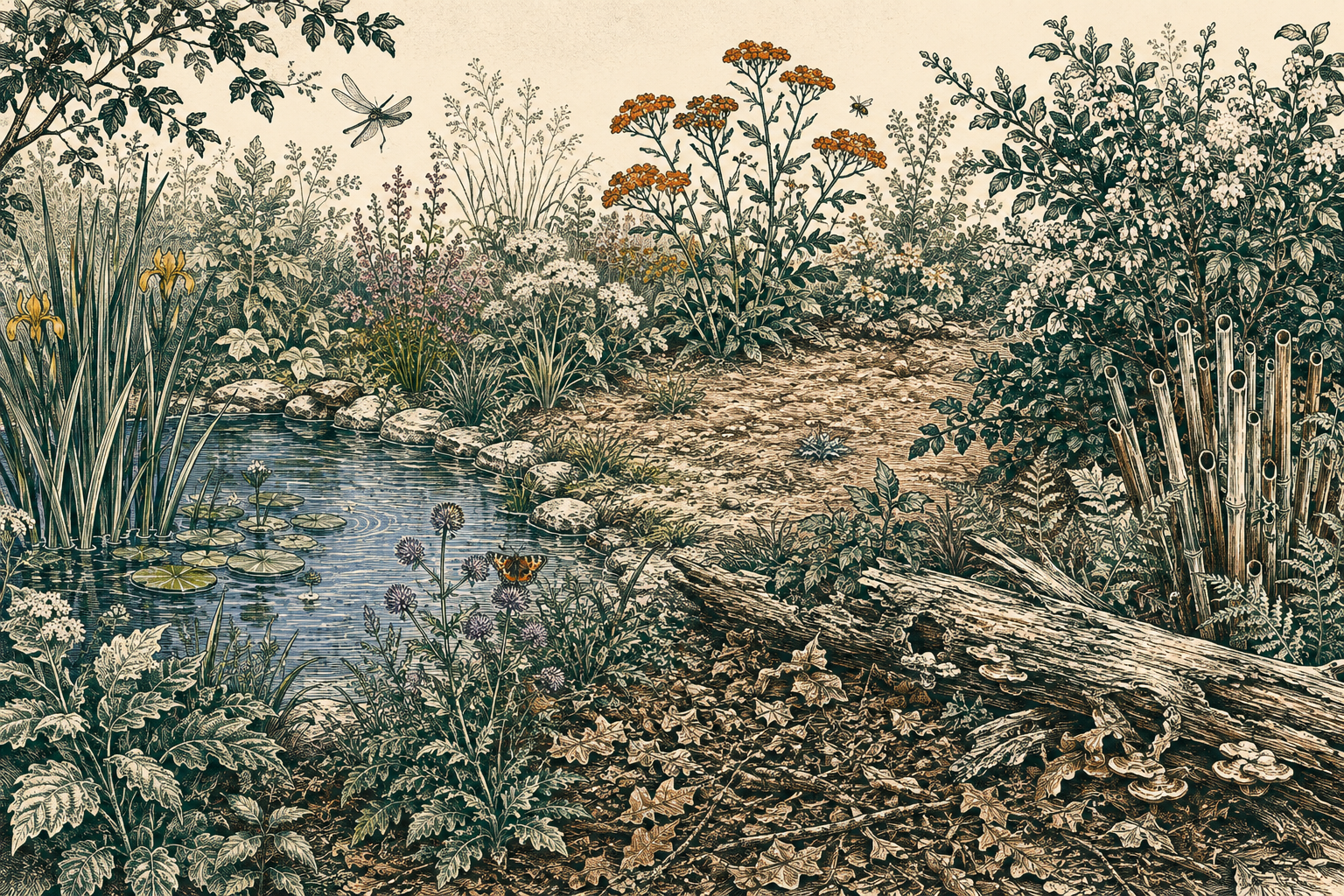
Different features provide different resources; there is no single hierarchy that applies to every garden. Illustration by Radius and Flyway
Why birds need the wider habitat
Invertebrates are important nestling food for many birds. Even species whose adults eat a large proportion of seeds or fruit may collect soft-bodied prey for their young, though the extent varies among species. That relationship is another reason to improve the whole garden rather than assume that one manufactured feature will carry the food web.
An experiment on Blue Tits provides a useful, specific example. The researchers found that parents varied the proportion of spiders delivered as the chicks aged. They then supplemented nestlings with taurine, a nutrient found at high concentrations in spiders, from two to 14 days old. The treated juveniles later differed from controls in risk-taking behaviour and were more successful in a spatial-learning task.
The study did not measure visual acuity, and one experiment on one bird species does not establish a universal nestling diet. It does show why the composition of invertebrate prey can matter as well as its quantity. A garden with varied vegetation and natural microhabitats is more likely to support that breadth of prey than an isolated hotel.
Should you build a bug hotel?
Yes, if the structure has a defined purpose and you are prepared to manage it. A cavity hotel can provide observable nesting places for some solitary bees and wasps. A stable mixed-material refuge can reuse garden material and add shelter. Neither should be sold as proof that a garden is supporting insects well.
Start with food, nesting ground and natural structure. Keep flowers available across the season, retain some dead stems and wood, leave useful patches of bare soil and avoid unnecessary pesticide use. Then add a hotel if it supplies a resource that is genuinely missing. Its best role is as one small, carefully managed part of a living garden.
Information and sources checked: 30 August 2026.Sources and further reading
MacIvor, J. S. and Packer, L. (2015), ‘Bee Hotels’ as Tools for Native Pollinator Conservation: A Premature Verdict?, PLOS ONE, 10(3), e0122126. The original Toronto study of standardised cavity-nest hotels.
Arnold, K. E., Ramsay, S. L., Donaldson, C. and Adam, A. (2007), Parental prey selection affects risk-taking behaviour and spatial learning in avian offspring, Proceedings of the Royal Society B, 274(1625), 2563–2569.
How to be the best bee hotel manager, Buglife. Revised and reviewed for Solitary Bee Week 2026.
A brief guide to solitary bee nest boxes, Bumblebee Conservation Trust.
Build a bee hotel and build a minibeast hotel, RSPB.