
Marsh Tit or Willow Tit? Calls, Plumage and Habitat Compared
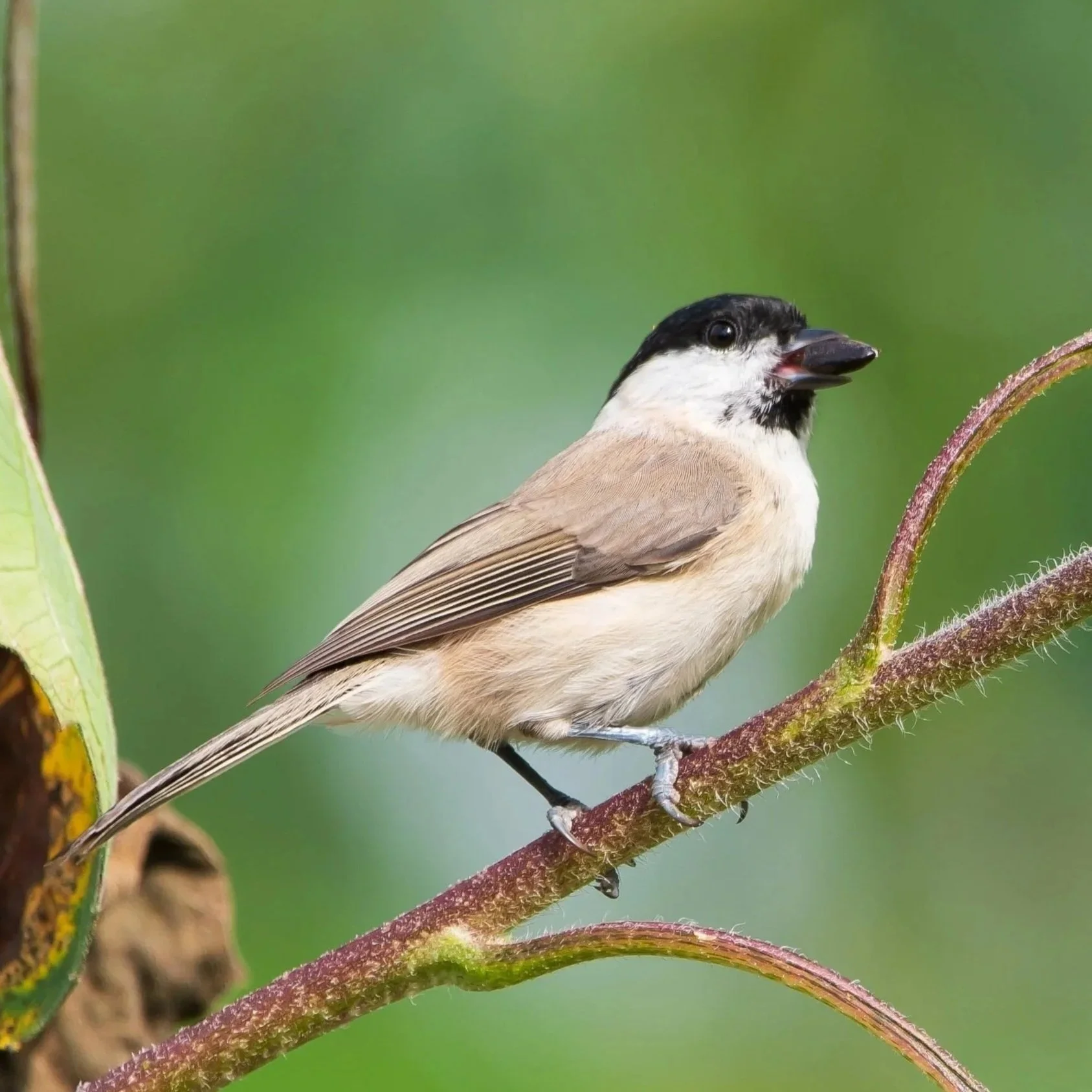
Marsh Tit on a leafy stem. A typical call carries more weight than cap gloss or bib size. Photo by Karlheinz Strohmaier via Pexels.
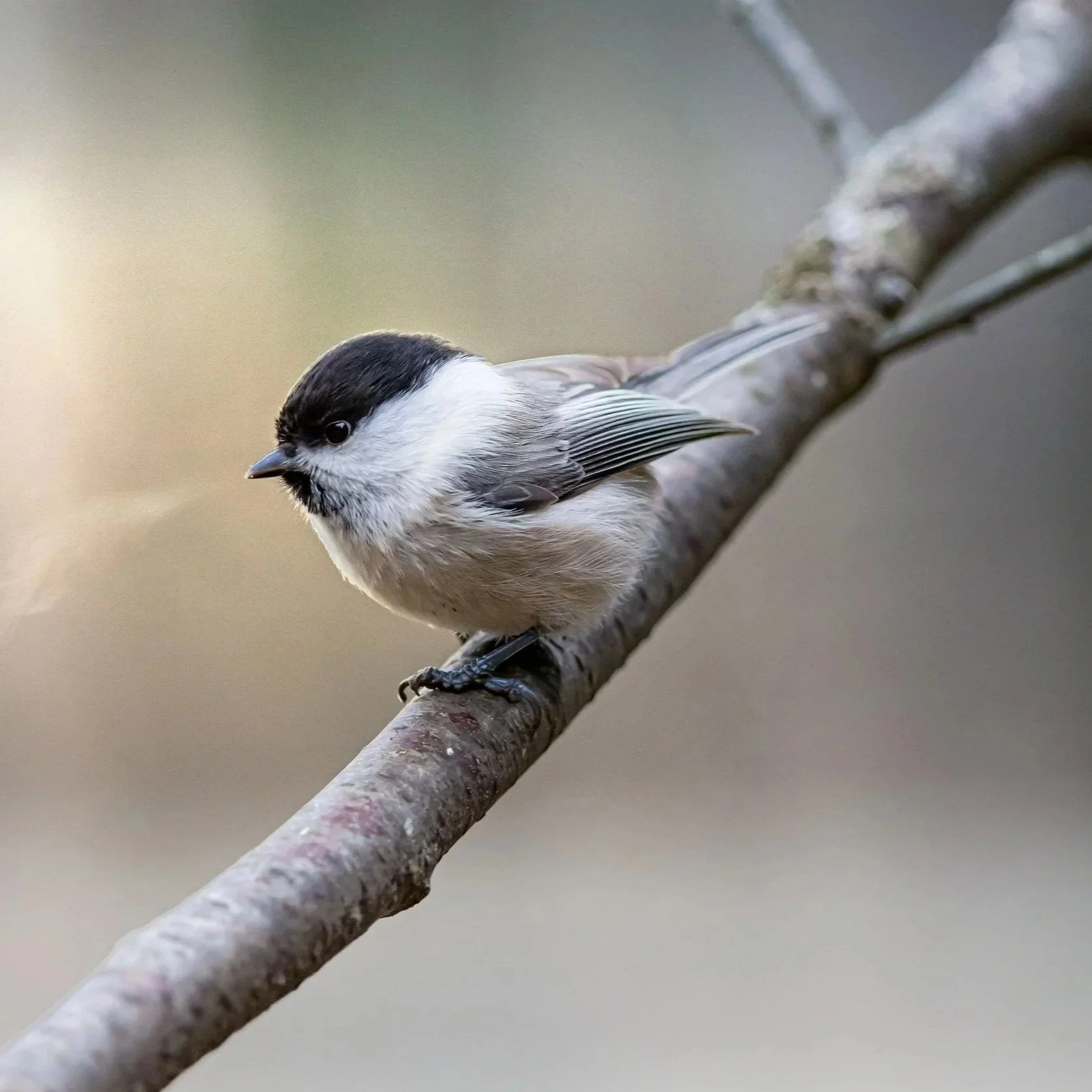
Willow Tit on a bare winter branch. The broad pale cheek is a useful supporting character, but voice remains stronger evidence. Photo by Erik Karits via Pexels.
Marsh Tit and Willow Tit are safest separated by ranking the evidence, not by adding up every familiar field mark. A full, typical call comes first. If the bird is silent, the pattern on the upper mandible is the next strongest feature. Only then should cheek pattern, wing, cap gloss, bib, structure and habitat be considered together.
A Marsh Tit’s familiar call is an explosive, rising pitchou. The corresponding Willow Tit call is slower, deeper and more rasping, often rendered as chay-chay, djur-djur or zi-zi chay-chay. Written syllables are only prompts, but the difference in rhythm and sound quality can be striking when a complete phrase is heard.
Silent birds demand more care. A clear photograph may reveal the pale mark on a Marsh Tit’s upper mandible, but cap gloss, bib size, head shape and habitat are too variable to establish the identification on their own.
| Character | Marsh Tit | Willow Tit | Evidence value |
|---|---|---|---|
| Voice | Explosive, rising pitchou; also rapid, varied ringing songs and other dee or zee notes. | Deep, slow scolding chay or djur notes, sometimes preceded by zi-zi; song usually a slow descending tiu-tiu-tiu. | Strong when typical |
| Upper mandible | Usually a pale mark below the nostril near the base of the upper mandible, often with a pale cutting edge. | Usually uniformly dark on the upper mandible; abrasion and reflected light can create false pale marks. | Strong in close views or photographs |
| Cheek | Whitish ear-coverts contrast with a greyer-brown rear cheek and neck side, producing a two-toned face. | The cheek usually looks more uniformly whitish towards the nape; the neck side can carry warm buff. | Useful on adults after September |
| Wing panel | Often rather plain-winged, but some birds show pale feather edges. | Often shows a paler panel across the secondaries and tertials, strongest in fresh plumage. | Supporting only |
| Cap, bib and shape | The cap may look glossy, the bib often appears neat, and the head can look smaller. | The cap may look matt, the bib can look broader, and the head may appear bulky or bull-necked. | Weak in isolation |
| British habitat | Mainly mature or semi-mature broadleaf woodland with a developed shrub layer. | Most associated with damp young woodland, wet scrub, willow carr and post-industrial sites with decaying wood. | Context, not identification |
Field rule: voice and the upper-mandible pattern should carry more weight than cap gloss, bib size, head shape or habitat. If neither is available, record the bird as Marsh/Willow Tit rather than forcing an identification.
The field rule is simple: give a typical call and a clear upper-mandible pattern more weight than cap gloss, bib size, head shape or habitat. If neither is available and the remaining evidence does not resolve the identification, record the bird as Marsh/Willow Tit.
Calls provide the strongest evidence
Concentrate on the quality and rhythm of the sound rather than its spelling. The Marsh Tit’s pitchou begins abruptly and has an explosive, rising quality that can sound almost like a sneeze. Its songs are varied, quick and ringing.
Willow Tit calls sound deeper and more drawn out. The familiar scolding notes are commonly written as chay, djur or zi-zi chay-chay. Its song is slower than a Marsh Tit’s and often consists of a short series of clear, descending whistles.
These are the best-known vocalisations, not the entire repertoire of either species. Marsh Tits can omit the pitchou and give isolated dee or zee notes, while Willow Tits produce calls that are less distinctive than their familiar scolding phrase. A single short note from a hidden bird is therefore much weaker evidence than a complete, repeated phrase.
The identity of the caller must also be established. I have heard Great Tits produce calls close enough to Marsh or Willow Tit to cause a moment’s hesitation. Where possible, watch the bird calling or make a recording that captures several complete phrases. Recorded sound can be checked; a remembered fragment cannot.
Check the upper mandible
The strongest visual character is a pale mark on the side of a Marsh Tit’s upper mandible, below the nostril and close to the cutting edge. Willow Tits generally lack this mark.
Broughton, Hinsley and Bellamy tested this character on several European races in their original 2008 study. Across 395 birds examined in the hand, the presence or absence of pale marks on both sides of the upper mandible produced a calculated 98.0% probability of correctly identifying an unknown bird.
That result makes the character highly valuable, but it does not mean that 98% of field photographs will produce a safe identification. The study examined birds in the hand and assessed both sides of the bill. In the field, the mark can be hidden by angle, shadow or image quality. Reflected light can create a false pale spot, while wear can produce misleading marks on a Willow Tit.
Look specifically at the upper mandible. A pale cutting edge on the lower mandible is not the same character and can occur in both species. Young birds can also retain pale gape material during their first weeks out of the nest.
Try to obtain sharp, side-on photographs of both sides of the bill. The absence of a mark in a dark or distant photograph proves little; the relevant surface must be clearly visible before the bill can carry much weight.
Cheek pattern and secondary characters
On an adult Marsh Tit, the whitish ear-coverts tend to contrast with the colder grey-brown rear cheek and neck side. This gives the face a two-toned appearance. A Willow Tit’s pale cheek extends farther towards the nape and changes more gradually into the neck side, where a warm buff wash can be present.
Cheek pattern is one of the better plumage characters, but it is less dependable on young birds. Before the post-juvenile moult, both species can have clean pale cheeks and dull caps. From October onwards the adult pattern becomes more useful, although light, exposure and feather wear can still change its appearance.
The traditional distinction between a glossy Marsh Tit cap and a matt Willow Tit cap is weaker. Cap gloss changes with light, angle, age and wear. Bib size varies, and posture can make either bird appear large-headed or bull-necked.
A pale wing panel supports Willow Tit when it is clear and agrees with the cheek pattern. It is strongest in fresh plumage and becomes less distinct with wear. Marsh Tits can also show enough pale edging to cause confusion.
Use these characters in combination, but do not allow several weak impressions to outweigh a typical call or a clearly photographed upper mandible. The principle is the same as in the Tree Sparrow and House Sparrow comparison: begin with the feature least affected by light, posture and viewing angle, then use secondary characters to support or challenge the result.
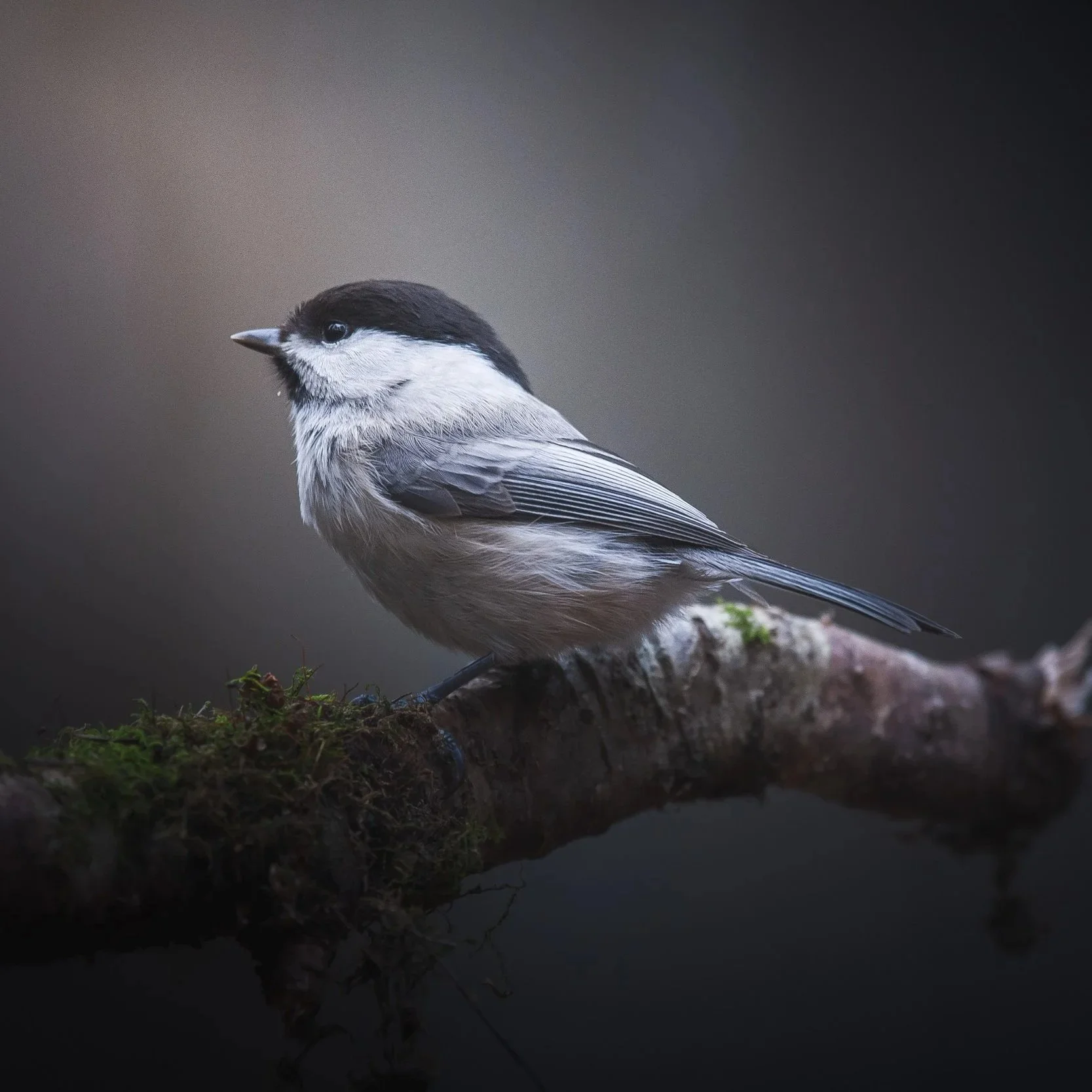
Willow Tit on a moss-covered branch. Its even pale cheek and wing pattern support the identification, though neither is diagnostic alone. Photo by Daniil Komov via Pexels.
Habitat changes probability, not identity
In Britain, Marsh Tits are associated chiefly with mature deciduous woodland containing a developed understorey. Willow Tits favour damp young woodland, wet scrub, willow carr, overgrown gravel workings and other early-stage habitats containing soft, decaying wood.
Their nesting behaviour helps explain this difference. Willow Tits excavate their own holes in soft rotten wood, whereas Marsh Tits use natural cavities or enlarge existing holes. This is useful ecological context, but it is not a reason to approach an occupied nest.
Habitat overlap is real. In Lithuania, I have watched Marsh and Willow Tits using the same mixed woodland and sometimes moving in the same winter flock. A brief view in such a flock may reveal little more than a black cap, pale cheek and brown back. The habitat could not decide the identification; a call frequently could.
Birds also move across habitat boundaries in winter, and apparently suitable habitat may hold only one species—or neither. Use local distribution and habitat knowledge to decide what is plausible, then identify the bird from evidence attached to the bird itself.
Creating a record others can check
If the bird is calling, record several complete phrases. Note whether you watched that individual make the sound. Keep the original file, including quieter sections that may help establish whether another bird was calling nearby.
Identification apps can direct attention to a sound, but the name on the screen does not establish which bird produced it. The recording still needs to be heard and assessed independently, as discussed in Can You Trust Merlin Sound ID?.
For a silent bird, try to photograph both sides of the bill as well as the cheek and closed wing. Write down the habitat, date, behaviour and location while the observation is fresh. These details provide context, but they should not be used to strengthen an identification that the call, bill and plumage do not support.
BTO’s BirdTrack guidance explains the supporting information needed for scarce or locally unusual birds. A useful submission states which diagnostic features were observed, why confusion species were rejected and whether photographs or sound recordings are available.
Willow Tit requires particular attention during the breeding season. The Rare Breeding Birds Panel guidance treats even one Willow Tit in suitable breeding habitat between February and July as possible breeding evidence. Submit such records through BirdTrack or the county recorder network, add the highest breeding-evidence code justified by the observation and keep precise nest information out of public posts.
Both species are Red-listed in Britain. The current BTO/JNCC/RSPB Breeding Bird Survey report gives smoothed UK abundance declines between 1995 and 2024 of 92% for Willow Tit and 53% for Marsh Tit. Careful records help document where the remaining populations occur. Forced certainty does not: when the available evidence remains inconclusive, submit the bird as Marsh/Willow Tit.
Sources and further reading
Broughton (2009): Separation of Willow Tit and Marsh Tit in Britain—a review
Radius & Flyway: Tree Sparrow and House Sparrow identification
Information and external links checked on 30 August 2026.