

Can You Trust Merlin Sound ID? How to Decide Which Identifications to Believe
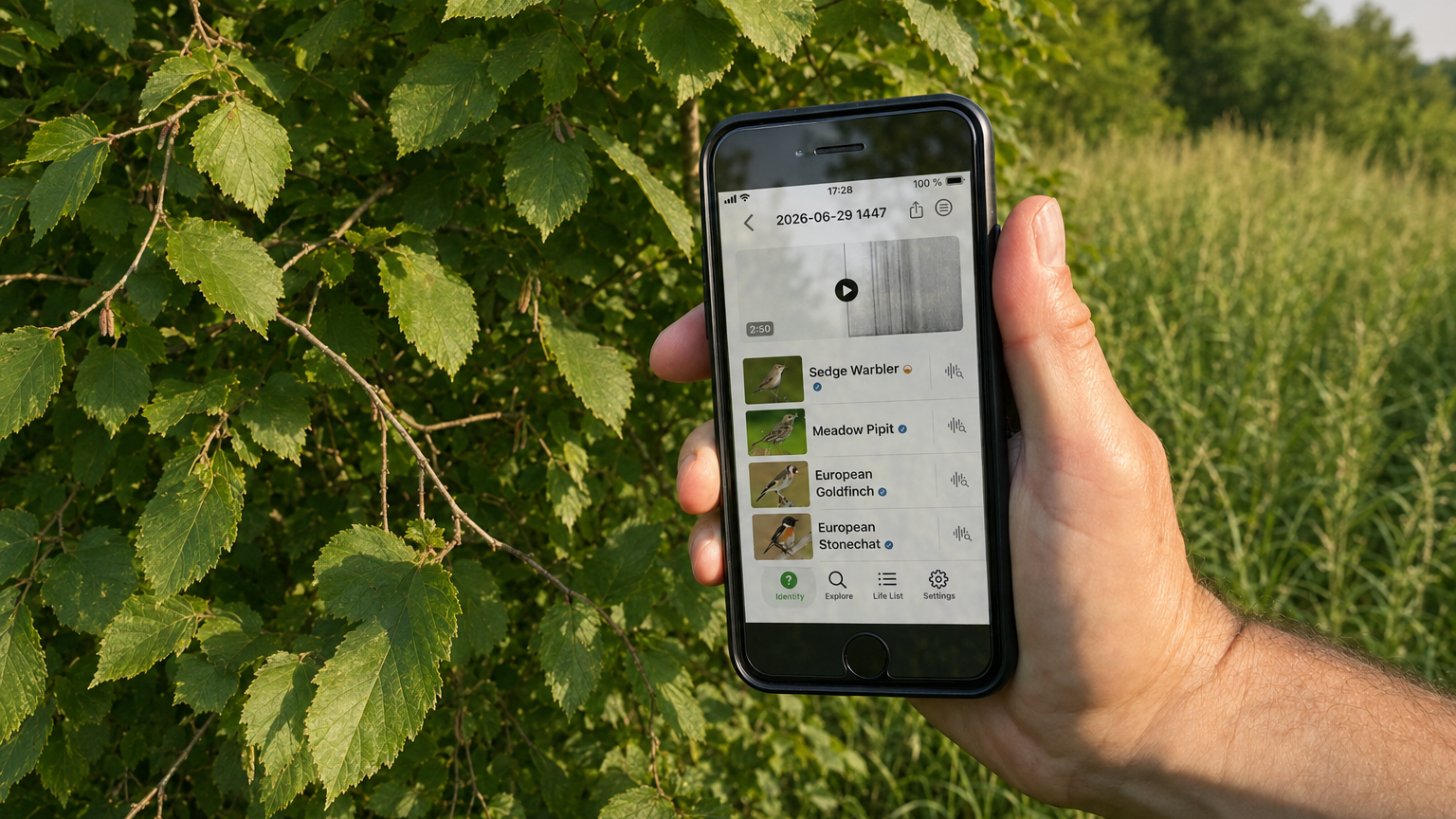
Merlin Sound ID can direct attention to a call, but the suggestion still needs checking against the recording and the bird.
Merlin Sound ID often alerts me to a bird before I hear it myself. It can jog my memory of calls I haven’t heard for a while, draw attention to a quieter call I may have missed, and preserve the recording for another listen. These are real advantages, but the identification on the screen remains just a suggestion. I have repeatedly watched Rooks calling whilst Merlin labelled them as Carrion Crows. Because the birds were in view, the mistake was obvious. When the bird is not in view, deciding what to believe is harder.
The question is not whether Merlin is reliable; it is how much weight you should give a particular suggestion.
What Merlin does well
Merlin provides an excellent way to learn the calls of common birds. It can also pick out the call of a rarity within a mixed flock.
That early warning changes how you search. I have often observed a raptor I would otherwise have missed; it is excellent at picking up distant calls. The suggestion tells you to scan the sky rather than continue looking into the scrub. For a common bird giving a clear, repeated and distinctive song, Merlin is most often correct. If I can hear the sound myself, match it to the suggested species and find no reason to doubt it, I will accept it. That is different from accepting the identification because it appeared on the screen.
What the name on the screen cannot tell you
The app has been trained to recognise the patterns that different birds’ sounds make on a spectrogram. It also considers the birds likely to occur in the area before producing a list of possibilities. What it cannot do is connect a sound to the bird in front of you. The microphone may have picked up another bird nearby, or a short burst of noise that produces a similar pattern. How much weight you give the suggestion depends on the recording's clarity and what else you can see or hear.
Mimicry and overlapping calls can cause more issues. A short sound might sound like the start of one species’ call but not include the rest of the phrase that would confirm it. The app might also pick up a quieter or more distant bird instead of the one you’re focused on.
That is why you should treat an unusual identification as a reason to investigate, not as a record. The less likely the bird would be at that place and time, the more supporting evidence you need.
Listen to the recording, not just the name
Begin by replaying any surprising result. Can you clearly hear the bird Merlin claims is there? Is it a full phrase or just a short, noisy fragment? Does the call repeat? Sometimes wind, handling noise, another bird, or a distant sound can trigger the suggestion.
The quality of the recording matters. Cornell's Merlin Sound ID guidance recommends keeping the microphone clear, standing still, and recording several vocalisations with as little background noise as possible. Cornell also describes Merlin's suggestions as a starting point that you should check independently before reporting a bird.
When Merlin produces an unexpected result, I usually stop the recording and start again. In my experience, a false suggestion caused by a single noise often doesn't repeat in a fresh recording. If Merlin suggests the same species again, the bird is more likely to be present. This does not reset or correct the app. A genuine bird may also remain silent. But it does give you a second sample to compare with the first.
It’s also important to see how Merlin works on your own device. In 2025, researchers in Maine used Merlin on two devices at the same time during 70 point counts. The devices gave different species lists in 40 cases. Even after removing false positives, they still disagreed in 26 counts. This may be due to differences in microphone quality or device placement. Since only one habitat was tested, we don’t know how often devices would disagree elsewhere. Still, it’s a good reminder that your device can affect what Merlin picks up. The study also found that people recorded more detections than Merlin, but the app did find four species the people missed.
Match the evidence to the claim
Not every suggestion needs the same response. A Chiffchaff singing repeatedly in spring is different from a bird that would be hundreds of kilometres beyond its known range.
| Merlin suggestion | Appropriate response |
|---|---|
| Common bird, clear repeated song | Accept when you can hear and match the sound yourself. |
| Common bird, single short call | Treat it as a possibility and listen for a repeat. |
| Uncommon but seasonally plausible | Make a fresh recording and seek independent field evidence. |
| Rare bird during migration | Search carefully and preserve the original recording, notes, photographs or video. |
| Bird out of season or range | Treat it as a likely false positive unless stronger evidence appears. |
| Potential first for Britain | The app result has no standing by itself; independently verifiable evidence is essential. |
| Name attached to a noisy fragment | Disregard it unless the sound repeats clearly or other evidence supports it. |
This does not mean that common birds matter less. It recognises that errors have different consequences. An everyday record may only affect your own list. A claimed rarity may enter a national database, draw other birders to the site or become part of the evidence used to understand a species' range.
Use unusual suggestions to direct the search
Migration changes what is plausible. A bird that would be remarkable in midwinter may be a reasonable possibility during active passage. This does not make the suggestion proof, but it may make it worth following up.
On autumn migration, thousands of geese sometimes pass overhead, often in skeins too large to examine bird by bird. An odd bird of another species will sometimes join one of them. I leave Merlin running whilst the geese pass, and if it suggests a rare species, I take a closer look at that skein. I don't automatically accept the result, but on more than one occasion it has helped me find a scarce bird among the commoner geese. Merlin won't tell me which bird made the sound, but it can tell me when a passing skein deserves more attention.
The same principle applies to a gull roost, wader gathering or mixed passerine flock. Use the suggestion to decide where to look, then search for features that would support or contradict it.
When Merlin's suggestion shapes what you see
The greatest risk arises when the name on the screen becomes attached to a bird before evidence shows that the bird made the sound.
I know a birder whose Merlin recording suggested a Tawny Pipit. He was watching a distant bird that showed some features consistent with a pipit, including warm tones and a pale eye-stripe. The bird was too far away for a clear view. Merlin's suggestion therefore seemed plausible.
At first, there had been no obvious contradiction. The bird was distant, some features seemed to fit, and the most useful field mark was hidden. Merlin supplied a name before the visual evidence was complete. This is anchoring: once Tawny Pipit became the working hypothesis, ambiguous features were more likely to be interpreted in its favour.
Only the next day, when he observed the bird again, did he see its white rump and the black inverted T across its tail, revealing it to be a juvenile Northern Wheatear. We cannot now know whether Merlin responded to the Wheatear, another bird calling nearby or an unrelated noise. The problem was that its Tawny Pipit suggestion became attached to the bird in view, although there was no evidence that this was the bird that had made the sound. The birder then began to bend what he could see to fit the identification.
When an identification begins with Merlin, ask three questions:
Can I hear the claimed call in the recording?
Which observed feature actually establishes the identification?
What commoner species could explain the same sound or appearance?
The third question is particularly useful. It pushes you to look for evidence that could disprove the suggestion rather than collecting only the details that seem to support it.
Learn Merlin's recurring mistakes
False suggestions are not always random. Short contact calls, overlapping vocalisations, mimicry and poor recordings can produce the same problems repeatedly.
Rook and Carrion Crow are one example from my own birding. Familiar species with wide repertoires create others. A fluting Blackbird phrase can suggest Golden Oriole. Song Thrush mimicry may cause another species to appear on the screen, while some Great Tit calls can sound surprisingly close to Marsh Tit. Non-bird sounds can also produce a name when a brief noise shares part of the expected acoustic pattern.
This does not make Merlin useless. It tells you where to be cautious. A clear, repeated song is usually more persuasive than a single contact call, and a full phrase is stronger evidence than a fraction of a second.
Where Merlin is particularly useful
Marsh Tit and Willow Titshow why Merlin deserves a place in a birder’s field kit. The two species can be difficult to separate safely by appearance, while their best-known diagnostic calls differ much more clearly. The BTO describes their calls as the best way to tell them apart.
For someone who does not yet know those calls well, Merlin can highlight the relevant vocalisation, mark its place in the recording, and allow immediate comparison with reference sounds. It can also remind a more experienced observer of a call heard infrequently.
The screen should still not make the final decision. Both species have wider repertoires than their familiar textbook calls. The call must be audible in the recording, while distribution, habitat and any useful visual features remain part of the assessment. Merlin is valuable here because it helps you find and preserve the evidence, not because its label replaces it.
A possibility, not a verdict
I use Merlin regularly and have done so for many years. It has helped me find many birds I might otherwise have missed, and it sometimes recognises calls that I don't. However, whilst I find it an indispensable tool, you must understand that all identifications it makes are only suggestions until you have sufficient supporting evidence.