

Pink-footed Goose Migration in Britain: Arrival, Redistribution and Daily Flights
Pink-footed Geese begin arriving in Britain during September, with the main North Atlantic passage extending into October. Numbers at individual wintering sites continue to change through October and November as birds redistribute within Britain. A skein overhead may therefore be arriving from Iceland, moving between British regions or making its daily journey between roost and feeding fields.
These flights can look much the same. A high, calling flock travelling over Norfolk in October may already have spent weeks in Scotland. A line of birds heading inland at first light may have travelled only from the coast. Understanding the season means following what happens after landfall as well as looking for the first arrivals. Our British bird migration guide places these movements alongside the other arrivals and departures of autumn.
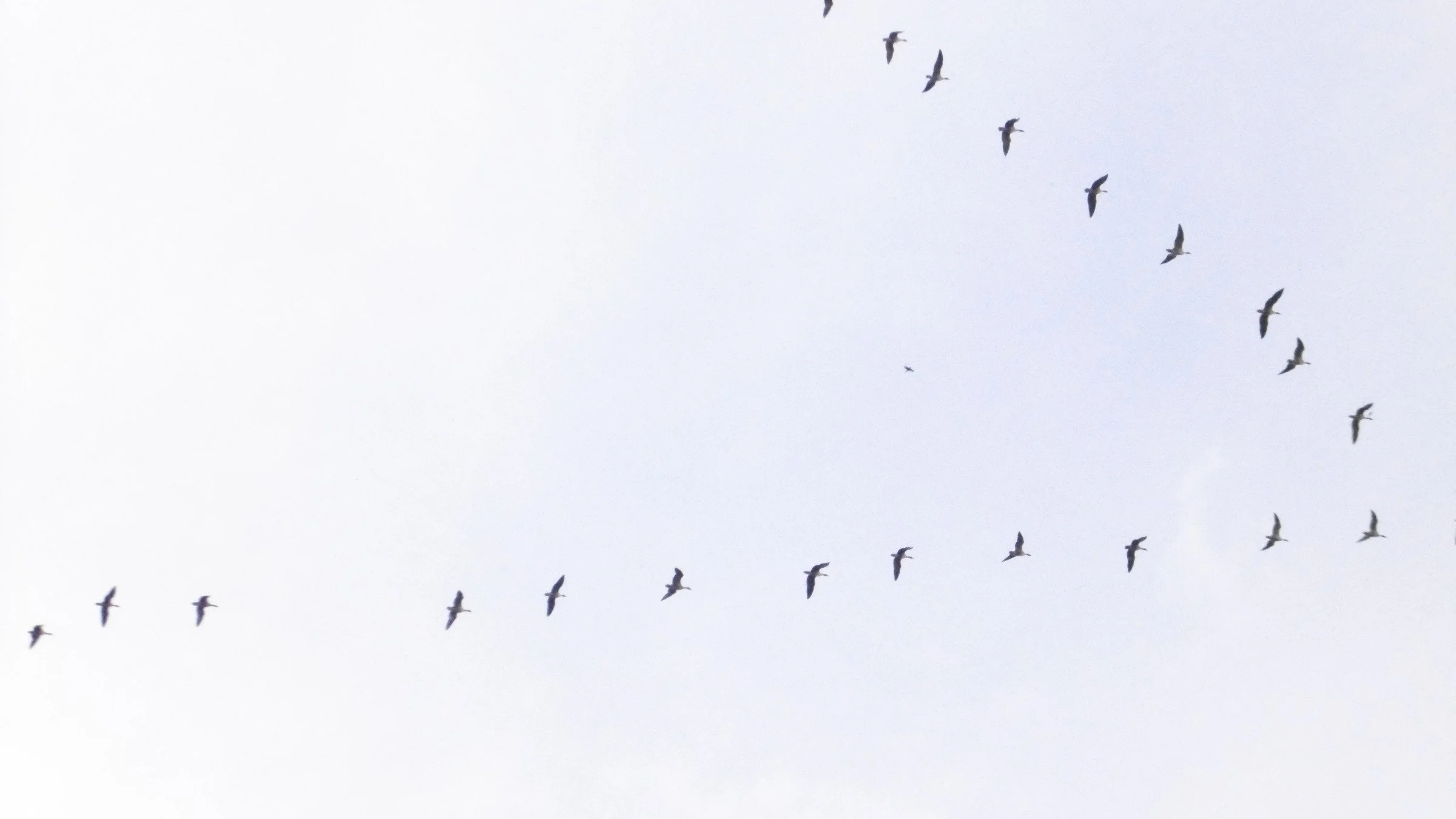
Photograph: Apricaria, Skein of pink-footed geese in 'V', CC BY-SA 4.0. Cropped and resized by Radius & Flyway; adapted image under the same licence.
When do Pink-footed Geese arrive in the UK?
September is the month to start listening. The main arrival builds during its second half and into early October, although weather affects the timing of individual crossings. Scotland receives most first landfalls, with some birds reaching northern England directly. Arrival in Britain and arrival at a particular Norfolk roost are different dates.
The European Bird Migration Atlas places the main movement from Iceland from mid-September onwards. A Scottish Government review of migration evidence identifies late September and early October as the peak, with the great majority gone from Iceland by the third week of October. November increases farther south should therefore be considered against the changing British distribution, rather than treated as another wave from across the Atlantic.
Most birds remain until spring. Northward movements within Britain can begin during winter; the main return crossing to Iceland is in April, with the last departures extending into early May. Birds continuing to East Greenland reach it later in spring. A northbound skein in February is consequently not evidence of an early ocean departure.
Where do Britain's Pink-footed Geese come from?
The birds wintering here belong to the Iceland and East Greenland population. Greenland breeders pass through Iceland, joining birds that breed there before the onward crossing to Britain. Iceland is both a breeding country and a staging area: a goose arriving from Iceland need not have nested there.
Keep this population separate from the Pink-footed Geese breeding in Svalbard. Their principal wintering areas lie in continental Europe, notably Denmark, the Netherlands and Belgium. A tracking result from the Svalbard flyway cannot automatically explain what a flock over the Wash is doing, even though the species is the same.
The British connection is broad. Eastern Scotland, the Solway, Lancashire and eastern England all belong to the winter system. Norfolk and the Wash are important parts of it, but drawing every route towards Norfolk would misrepresent the population.
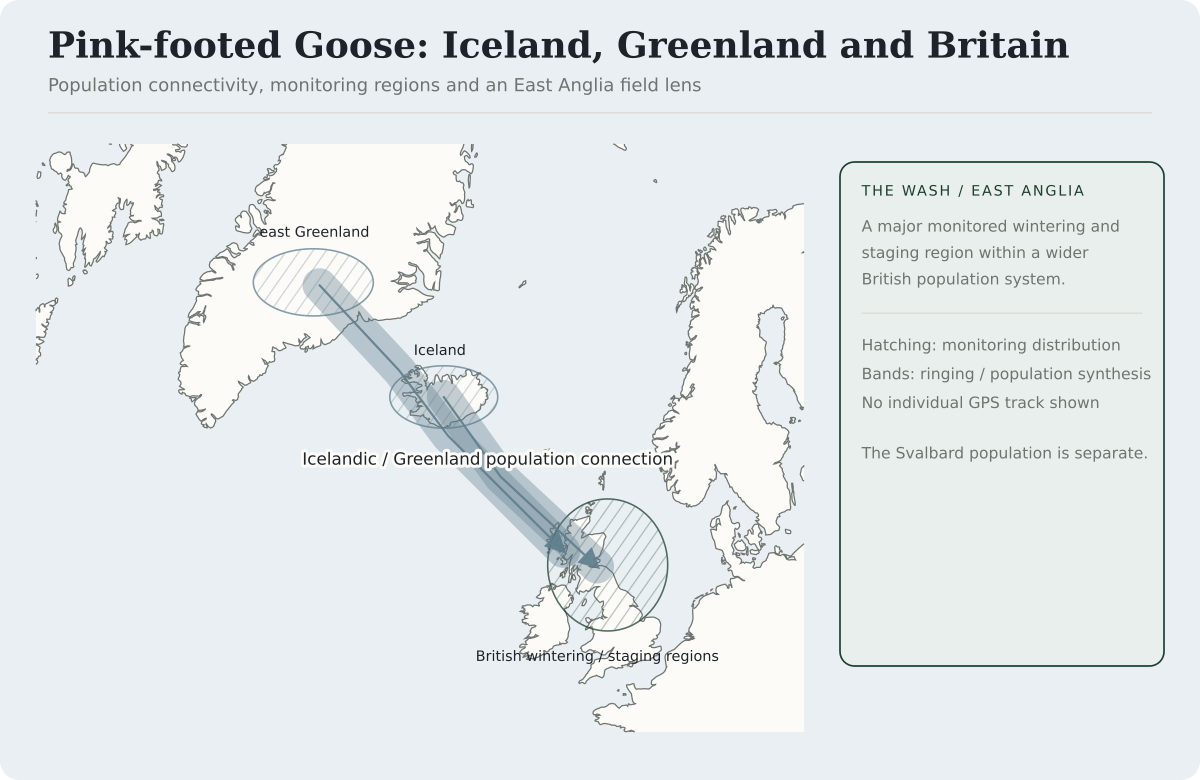
Map: Radius & Flyway, 2026. Basemap: Natural Earth vector 4.1.0, public domain. Original map dated 31 July 2026; interpretation checked 7 September 2026. Open the full-size map.
Where do they go after reaching Britain?
Arrival is followed by redistribution through a network of roosts and feeding areas. Some places hold geese for much of the winter; others are used more heavily during passage or when nearby fields offer suitable food. Birds reaching Scotland do not all continue south, nor do those moving south follow one fixed sequence of stops.
The 2024 Icelandic-breeding Goose Census results recorded 23,084 Pink-footed Geese in Norfolk and the Wash in October and 63,285 in November. Coverage also rose, from nine sites to thirteen. Those counts show a much larger recorded concentration later in autumn; they neither identify the previous whereabouts of the birds nor measure movement independently of survey coverage.
Tracking gives a more direct view. In research published by Lovas-Kiss and colleagues in 2023, some tagged birds made northward movements within Britain of up to 400 km during autumn. The underlying tracking project fitted 73 females, mostly adults, so these were sampled journeys rather than a description of every flock. Nevertheless, they demonstrate why autumn movement cannot be reduced to a steady drift south.
Researchers tracking how geese disperse plant seeds also recorded their daily movements between roosts and feeding fields. These journeys could exceed 20 km—a considerable flight that was still an ordinary feeding trip.
Why the feeding fields change
Pink-footed Geese need a secure roost and worthwhile feeding within reach. Estuaries, lakes and reservoirs provide night-time gathering places; surrounding farmland supplies much of their winter food. The practical unit is the combination of roost and fields, rather than either habitat considered alone.
Autumn cereal stubbles offer spilt grain. Harvested sugar-beet fields provide remains that can become valuable later, while improved grassland and growing cereals are also used. The RSPB's farming guidance explains why harvest and ploughing alter what is available. A productive field can disappear from the feeding landscape without any change in the nearby roost.
There is no neat national relay from Scottish stubble to Norfolk beet. Crops, harvest dates and field management differ between districts. Food is depleted, disturbance changes where birds settle, and difficult weather can make feeding less accessible. A changed morning flight line may mean the geese have chosen another field; a sustained regional change may indicate a much larger movement.
Migration, redistribution or a daily commute?
The distinction below is a practical one. Redistribution within Britain can itself form part of a seasonal migration; separating it from the ocean crossing helps describe what was actually observed.
| Movement | Usual timing | Evidence worth recording | Limit of the inference |
|---|---|---|---|
| North Atlantic arrival | Mainly September–October | Several incoming flocks during the arrival period; coastal landfall; wider arrival reports | One flock's height or direction cannot establish an Icelandic departure. |
| Redistribution within Britain | Autumn, winter and the spring build-up | Changing regional counts; movement beyond established feeding areas; marked birds | Counts alone cannot identify a flock's previous site. |
| Roost–feeding commute | Repeated daily, often around dawn and dusk | Departure from a known roost; repeated flight lines; an evening return | Migrants also travel at these times. |
Height is an unreliable shortcut. A very high flock looks purposeful, but low flight does not exclude a sea crossing. The Scottish review rated the available Pink-footed Goose flight-height evidence as low confidence. V formations are equally poor evidence of journey length: the opening photograph shows a skein identified by its photographer as travelling from roost to feeding ground.
Repetition is more useful. If birds leave a known roost towards farmland each morning and return from that direction later, commuting is a reasonable interpretation. If the line changes, check whether the feeding field has changed before proposing a regional departure.
For a passing flock, record the number, time, direction and any observed landfall or landing. Keep that observation separate from the suggested explanation. “About 300 heading south at 10.20” remains useful even when “arriving from Iceland” cannot be justified. Compare it with recent counts and reports elsewhere. Rings and tracking can reveal an individual journey; an unmarked skein usually leaves its starting point unresolved.
Identifying Pink-footed Geese in flight
Pink-footed Geese are smaller and more compact than Greylags, with a shorter-looking neck, rounded head and small bill. BTO's species account also emphasises their higher-pitched calls. Sound is often the first useful clue when cloud or poor light reduces a flock to silhouettes.
Listen for the higher, chattering calls of Pink-feet against the deeper honking of Greylags. Then assess structure across several birds. Distance and viewing angle make apparent size difficult, especially when the species are not together, so combine what you hear with what you see.
At closer range, the short, mainly dark bill with its pink band supports Pink-footed Goose. Greylag has a much larger, heavier bill. Pink-feet also show a dark brown head against paler grey upperparts. Cornell's identification account illustrates these features and the pale upperwings. Pink legs are useful on a settled bird, but rarely available in an overhead skein.
Formation does not identify the species, and a familiar call does not establish that every bird in a flock is the same. The BTO grey-goose identification guide is a useful preparation for examining birds on the ground, where other grey geese can be compared properly.
How many winter in Britain?
Britain supports almost the whole Iceland and East Greenland population in winter. The 2024 census estimate was 445,830 birds, including allowances for uncounted sites. It was 4% below the 2023 estimate. That annual difference should not be confused with the longer history: the same report's smoothed 25-year trend, ending in 2023/24, was up 96%.
BTO BirdFacts still displays a UK winter estimate of 510,000 for 2015–16. The figures describe different periods and estimation summaries, so they are not competing estimates for the same winter. The population remains far larger than it was a generation ago, but BTO notes some decline since the mid-2010s. A large flock at one reserve cannot settle the population trend.
Watching Pink-footed Geese in Norfolk
The Wash and north Norfolk coast offer opportunities to watch the connection between coastal roosts and inland feeding grounds. At RSPB Snettisham, sunrise and sunset flights are a winter attraction. These are distinct from the tide-driven wader gatherings: choosing a wader-spectacular tide does not by itself select the best goose flight. Use the official reserve information for current visit arrangements, and the Norfolk birdwatching directory for the wider network of sites.
Watch from established paths and viewpoints rather than approaching a roost or feeding flock. Disturbing geese from harvested fields can push them onto growing crops, as well as interrupting feeding. From a fixed viewpoint, follow the flight long enough to see whether it lands, continues inland or joins another skein. Returning to that viewpoint on another morning gives the next observation something to be compared with.
Sources checked 7 September 2026. Seasonal timings describe recurring patterns, not a forecast of this autumn's arrivals.