

UK thrush identification: Song Thrush, Mistle Thrush, Redwing and Fieldfare
Song Thrush and Mistle Thrush are the most easily confused of Britain’s familiar spotted thrushes. In autumn, Redwing and Fieldfare add two more possibilities: Redwing resembles Song Thrush in size and general colour, while a distant Fieldfare can initially suggest Mistle Thrush. The useful distinctions lie in their proportions, head patterns and the arrangement of colour across the plumage.
A Fieldfare’s grey head or a Redwing’s pale eyebrow can settle an identification quickly. Song and Mistle Thrush usually need a closer comparison. Size helps when birds stand together, but a lone thrush across a field offers little sense of scale. A clear view of its face and breast may tell us more.
Blackbird and Ring Ouzel are also thrushes, and all six belong to the genus Turdus. This guide concentrates on the four spotted species most usefully compared together.
The four species at a glance
These describe typical birds. The photographs are not to scale.
| Species | Main visual clues | Useful voice |
|---|---|---|
| Song Thrush | Compact; warm brown upperparts; relatively plain face; dark spots on a creamy breast | Short tsit; song built from repeated phrases |
| Mistle Thrush | Larger, longer-winged frame; cooler grey-brown upperparts; bold spots on a pale underside | Dry, carrying rattle |
| Redwing | Strong pale eyebrow; streaked breast; rusty-red flanks and underwings | Thin, high, drawn-out tseep |
| Fieldfare | Grey head with dark marking around the eye; grey lower back and rump contrasting with a chestnut upper back; dark tail | Repeated harsh chack notes |
Song Thrush or Mistle Thrush?
A typical Song Thrush has a compact outline, warm brown upperparts and a creamy, spotted breast. Mistle Thrush has a larger frame and longer wings, often standing upright with its head held high. Its plumage usually looks cooler and paler. Seen together at a similar distance, the difference can be quite marked.
The difficulty comes when there is only one bird, or when posture disguises its proportions. A feeding Mistle Thrush can crouch low; an alert Song Thrush can stretch upwards. Across uneven ground, the nearer bird may also appear larger regardless of species. Structure remains useful, but it needs to agree with the plumage.
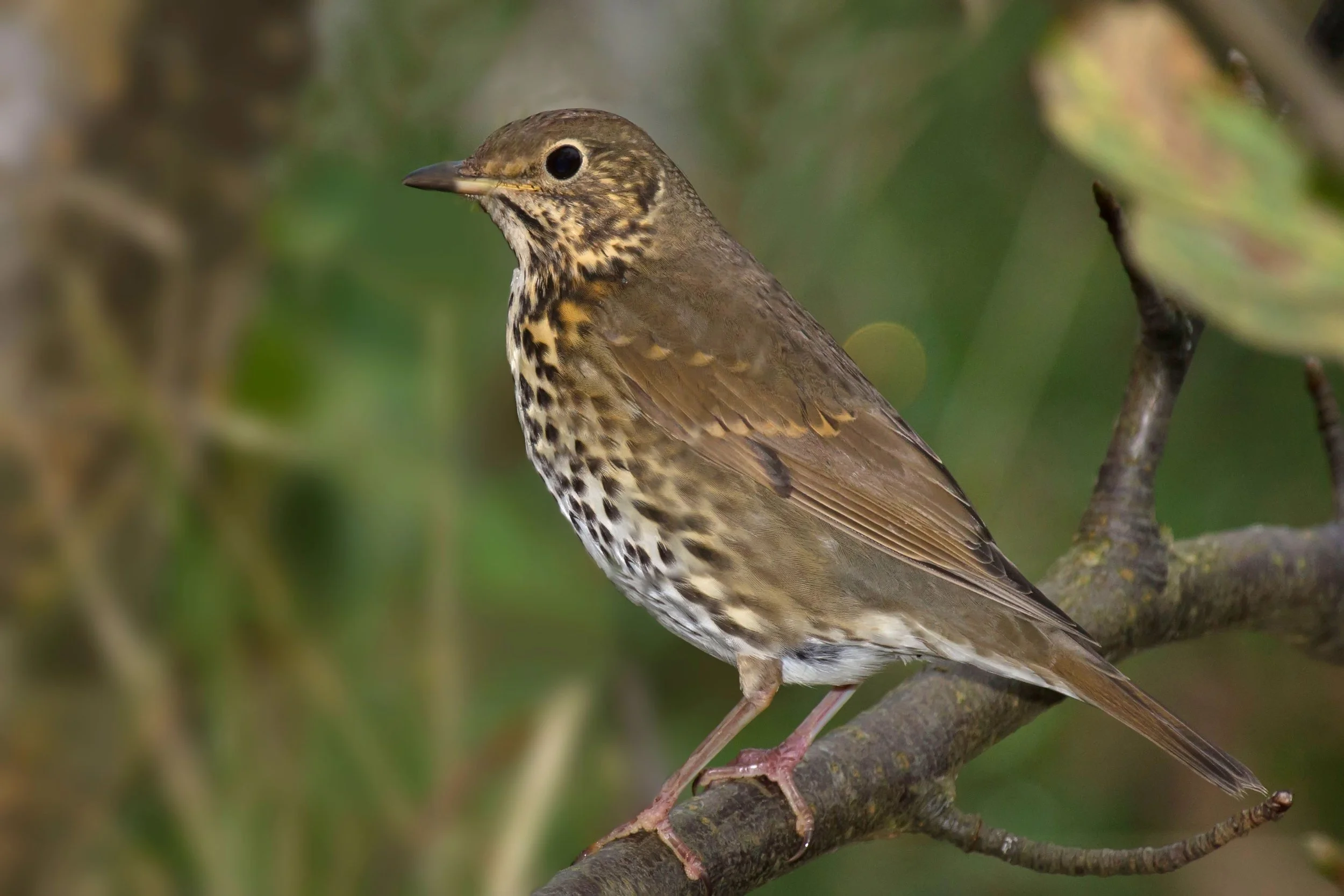
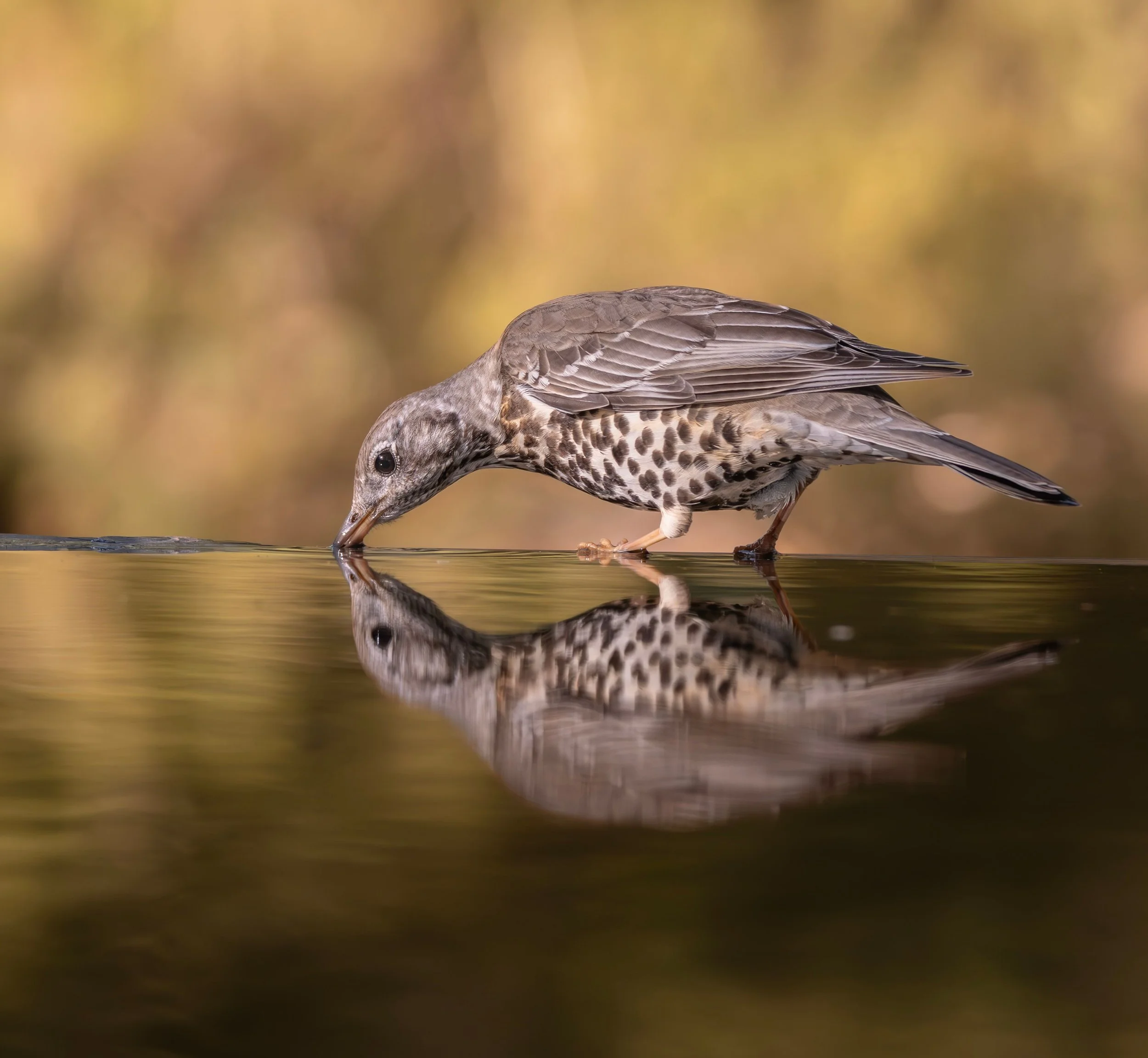
Song Thrush often has pointed spots on the upper breast, described as arrowheads or inverted hearts. Mistle Thrush’s spotting is generally larger and bolder against a whiter underside. This is a useful comparison across the breast and flanks, but an individual spot is a poor basis for identification. Its apparent shape changes with the angle of the bird and the way its feathers lie.
Colour adds another part of the comparison. In neutral light, Song Thrush’s warm brown back and buff tones beneath contrast with Mistle Thrush’s colder appearance. Strong sunlight warms both birds; shade can flatten the distinction. A photograph may exaggerate it further through exposure or colour balance. When colour and spotting seem to disagree, the next useful evidence is a different view of the bird.
Flight can provide that view. Mistle Thrush shows long wings and whitish outer tail edges, although the tail markings need a favourable angle. Its dry rattling call is often more conspicuous than either feature. Song Thrush gives a short tsit. A singing bird is easier still to recognise by the repeated phrases, each delivered several times before it moves to the next. The RSPB Song Thrush and Mistle Thrush pages include recordings alongside their identification notes.
Redwing or Song Thrush?
Redwing’s bold pale eyebrow is often the first useful feature on a bird partly concealed in a hedge. It gives the face a strongly patterned appearance, unlike the relatively plain face of Song Thrush. Dark streaks down the pale breast reinforce the difference.
The rusty-red flank is conspicuous in a good side view, but a folded wing or a few leaves can hide it completely. This makes the head pattern especially valuable: a Redwing does not need to show its red flank to be recognisable.
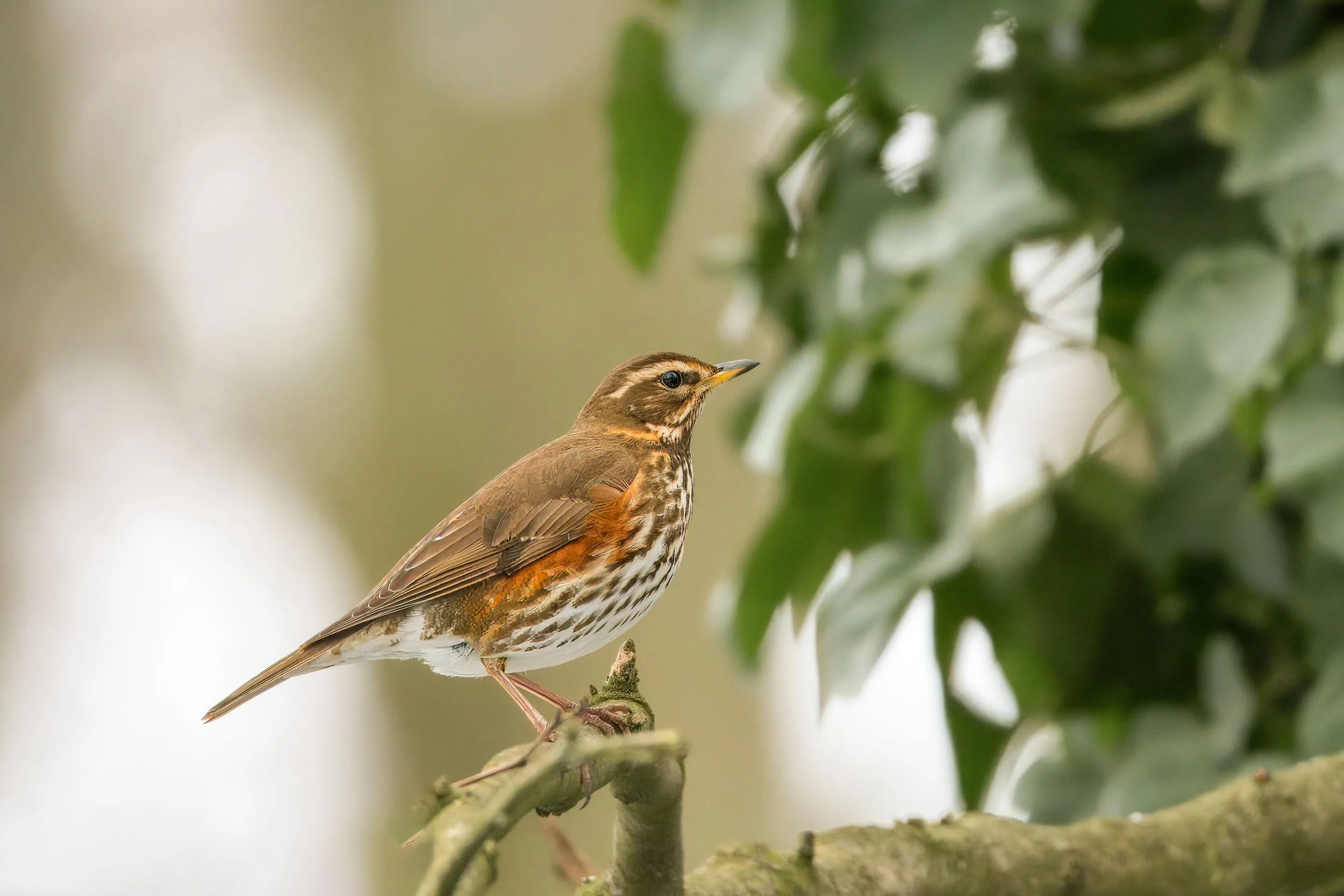
A bird turning on a branch may reveal the flank, and a lifted wing can expose the red underwing. These movements add evidence that was missing from the first view. Through dense twigs, however, a glimpse of a pale line above the eye can be misleading. The useful view shows how the eyebrow sits within the whole face, together with the breast markings.
Redwing’s flight call is a thin, high tseep, more drawn out than Song Thrush’s short note. It can reveal passage overhead after dark, when there is no plumage to inspect. The written syllables only approximate the sound; listening to the Redwing recording alongside Song Thrush makes the difference in length and quality much clearer.
Fieldfare or Mistle Thrush?
Fieldfare’s grey head is the first feature to look for, with dark marking around the eye and particularly between the eye and bill. The lower back and rump are grey too, separated from the head by a chestnut-brown upper back. Together, these areas give Fieldfare a much more contrasting appearance than Mistle Thrush. The dark eye marking strengthens the head pattern in a closer view; the larger blocks of grey and chestnut are more useful at distance.
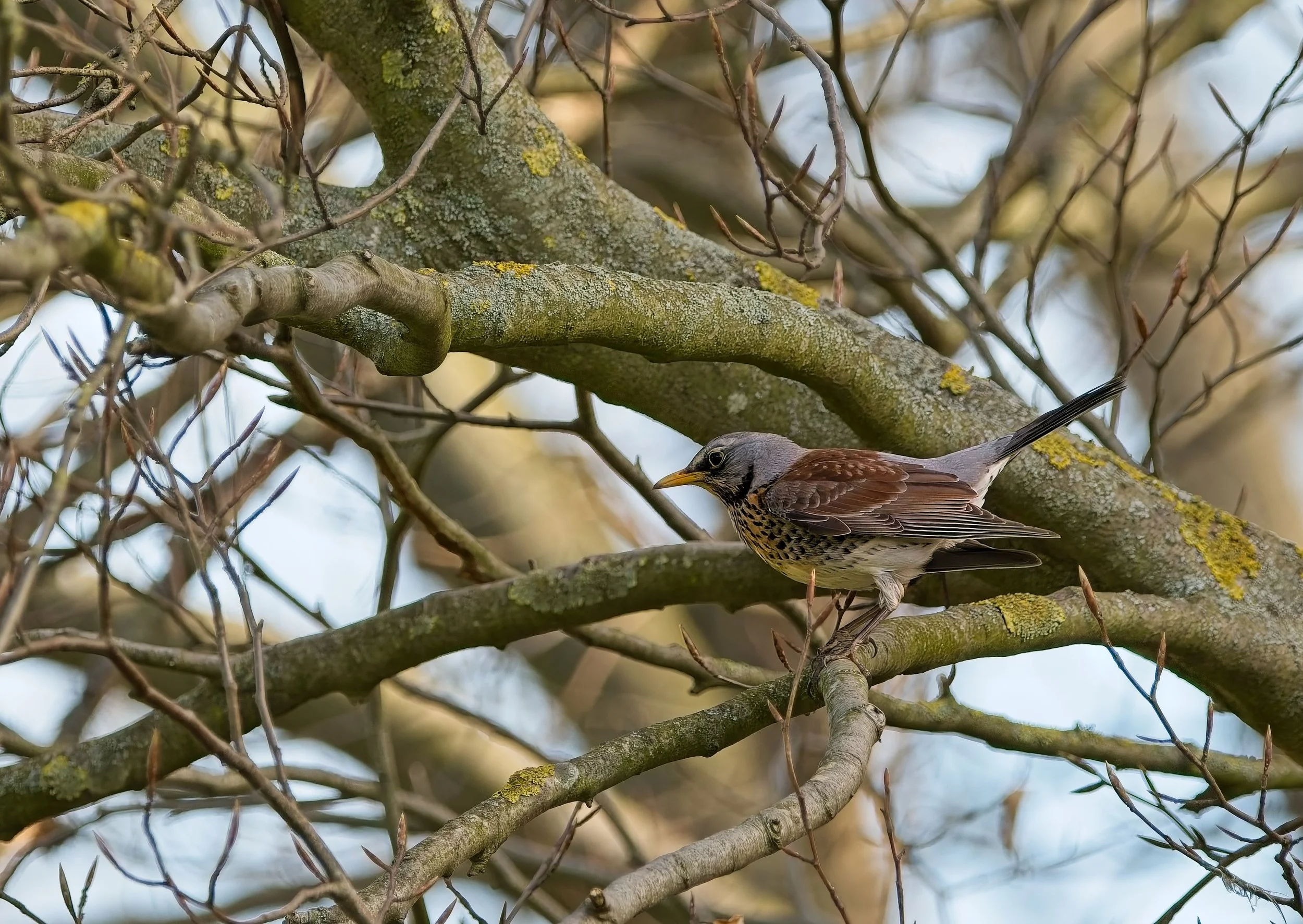
Both birds are large thrushes and can stand upright on the ground. From directly in front, Fieldfare’s warm, heavily marked breast may dominate the view while its back and rump remain hidden. As it turns, the grey head against the chestnut back becomes much easier to judge. Mistle Thrush lacks that clear sequence of contrasting colours, even when its head looks greyer than its back. The RSPB thrush comparison describes these plumage differences.
Fieldfares often announce themselves with repeated harsh chack notes as they move between trees or rise from a field. Mistle Thrush’s call has a drier, rattling quality. The rhythm helps separate them, especially when distance makes both sound merely harsh. The Fieldfare account includes a recording for comparison.
A winter flock deserves a second look after the obvious Fieldfares have been identified. Redwings frequently feed alongside them, and Song Thrushes may join mixed flocks too. Follow the smaller or less clearly patterned birds individually; movement into the same tree does not establish that they are the same species.
Poor views and young birds
Backlighting can remove most colour while leaving some contrasts visible. A pale eyebrow or a light head and rump separated by a darker back may survive the loss of detail. If only the outline and a spotted underside are visible, there may simply be too little to separate the species.
Fresh juvenile plumage brings a different problem. Young birds do not always match the clean adult patterns shown in identification photographs. Brown female and young Blackbirds can also have spots or streaks on the throat and breast, so spotting alone does not place a bird among these four species. An unfamiliar juvenile is worth photographing and comparing with an age-appropriate reference.
Calls can resolve a poor view, provided the sound belongs to the bird being watched. In a mixed flock, a nearby individual may be responsible. A short recording preserves something to examine later; an app’s suggested name cannot establish which bird called. Where the evidence remains insufficient, thrush sp. accurately records the observation.
When to expect them in Britain
Song and Mistle Thrushes occur throughout the year. Autumn migrants from northern Europe add to Song Thrush numbers, so even a familiar-looking bird in winter need not be a local resident. Mistle Thrush is also a year-round presence, although birds make seasonal movements.
Redwings begin arriving from the latter half of September, with most gone by mid-April. Fieldfare arrivals chiefly begin in October. Both are mainly winter visitors: Redwing has a very small breeding population in northern Scotland, while Fieldfare breeding in Britain is exceptional. These patterns help establish what to expect, but an unusual date should prompt closer examination rather than overrule a clear identification.
The month-by-month guide to bird migration in Britain puts these arrivals into the wider autumn sequence.