
Early birds: Wonderchicken and the origins of modern birds
A small fossil skull from Belgium brought the deep history of ducks and gamebirds into focus. Later discoveries have made that history richer, and less settled.
By M Hunt
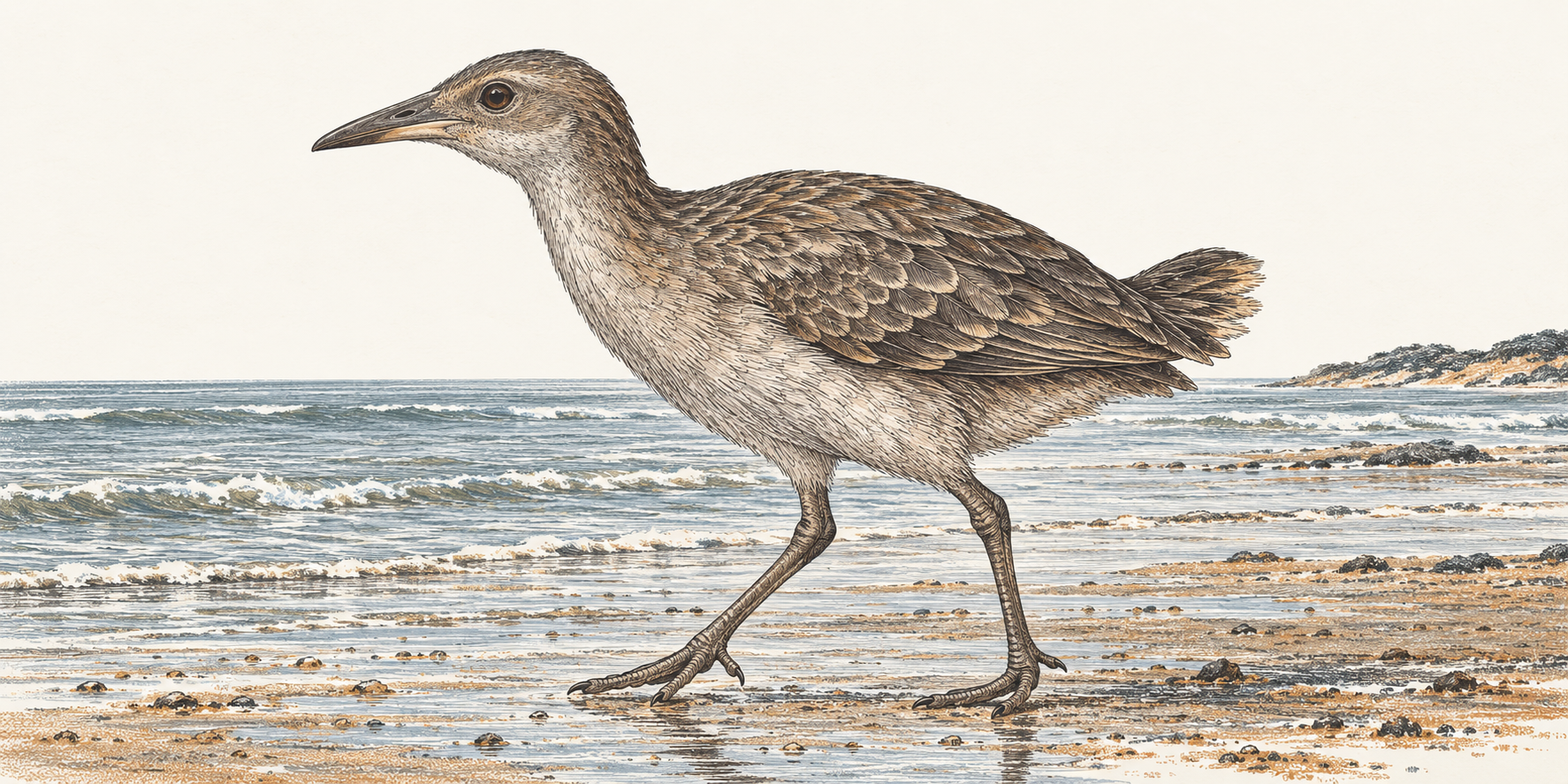
An interpretation of Wonderchicken beside a Late Cretaceous shore. Plumage, colour and soft tissues are imagined; the overall outline is illustrative, rather than a measured anatomical restoration.
Illustration created with AI assistance for Radius & Flyway, informed by Field et al. (2020) fossil data (CC BY 4.0) and the 2024 reassessment.
The skull was hidden inside a small block of rock from a Belgian quarry. Once CT scans exposed it, the combination of features looked unexpectedly familiar: here was a bird with connections to the great group that includes ducks, chickens and partridges, living shortly before the end-Cretaceous extinction.
Named Asteriornis maastrichtensis in 2020 and nicknamed Wonderchicken, it is about 66.7 million years old. Its significance is easy to lose in an “oldest bird” headline. Birds had already existed for tens of millions of years. What this fossil helps us investigate is the origin of the branches that survive today. Read the original discovery paper.
What does “modern bird” mean?
In this context, “modern” describes a place on the family tree, not a recent date or a familiar appearance. The crown group contains the last common ancestor of all living birds and all its descendants. Earlier branches outside that group can still be recognisably birdlike. Archaeopteryx and Wonderchicken therefore illuminate different parts of bird evolution. The researchers’ 2024 review explains this distinction.
Birds before Wonderchicken
Archaeopteryx, from the Late Jurassic of what is now Germany, lived about 150 million years ago. Its feathers sit alongside a long bony tail, teeth and clawed fingers. Looking at the fossil, the mixture is visible: features familiar from living birds are preserved in a skeleton that differs markedly from them.
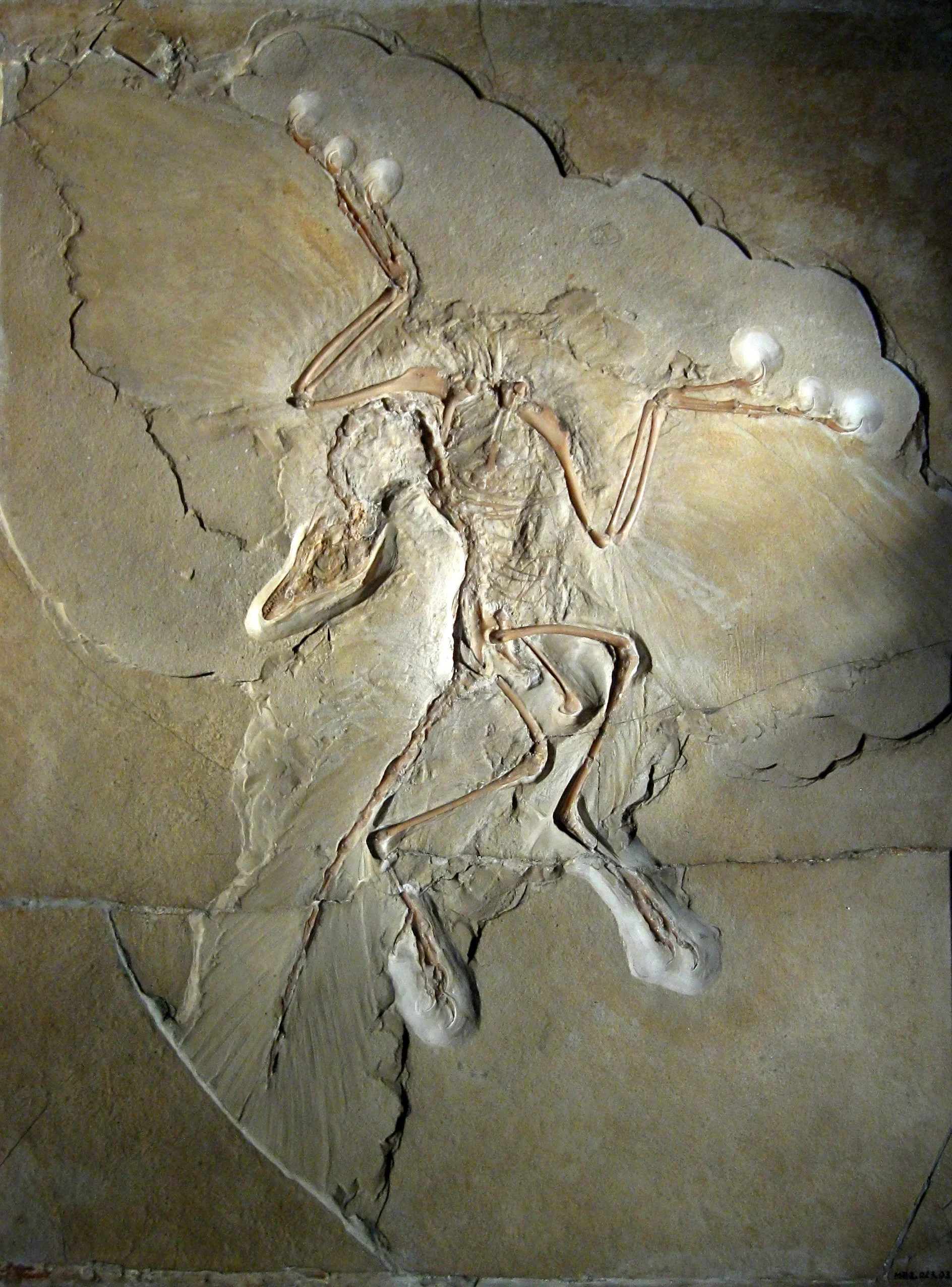
The original Berlin Archaeopteryx specimen, about 150 million years old. The feather impressions and long bony tail belong to the same animal. This is a different specimen from the Chicago fossil studied in 2025.
H. Raab, Archaeopteryx lithographica (Berlin specimen) / Wikimedia Commons, CC BY-SA 3.0. Current Commons version used without further alteration by Radius & Flyway.
Even this familiar fossil continues to yield new information. A 2025 study of the Chicago Archaeopteryx used ultraviolet light and CT scanning to examine structures that were difficult to see. Long feathers on the upper arm would have helped close the gap between wing and body, adding evidence relevant to its capacity for flight. The Field Museum explains the findings.
Another 2025 discovery widened the picture. Baminornis zhenghensis, from roughly 150-million-year-old rocks in China, had a short tail ending in a fused bony structure called a pygostyle. It places this important feature much earlier in bird history than the previous fossil record showed. Different combinations of bird anatomy were already present in the Jurassic; a short tail alone does not place a species among the ancestors shared by all living birds. Read the Baminornis paper.
A skull close to the living branches
Wonderchicken comes from a much later world. Its remains were found in marine deposits formed near a shallow sea in the region of present-day Belgium and the Netherlands. A nearly complete skull survived, together with parts of the limbs. Much of the animal remained enclosed in stone, making CT scanning central to recognising what had been found. Cambridge’s Wonderchicken exhibition follows that process from the fossil blocks to the reconstructed skull.
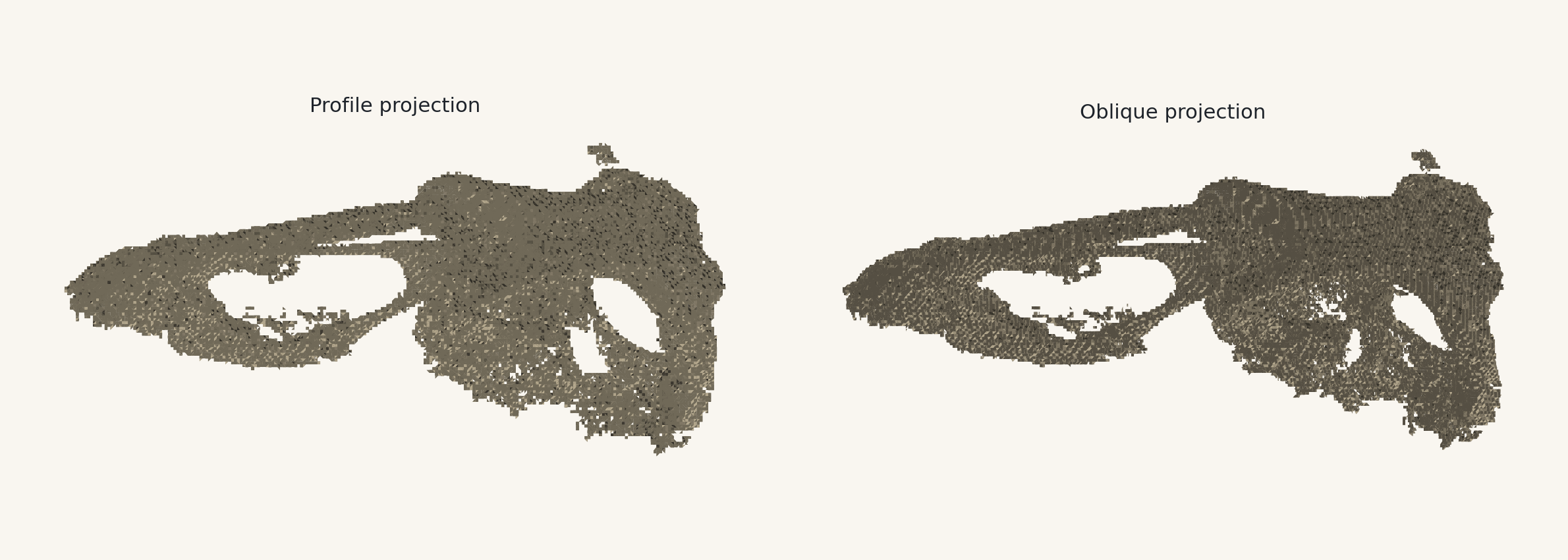
The fossil skull, displayed from two angles using the researchers’ CT-derived surface model. These are views of preserved material, with missing anatomy left missing. The source model’s orientation is retained; the views are labelled by projection rather than anatomical left and right.
Model: Field et al. (2020), Zenodo, CC BY 4.0. Rendering for Radius & Flyway; mesh simplified and source orientation retained.
The original analysis connected Asteriornis with Galloanserae, the branch that unites landfowl and waterfowl. The name Wonderchicken is memorable, but it should not make us picture a domestic hen walking through the Cretaceous. The interesting evidence lies in particular bones and their relationships to one another. Nor does the fossil establish that this individual species was the direct ancestor of today’s ducks or chickens. The discovery study.
Watch the discovery
Cambridge University’s 2020 film shows why the skull caused such excitement. Its “oldest modern bird” description belongs to that discovery announcement; the later studies below show why the comparison continues to change.
Longer legs, and a more careful picture
The reconstruction changed in 2024. By combining information from the preserved left and right hindlimbs, researchers inferred longer legs than those shown in the original reconstruction. That strengthens the possibility that Asteriornis waded in shallow water, although limb proportions cannot tell us exactly where it fed or what it caught. Read the skeletal reassessment.
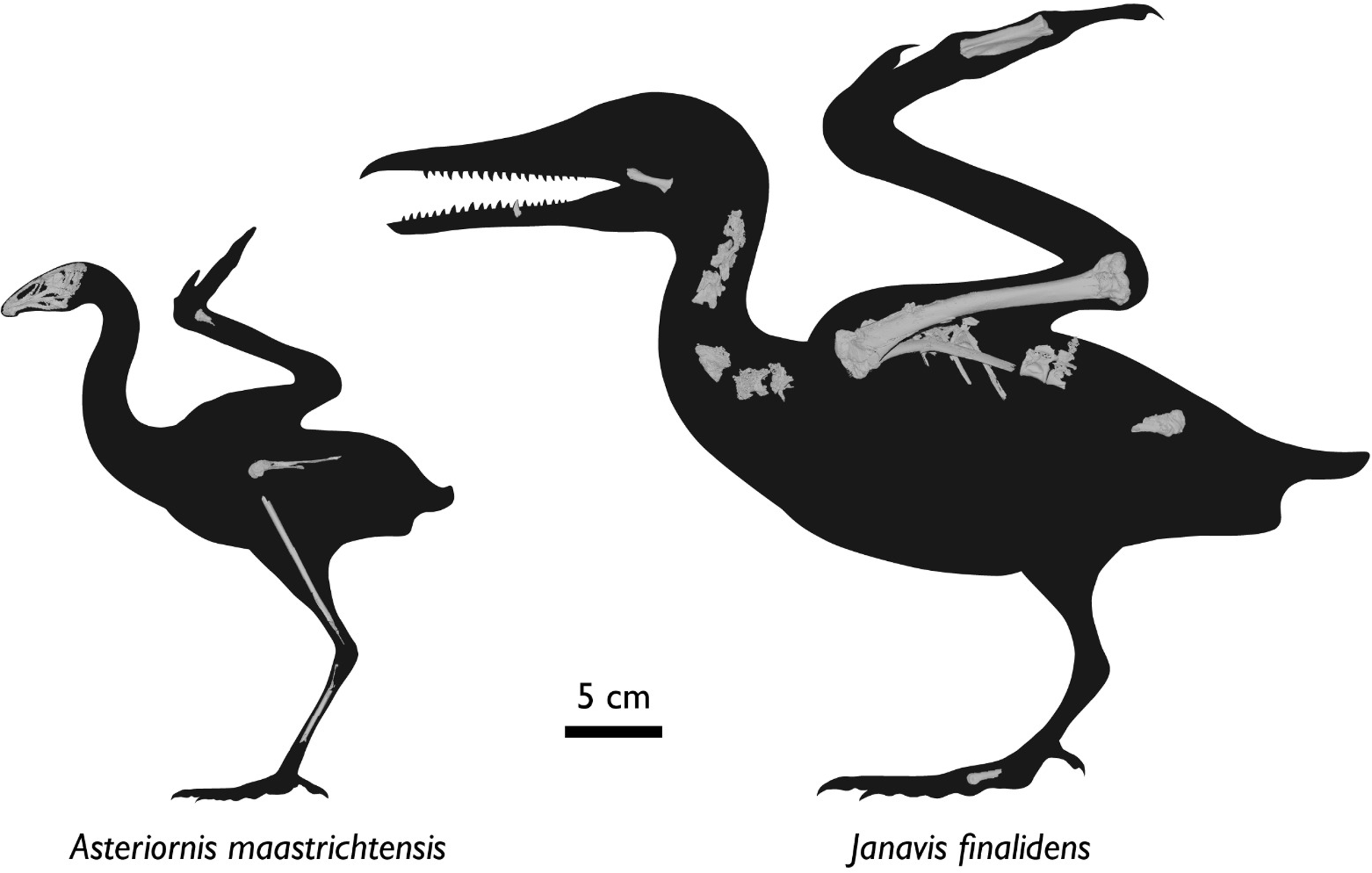
The 2024 reconstruction gives Asteriornis longer legs. Grey elements show preserved bones within reconstructed silhouettes. The much larger, toothed Janavis appears alongside it; it belongs to a branch outside living birds. Scale bar: 5 cm.
Figure 4, Field et al. (2024), CC BY 4.0. Unaltered.
The published silhouette makes another point clear: a near-complete skull is not a complete animal. Missing parts must be inferred. Our opening illustration gives the bird plumage and a coastal setting to help readers imagine it alive. Those choices remain interpretation. No preserved plumage from this specimen tells us that it was brown, and the illustration should not be used to measure its bill, body or legs.
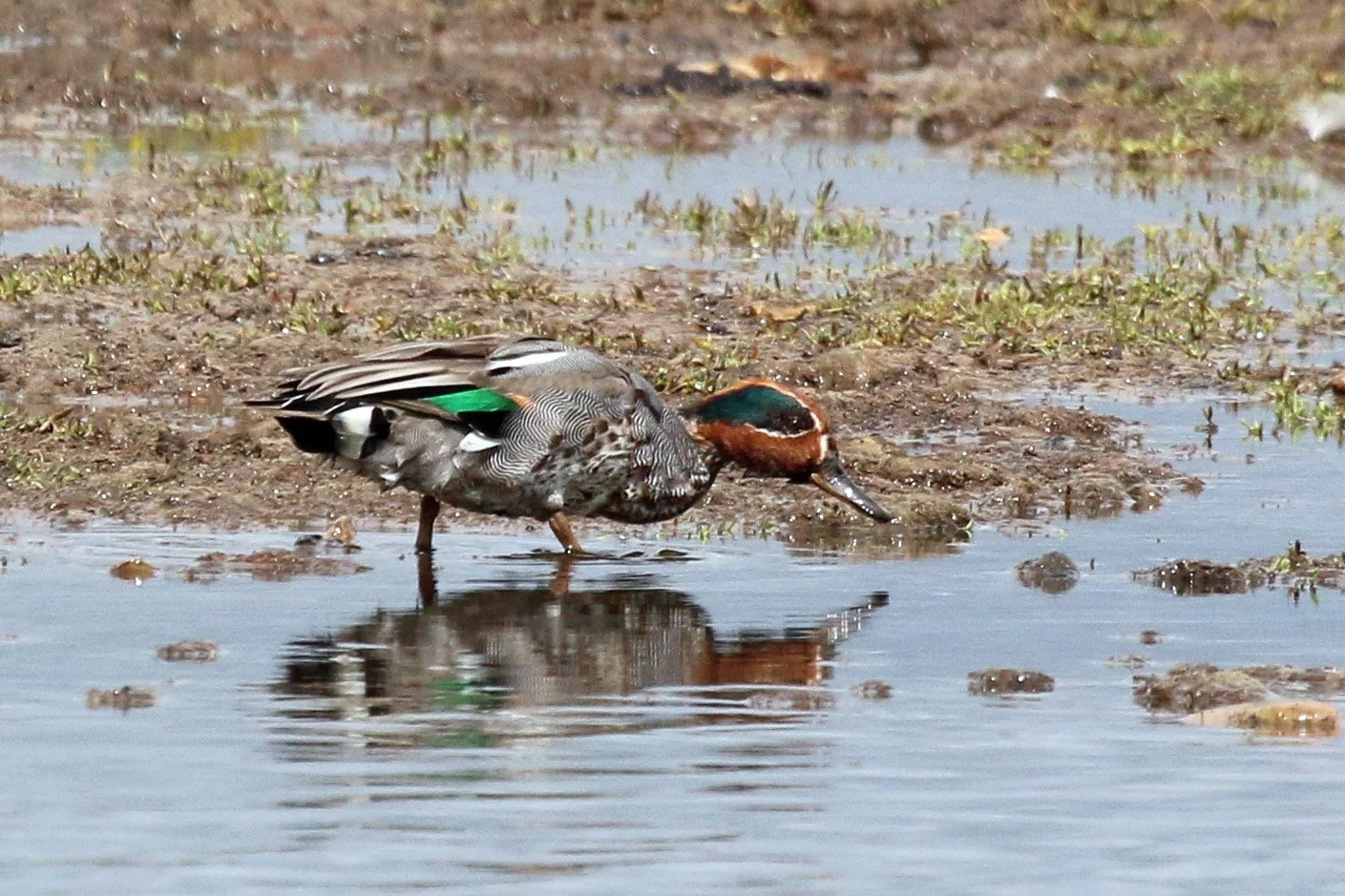
Eurasian Teal (Anas crecca): the waterfowl side of Galloanserae. The photograph shows a living comparison, not a proven descendant of the Wonderchicken specimen.
Charles J. Sharp / Sharp Photography, Eurasian Teal (Anas crecca) male, Hickling Broad, Norfolk, CC BY-SA 3.0. Unaltered.
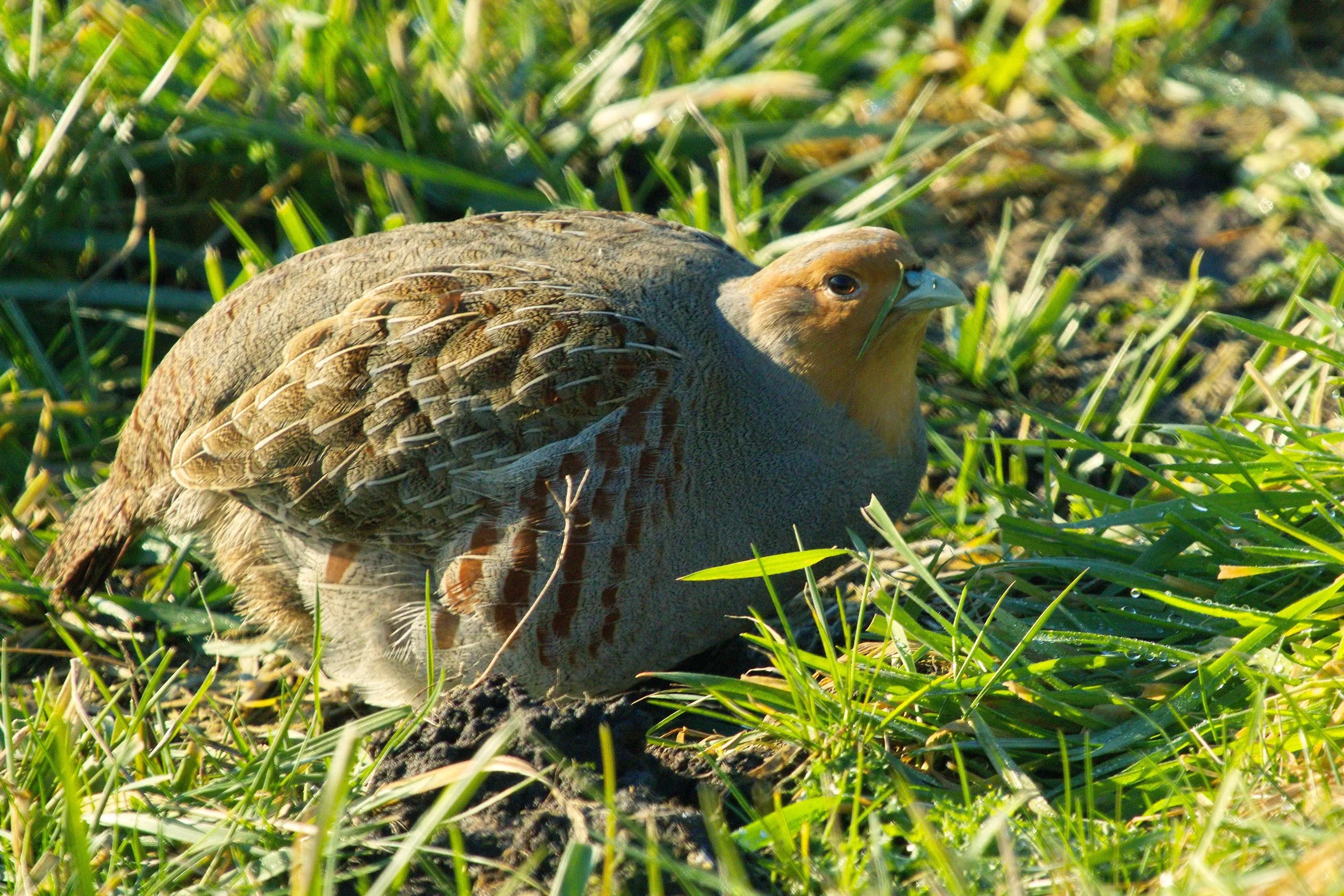
Grey Partridge (Perdix perdix): a member of the landfowl branch. Its relationship to waterfowl runs deeper than the difference between a field and a marsh might suggest.
Bernard Stam, Patrijs, Partridge (Perdix perdix) / Wikimedia Commons, CC BY-SA 2.0. Current Commons version used without further alteration by Radius & Flyway.
The living comparisons are useful because they make Galloanserae less abstract. A teal feeding at a muddy margin and a partridge in grass seem rather different birds. Yet waterfowl and landfowl share a major branch of the living bird tree. Placing Asteriornis close to that branch brings a familiar part of our birdwatching world into the Late Cretaceous.
An Antarctic skull complicates the headline
In February 2025, a newly described skull of Vegavis iaai supplied important evidence from Antarctica. At about 69 million years old, it predates Wonderchicken. The researchers interpreted features of its skull and braincase as support for its position among early waterfowl. The Nature paper sets out that case; Ohio University’s account explains the discovery and proposed ecology.
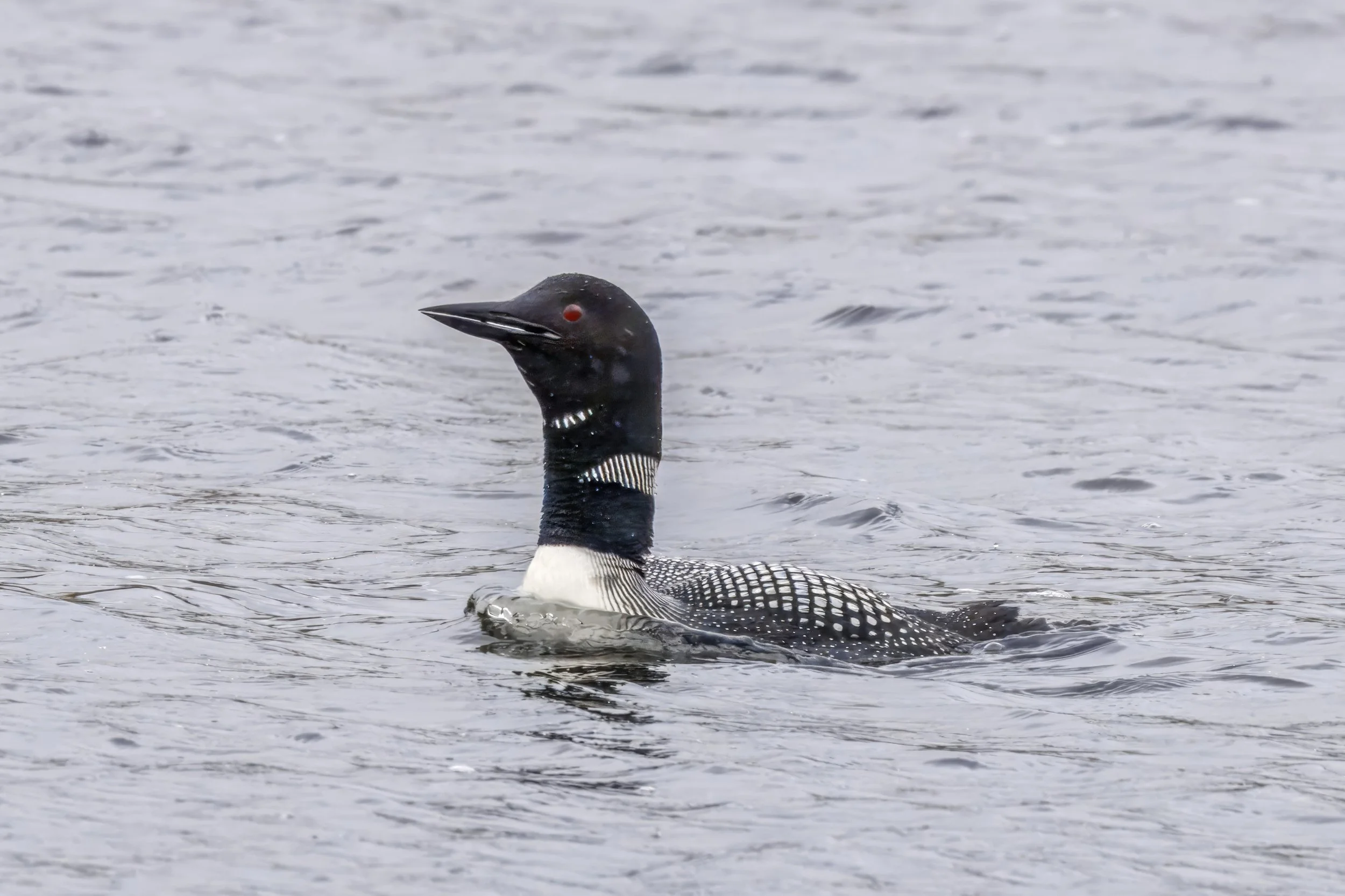
Its feeding equipment was particularly interesting. A pointed bill and the anatomy associated with strong jaw muscles suggested an underwater predator. Combined with evidence from the rest of the skeleton, the team proposed pursuit diving powered by the feet, with an ecological resemblance to living divers or grebes. An early relative of waterfowl need not have fed like a dabbling duck.
.jpg)
_male,_Hickling_Broad,_Norfolk.jpg)

Great Northern Diver (Gavia immer), also called Common Loon. The 2025 Vegavis study suggested a comparable way of pursuing prey underwater. Similar feeding equipment does not, by itself, prove close ancestry.
Charles J. Sharp / Sharp Photography via Wikimedia Commons, CC BY-SA 4.0. Unaltered.
_breeding_Kaldbakstjarnir.jpg)
That does not settle the family tree. Some anatomical similarities can reflect a shared way of life, and a fossil’s placement depends on which characteristics are compared and how they are analysed. Vegavis has become a stronger candidate in one analysis while remaining open to challenge in another.
What the latest jaw study adds
A detailed study by Abi Crane and colleagues, first published online in December 2025 and appearing in the journal’s 2026 volume, revisited the lower jaw. In living adult birds, several jaw bones become fused. CT scans of younger birds helped the researchers distinguish those components and compare them with fossils. Read the jaw study.
The results strengthened a galloanseran relationship for Asteriornis, especially similarities to the landfowl side. For Vegavis, however, the authors found features resembling some extinct groups outside living birds and a lack of certain expected galloanseran specialisations. They raised questions about its proposed position. This was an analysis of particular anatomical evidence with limited taxon sampling, not a final vote on the whole bird family tree.
For a reader following the discoveries, the useful question is therefore: which new bones or comparisons changed the argument? A younger fossil with a revealing skull can sometimes tell us more about relationships than an older but fragmentary find.
A glimpse of birds breeding in the Cretaceous Arctic
Other finds illuminate behaviour as well as ancestry. Research published in 2025 described bird remains from roughly 73-million-year-old deposits in northern Alaska. Among them were bones of very young birds, providing evidence that birds bred in the Arctic while non-avian dinosaurs still lived there. The Science paper and researcher Lauren Wilson’s account describe the evidence.
The remains point to a varied bird community, but small fragments are not enough to identify every species as a member of a living family. Nor does evidence of local breeding show whether those birds migrated. What it does provide is a rare glimpse of birds raising young at high latitudes long before the communities we recognise today.
Looking again at a familiar bird
A partridge’s sturdy outline or a diver’s pointed bill offers a useful starting point for thinking about the past. The harder work begins when resemblance is tested against the skeleton. Fossils preserve enough detail to make those comparisons possible, and enough gaps to keep the answers provisional.
That is what makes Wonderchicken worth returning to. Its value has grown as its legs, skull and jaw have been studied more closely. The fossil lets us follow how a picture of an ancient bird is built, corrected and placed beside the birds still around us.
Continue reading
Why Blackcaps now spend winter in Britain — Ringing, inherited behaviour and a changing migration route.
Why do birds sing at dawn? — How research changes the interpretation of a familiar sound.
For occasional updates from the field and the latest articles, join the Radius & Flyway mailing list using the sign-up form on our homepage.
Research and further reading
Research checked 6 September 2026.
University of Cambridge, Sedgwick Museum (2020 discovery; exhibition accessed 2026). Dawn of the Wonderchicken.
Field, D. J. and colleagues (2020). Late Cretaceous neornithine from Europe illuminates the origins of crown birds. DOI: 10.1038/s41586-020-2096-0.
Field, D. J. and colleagues (2024). Remarkable insights into modern bird origins from the Maastrichtian type area (north-east Belgium, south-east Netherlands). DOI: 10.1017/njg.2024.11.
Chen, R. and colleagues (2025). Earliest short-tailed bird from the Late Jurassic of China. DOI: 10.1038/s41586-024-08410-z.
Field Museum (14 May 2025). UV light and CT scans helped scientists unlock hidden details.
Torres, C. R. and colleagues (2025). Cretaceous Antarctic bird skull elucidates early avian ecological diversity. DOI: 10.1038/s41586-024-08390-0.
Ohio University (7 February 2025). Cretaceous fossil from Antarctica reveals earliest modern bird.
Crane, A. H., Benito, J., Chen, A., Ksepka, D. T. and Field, D. J. (2026; first published online 25 December 2025). Mandibular morphology clarifies phylogenetic relationships near the origin of crown birds. DOI: 10.1186/s12862-025-02487-4.
Wilson, L. N. and colleagues (2025). Arctic bird nesting traces back to the Cretaceous. DOI: 10.1126/science.adt5189.
Wilson, L. N., Princeton University (9 June 2025). Birds nested alongside dinosaurs in Cretaceous Arctic Alaska.
Field, D. J., Benito, J., Chen, A., Jagt, J. W. M. and Ksepka, D. T. (2020). Asteriornis 3D surface files. DOI: 10.5281/zenodo.3610226.