
Whooper vs Bewick’s Swan: How to Tell Them Apart
By Mark Hunt
Whooper and Bewick’s Swans both have white adult plumage and black-and-yellow bills. The most useful difference is the shape of the yellow patch. On a Whooper, it forms a long wedge reaching forwards beneath the nostril. On a Bewick’s, the patch is smaller and more rounded, ending behind the nostril.
Whooper is also the larger bird, but size is much easier to judge when the two are together. Start with the bill, then use the rest of the bird to support your identification. These features apply to adults; young birds need a different approach. WWT’s swan guide.
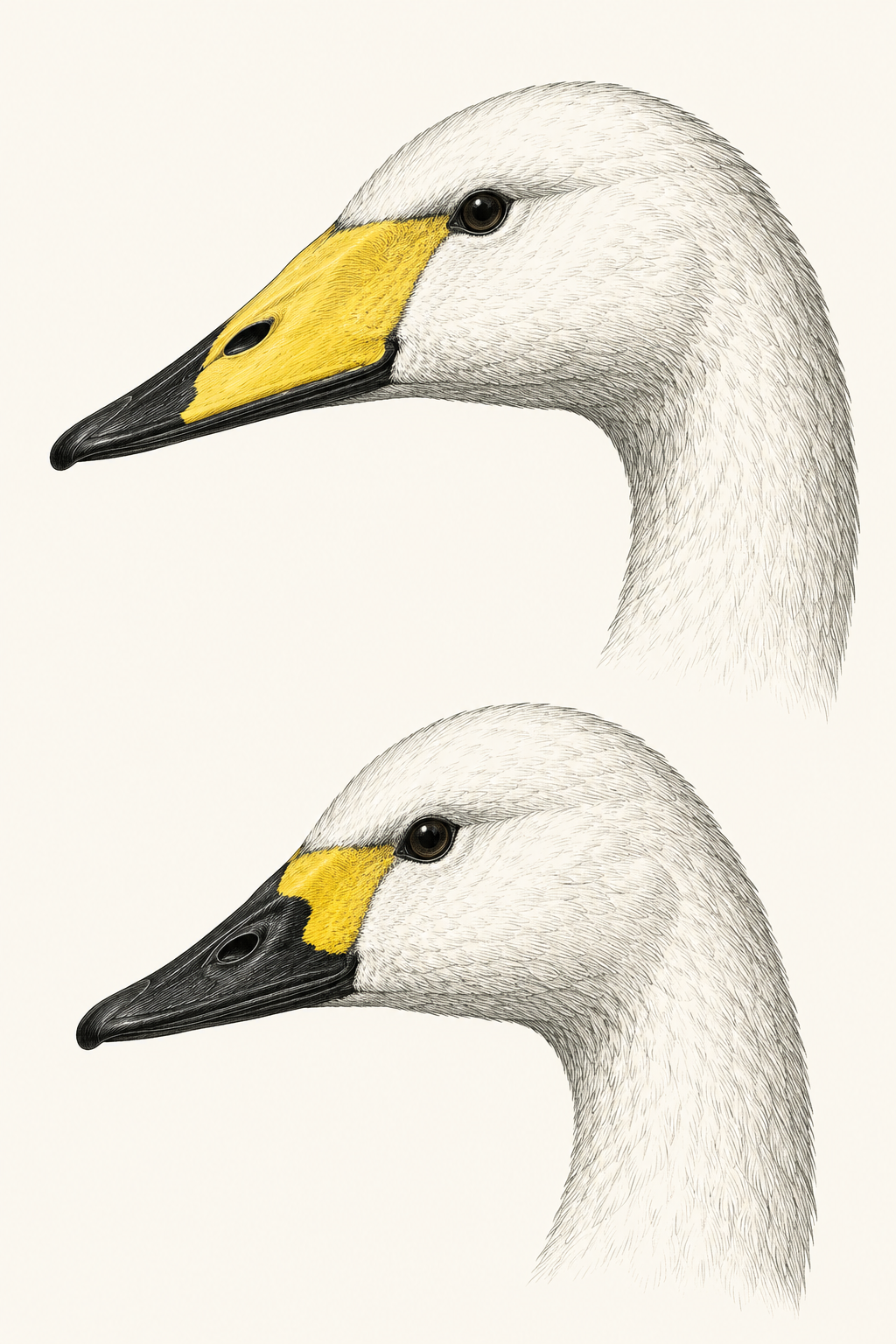
Whooper above, Bewick’s below. Compare the shape and extent of the yellow on each adult’s bill. Heads are not shown to scale. AI-generated editorial illustration for Radius & Flyway.
Compare the bills first
Look for a bird with its head turned sideways. This gives you a clearer view of the boundary between yellow and black than a bird facing directly towards you. The nostril is the small opening partway along the upper bill.
Check where the yellow ends in relation to that opening. The outline matters more than an estimate of how much of the bill is yellow. Markings vary between individuals, so do not expect every bird to match one illustration exactly. The RSPB describes the contrast as a triangular yellow patch in Whooper and a rounded one in Bewick’s.
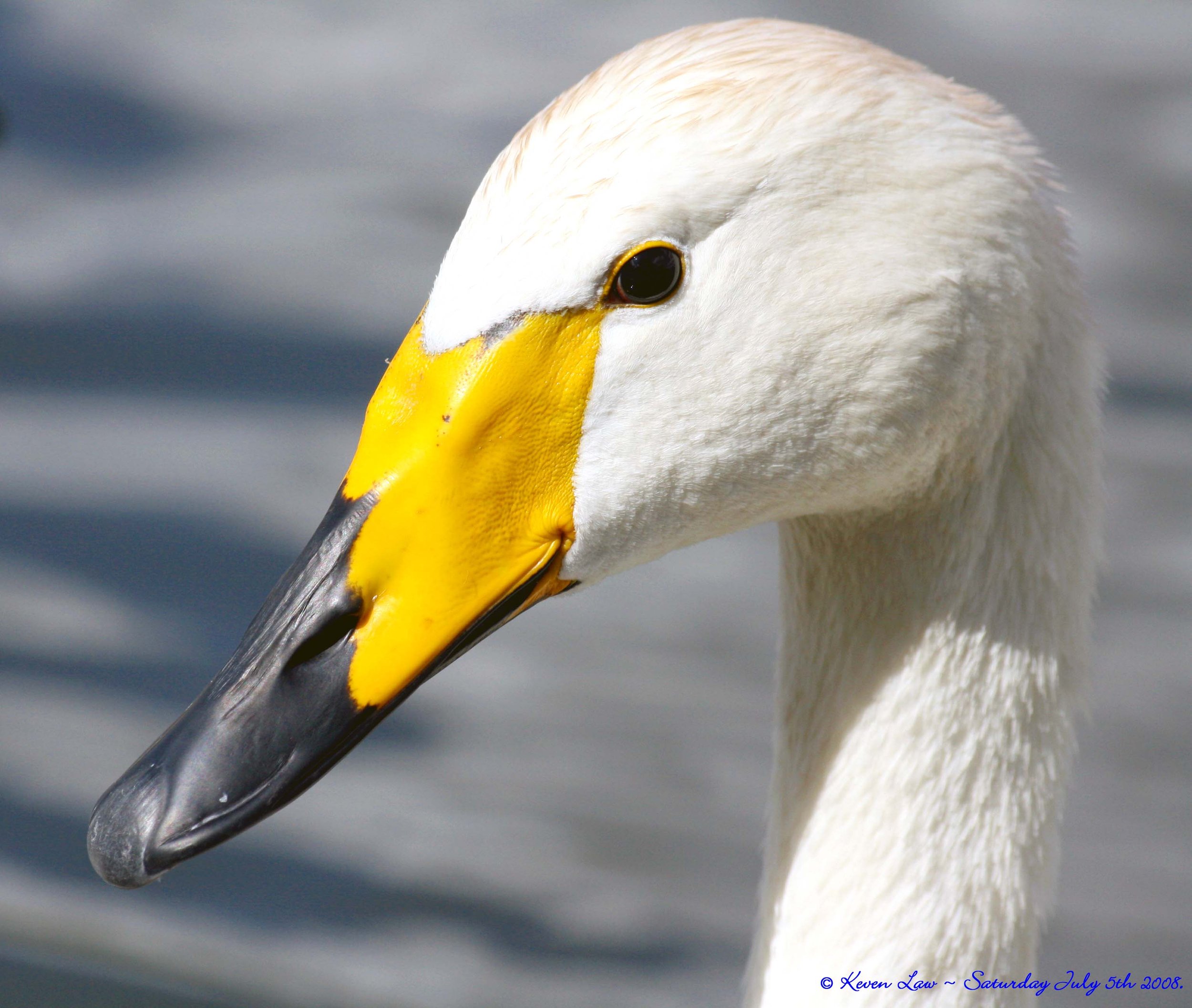
The Whooper’s yellow patch extends forwards along the bill. “My Best side...” — Keven Law, via Wikimedia Commons, CC BY-SA 2.0. Unmodified.
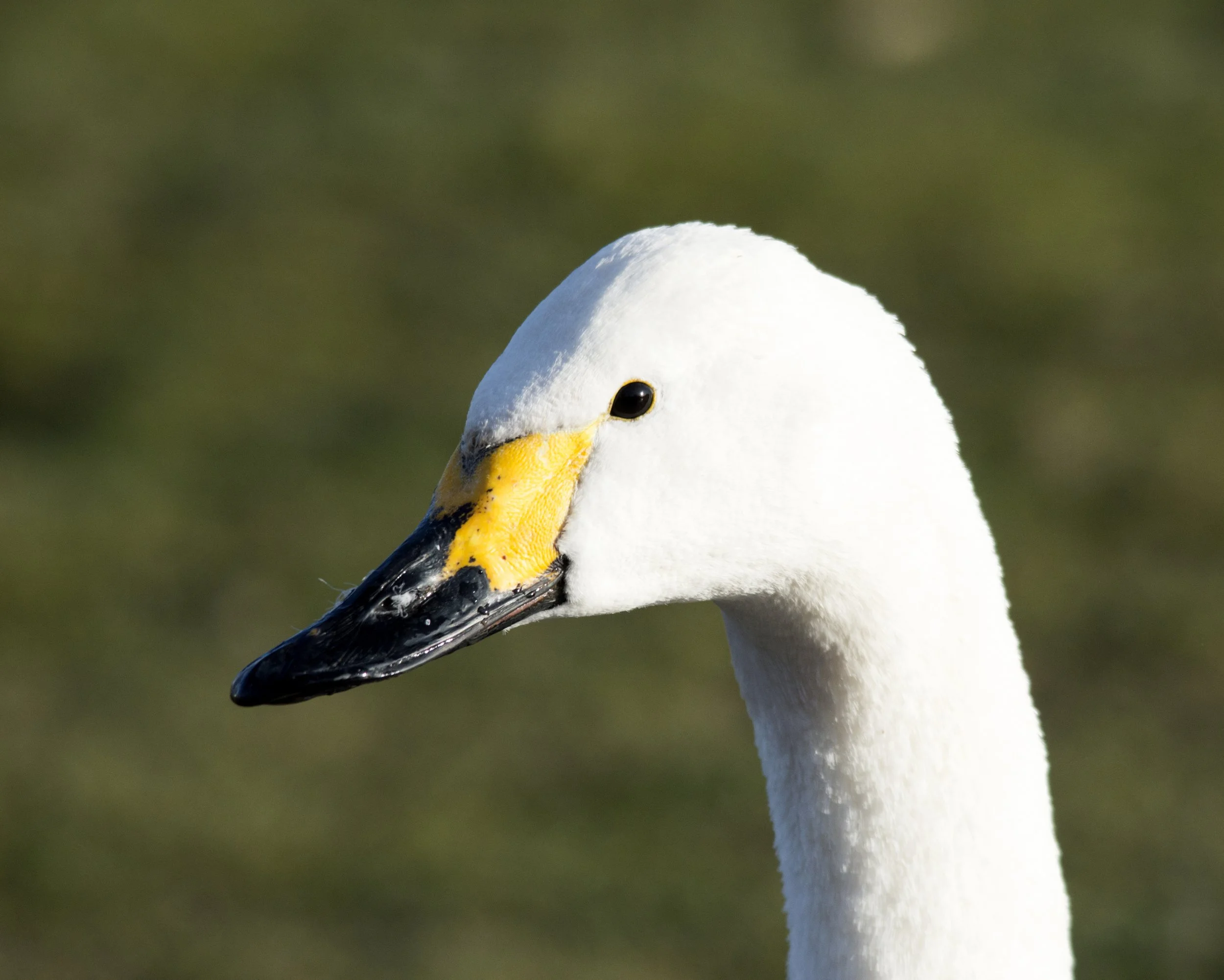
The Bewick’s has a smaller yellow patch, leaving more of the bill black. “Bewick Swan” — Jacob Spinks, via Wikimedia Commons, CC BY 2.0. Unmodified.
| Feature | Whooper Swan | Bewick’s Swan |
|---|---|---|
| Yellow bill patch | Larger, with a pointed wedge | Smaller, with a rounded boundary |
| Relative size | Larger | Smaller |
| Neck posture | Often upright | Can also be upright |
Adult features only. Compare size between birds at a similar distance.
An upright neck does not settle the identification: both species can hold their necks straight. Size helps when birds are close together at a similar distance, but it's much less useful for a lone swan across a large lake.
Where Mute Swan fits
An adult Mute Swan has an orange bill with a black base and a prominent black knob where the bill meets the forehead. That separates it from the two yellow-billed swans.
Its familiar curved neck can help draw your attention, but the bill gives a more direct answer. A swan’s posture changes as it feeds, rests or watches other birds.
Mute Swans are present throughout the year in Britain. That does not mean every bird stays in one place: some move considerable distances and gather in winter flocks. RSPB’s Mute Swan account.
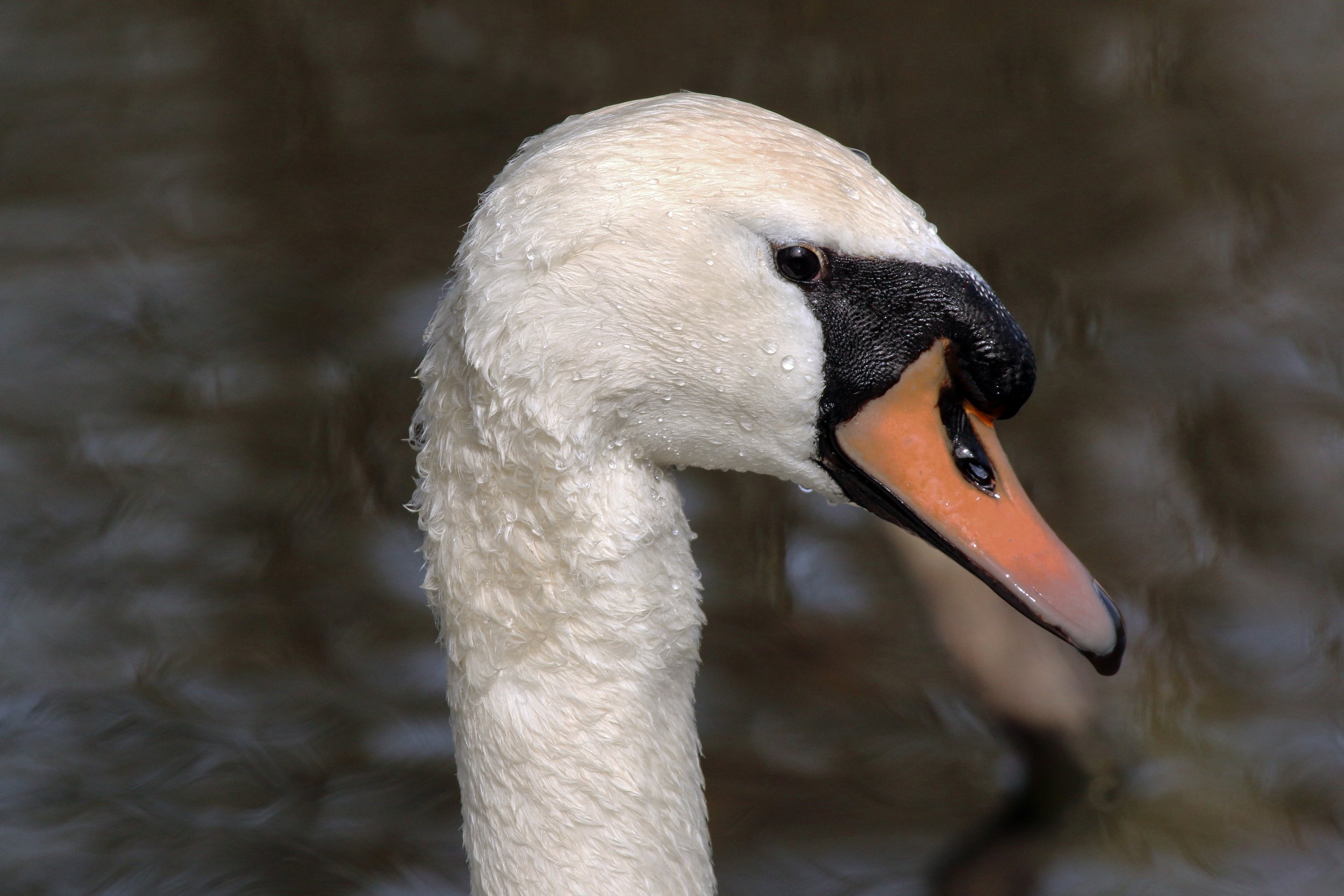
The orange bill and black knob identify an adult Mute Swan. “Mute swan (Cygnus olor) head” — Charles J. Sharp, via Wikimedia Commons, CC BY-SA 4.0. Unmodified.
When the view is difficult
A sleeping swan with its bill tucked away may remain unidentified until it lifts its head. A distant bird may turn several times before the yellow boundary becomes clear.
Wait for that better view. If you take photographs, keep several frames showing different angles. A photograph can preserve a useful detail, but enlarging a blurred image does not necessarily reveal what was there.
Check several birds rather than assuming every swan in a flock belongs to the same species. If you still cannot resolve the features, recording “Whooper/Bewick’s Swan” is a reasonable description of what you saw.
Young swans need a different approach
The adult bill comparison does not work in the same way on young birds. Young Bewick’s Swans are greyish, with pinkish bills, rather than small copies of the black-and-yellow adults. RSPB’s Bewick’s Swan account.
The colours also develop through the winter. Research at Slimbridge recorded first-winter Bewick’s bills changing from cream, pink and black towards less sharply defined yellow-and-grey patterns. Further changes could occur during the second winter. Evans’s study of bill patterns.
Watch the birds around a youngster. Young Whoopers and Bewick’s usually remain with their parents through spring migration, so a family group can provide helpful context. A grey bird standing beside an adult is not automatically that adult’s offspring: watch whether they repeatedly feed, rest and move together. WWT’s swan guide.
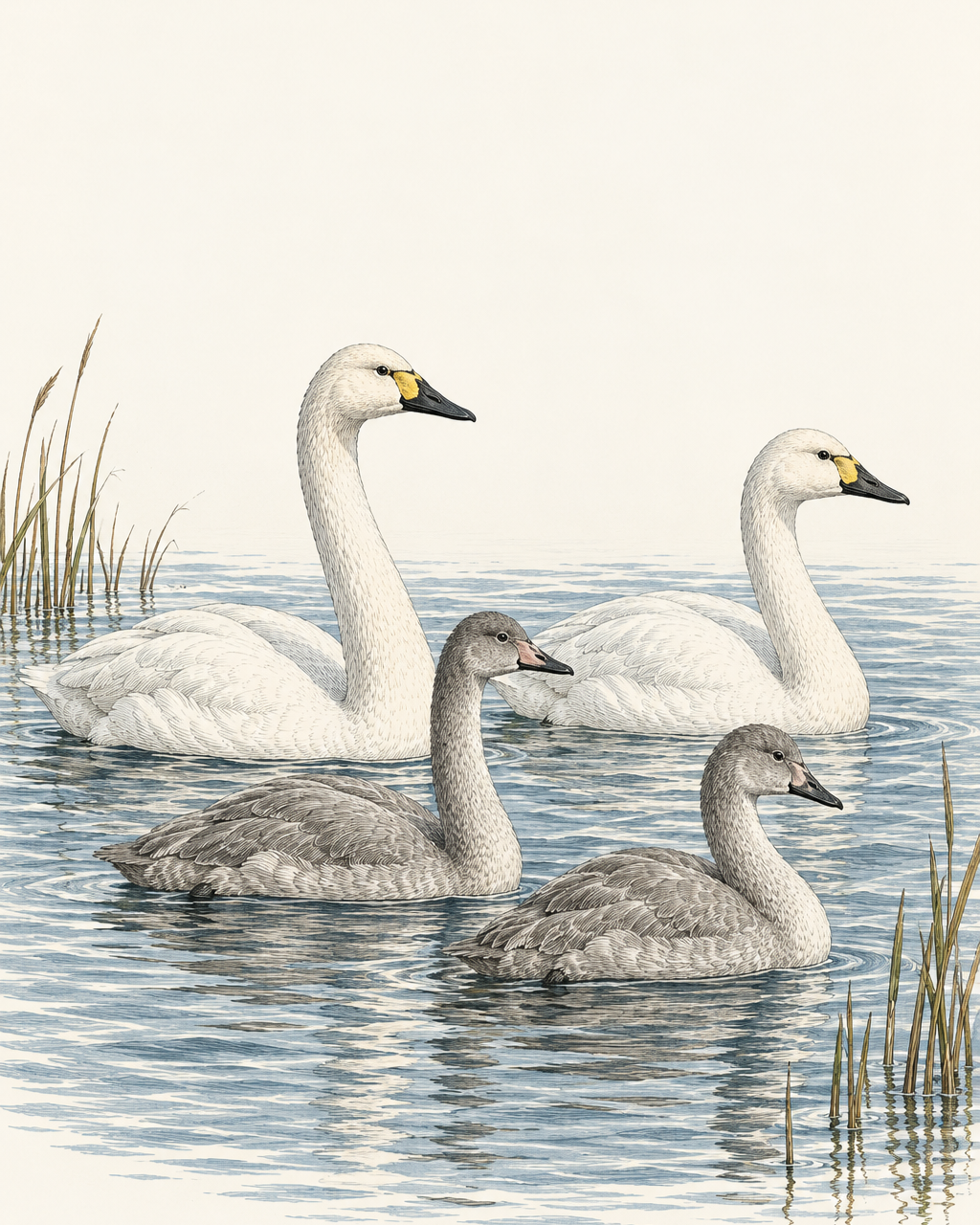
An illustrated Bewick’s family. Young birds have developing plumage and bill colours, so the adult bill comparison does not cover every swan in the flock. AI-generated editorial illustration for Radius & Flyway.
Listen as well as look
Whooper Swans make loud, trumpeting calls, including in flight. Bewick’s are vocal too, with shorter phrases that WWT describes as commonly paired. Mute Swans are not silent: they make several calls, and their wings produce a conspicuous throbbing sound in flight. WWT’s swan guide.
Calls become more useful with familiarity. Listen while watching birds whose identity you have already established, so you can connect the sound with the species. A brief call from an unseen flock may still leave the identification unresolved.
Recognising the same Bewick’s Swan again
Once you can identify a Bewick’s, a closer look can reveal differences between individuals. The yellow-and-black markings vary enough for experienced observers to recognise returning birds.
WWT has used this approach at Slimbridge since winter 1963/64. By December 2023, researchers had identified 10,000 individual swans over the study’s history, building records of their lives and family relationships. This is the total studied over decades, not the number present in one winter. WWT’s bill-pattern study.
In a study published in 1977, 20 observers matched photographs of 52 swans taken in different winters. Experienced participants averaged 47 correct matches; inexperienced participants averaged 29. Each bird was shown from both sides and head-on, giving much more information than a single distant photograph. Evans, 1977.
For a birder visiting the same flock regularly, this offers something to follow beyond the species list. Photograph both sides when the bird turns naturally, keep the dates, and compare several details on subsequent visits. A possible match is a starting point for further observation. Our article on photography as field evidence looks at what photographs can preserve when a live view is brief or incomplete.
Different journeys to Britain
Most Whooper Swans wintering in Britain come from Iceland, although a small number breed in northern Britain. Bewick’s arrive from Arctic Russia, with their British winter distribution concentrated mainly in eastern England and around the Severn Estuary. RSPB’s Whooper account, Bewick’s account.

.jpg)
_head.jpg)
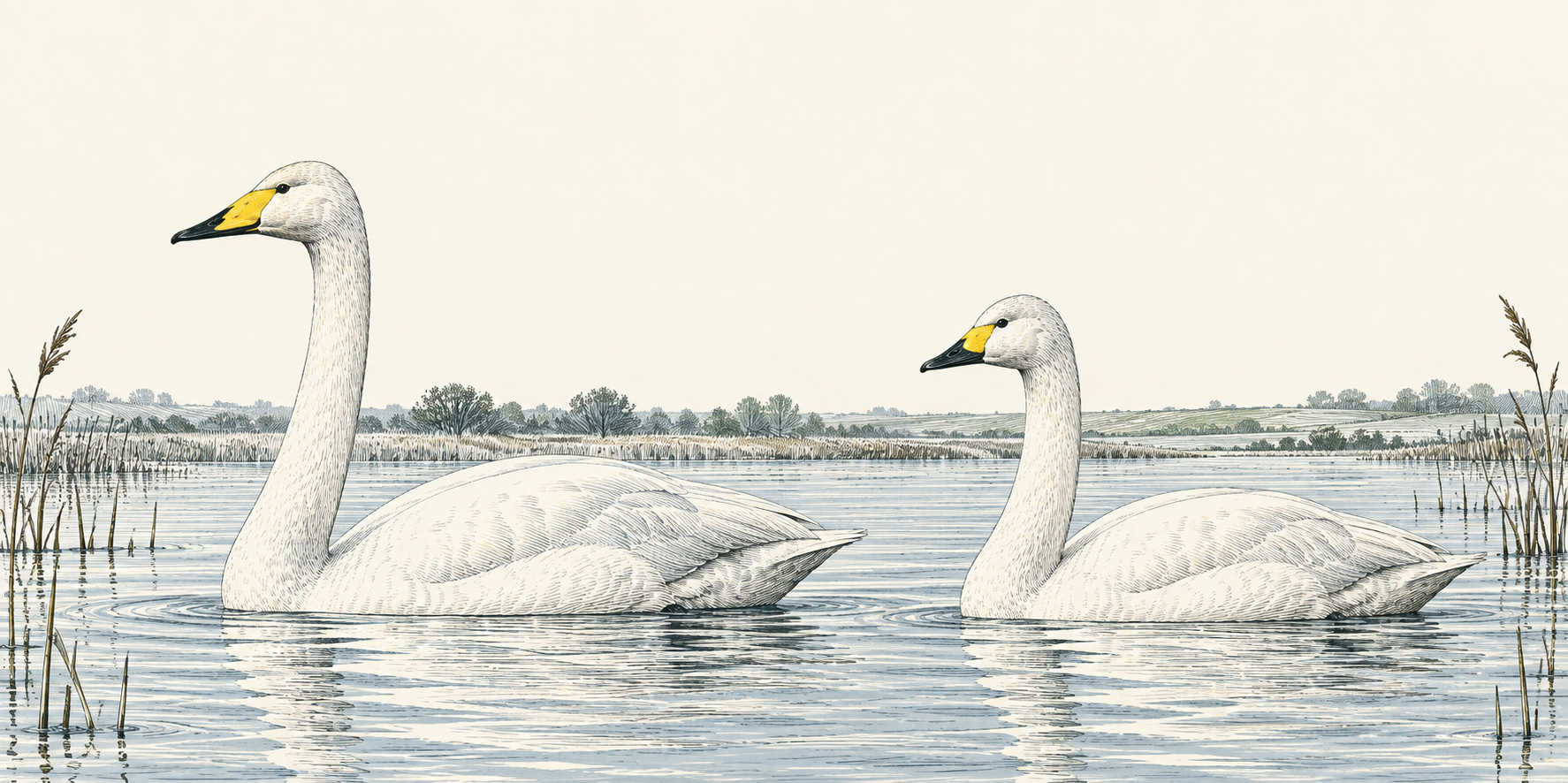
Whooper left, Bewick’s right, in an illustrated winter wetland. Their journeys to Britain begin in different breeding regions. AI-generated editorial illustration for Radius & Flyway; not a measured size comparison.
Fewer Bewick’s reaching Britain does not have a single explanation. Research has documented a shift towards wintering farther east in Europe, with warming conditions contributing to that change. The wider Northeast/Northwest European population has also declined. Some birds are wintering elsewhere, but redistribution does not explain the whole loss. Nuijten and colleagues, 2020, Koffijberg and colleagues, 2025.
For the wider pattern of seasonal arrivals and departures, see Bird Migration in Britain: A Month-by-Month Guide.
Research checked: 15 September 2026.
Join our mailing list for occasional field notes and new articles on bird identification, migration and fieldcraft.