

Photography as Field Evidence: Identifying a Young Spotted Flycatcher
Three imperfect photographs taken with a lightweight bridge camera preserved enough evidence to resolve a brief and initially confusing encounter.
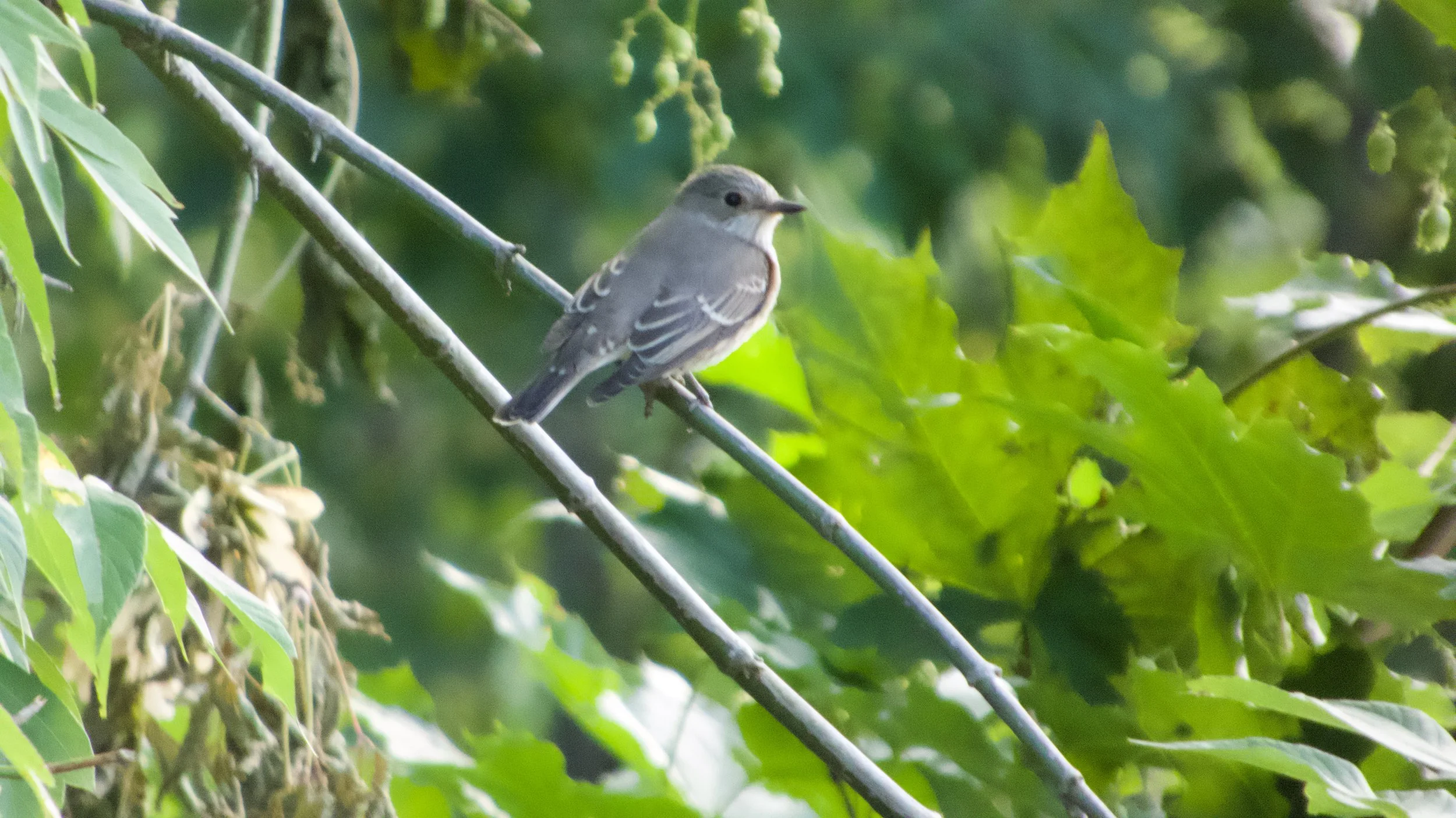
The side view preserved the bird’s fine bill, long folded wing and general proportions. It was photographed handheld in Auto mode at approximately 976mm equivalent. Photograph © M Hunt.
The bird in these photographs was, I believe, a first-calendar-year Spotted Flycatcher. That judgement does not rest on one decisive image. It comes from several photographs showing different features, supported by the bird’s behaviour, the date and what I had been seeing locally.
On 25 August, at a wooded site in Lithuania, the small flycatcher repeatedly appeared among the trees, perched briefly and disappeared again. A fence prevented me from getting closer. I had 8×25 binoculars with me, but at that distance I couldn't see enough detail to resolve the finer plumage features.
It was a dark, rainy day. In the poor light, the bird appeared compact, with a pale eye-ring and an unusually open facial expression. My first thought was Red-breasted Flycatcher. A few had been seen at the site during spring migration, so the possibility that a pair had bred was not unreasonable, but the view was too brief and distant for a confident identification.
The encounter lasted about two minutes. The bird flew out after insects, returned to the same small area and settled only briefly. This was characteristic flycatcher behaviour, but it did little to separate the possible species. Each time it perched, I tried to take another photograph.
A record photograph does not need to be beautiful
I was carrying a Panasonic Lumix FZ82D. The camera was in Intelligent Auto mode, so there was little photography involved beyond finding the bird in the viewfinder, focusing and pressing the shutter whenever it settled. I took the photographs handheld.
The bird is small in the frame, fine detail is soft, and the light has affected its apparent colour. The photographs are nevertheless adequate for identification. Photographic quality and identification value overlap, but they are not the same thing. A soft photograph showing the tail may be more useful than a sharp portrait in which the tail is hidden.
What three photographs showed
No single frame settled this identification. Their value came from recording the bird in different postures.
The side view showed a fine insect-catching bill and a relatively long wing. Fluffed feathers made the body look rounder and more compact than its underlying structure.
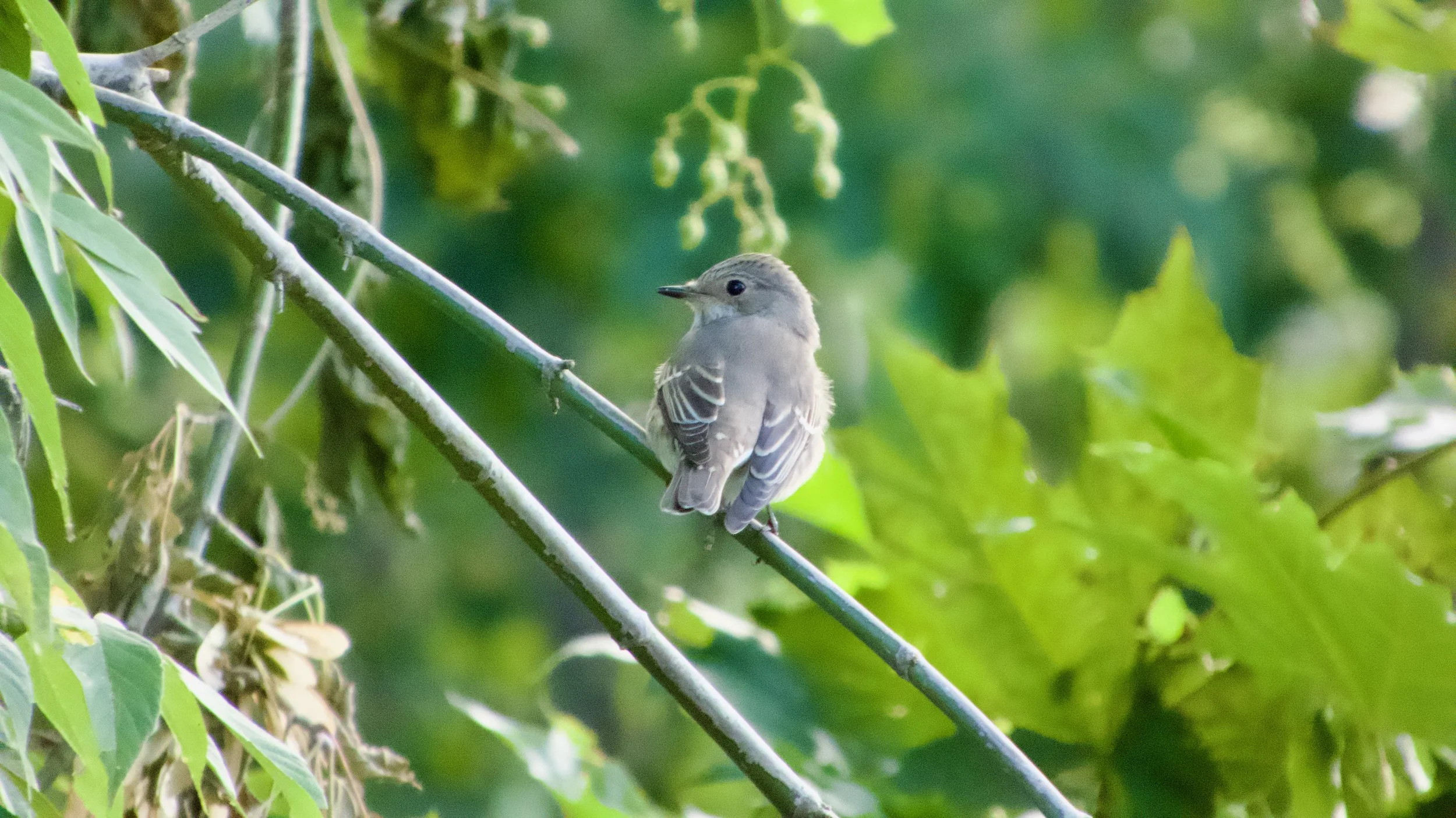
A second posture gave the clearest view of the streaked crown and the best available view of the closed tail. The tail was not spread, so Red-breasted Flycatcher could not be excluded from this frame alone. Photograph © M Hunt.
The rear three-quarter view provided the clearest crown pattern. Fine dark streaks were visible across the forehead and crown. It also gave the best available view of the closed tail, which did not show the conspicuous pale basal panels expected on a Red-breasted Flycatcher.
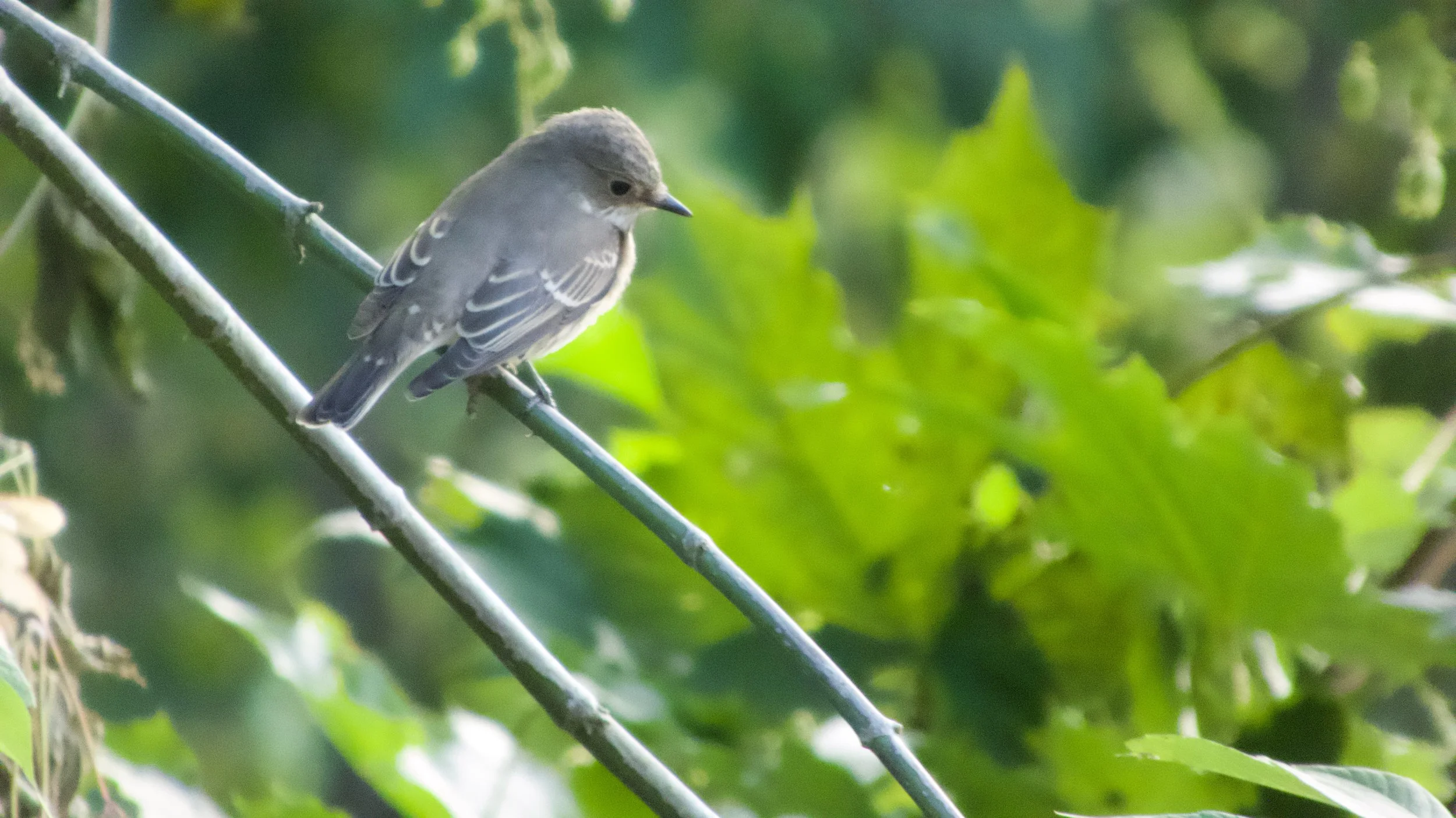
Small flycatcher perched with its head lowered, showing pale-tipped wing coverts and the long folded wing. Photograph © M Hunt.
The head-down view made the long primary projection clearer. It also showed that the supposed eye-ring was much less complete than it had appeared through my binoculars.
Once a recognisable record shot has been secured, another angle may contribute more than several near-identical photographs. The head, folded wing, rump and tail answer different questions.
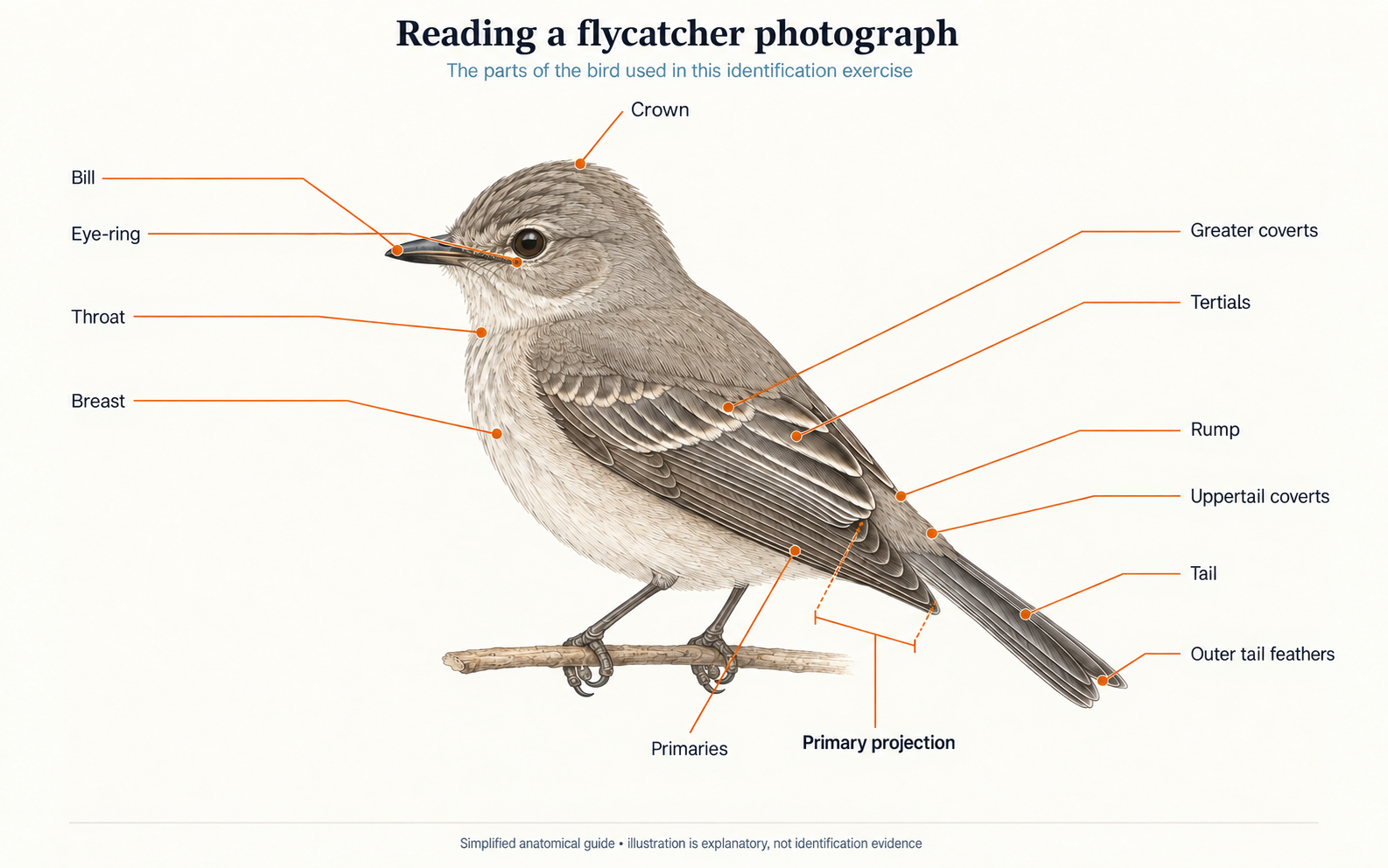
Flycatcher topography used in this article. Primary projection is the distance from the tip of the longest tertial to the tip of the longest primary. AI-generated illustration; topography and labels manually corrected by Radius & Flyway.
Age the bird before identifying it
The greater coverts had broad pale tips and the tertials carried pale fringes. These could be read as a wingbar, encouraging comparison with the Ficedula flycatchers. Their more useful meaning was that this was a young bird retaining juvenile wing feathers.
Recently fledged Spotted Flycatchers are much more heavily spotted than this individual. During the post-juvenile moult, many of the patterned body feathers are replaced by plainer feathers, while juvenile coverts and flight feathers remain. The result can be an immature Spotted Flycatcher that no longer looks particularly spotted.
Age and species therefore needed to be considered separately. Pale-tipped coverts can establish that a bird is young without identifying which flycatcher it is. In a first-winter Spotted Flycatcher, they can remain alongside the longer-winged structure and crown streaking visible here.
Testing Red-breasted Flycatcher
Red-breasted Flycatcher deserved consideration because of my first impression. A female-type or first-year bird can be rather plain, with a pale face and a narrow wingbar formed by young covert feathers.
The photographs weakened that identification. The apparent eye-ring was neither bold nor complete. The crown was streaked rather than plain, and the bird looked longer-winged than my initial view had suggested. Most importantly, none of the photographs showed the white panels at the bases of the outer tail feathers that are central to recognising Red-breasted Flycatcher. The tail was never fully spread, so their absence could not eliminate the species by itself, but the images provided no positive tail evidence for it.
Pied and Collared Flycatchers also occur in the region. I had seen many Pied Flycatchers during spring, although Spotted Flycatchers were the flycatchers I encountered most often in late August and had definitely nested at this site. This bird lacked the distinct white patch at the primary bases expected on Pied or Collared. Its crown streaking, long-winged form and plain dark tail continued to favour Spotted.
The combination mattered more than any one mark: crown streaking, retained juvenile wing feathers, long primary projection and no visible contrasting tail pattern.
What Sound ID added
Merlin Sound ID also suggested Spotted Flycatcher during the encounter. I did not retain the recording, and I could not establish that the bird in front of me produced the detected call. Another Spotted Flycatcher could have been calling nearby.
I treated the result as context rather than confirmation. A name on the screen cannot connect a sound to a particular visible bird unless the observer establishes that connection. The same limitation is examined in Can You Trust Merlin Sound ID?.
What Auto mode did in poor light
The RAW file preserved the camera’s exposure data. The clearest side-view frame was taken at a focal length equivalent to approximately 976mm on a full-frame camera. Intelligent Auto selected 1/125 second, f/6 and ISO 1000.
Those figures explain the photograph. At nearly 1,000mm equivalent, 1/125 second is slow, while ISO 1000 asks a great deal of the FZ82D’s small sensor. Camera movement, movement by the bird and noise reduction all reduce fine detail. Stabilisation can reduce hand movement, but it cannot freeze the bird.
Stronger light permits a faster shutter speed or lower sensitivity and much cleaner photographs. I have not yet tested the camera properly in such conditions because every outing since buying it has been dark. Here, Auto mode found a compromise that produced identification evidence with virtually no intervention.
Perched birds have so far been straightforward to photograph. Fast-flying birds have been much harder: the narrow field of view makes them difficult to find and follow, and Auto mode may select a shutter speed too slow to freeze flight.
Why I was carrying a bridge camera
I had gone to the shop intending to buy a Nikon COOLPIX P1100. Seeing its size and lifting it changed my mind. I am not primarily a photographer and I often cover large patches on foot. The camera may be carried for hours and used for only a few minutes, so weight was decisive.
The FZ82D weighs about 640g, has a 20–1200mm-equivalent optical zoom and cost me less than £350. The P1100 weighs about 1.4kg and reaches 3000mm equivalent. I accepted less reach in return for a camera I was more likely to carry. My main aim is to obtain identification evidence, although the occasional excellent photograph would be welcome. A fuller comparison belongs in a separate review after I have used the Lumix for longer and in better light.
The FZ82D is not dust-resistant, splash-resistant or waterproof, so on this rainy outing I protected it whenever it was not being used.
Camera, binoculars or telescope?
The camera did not replace my binoculars. They found the bird quickly and let me follow its behaviour, but could not resolve enough plumage detail at that distance, and the fence prevented a closer approach.
A telescope might have provided a better live view. The bird’s repeated appearances and disappearances would still have made prolonged study difficult, and an unrecorded view could only be reconstructed from notes and memory afterwards.
The camera preserved three short views that could be enlarged, compared and shown to somebody else. This is valuable when documenting an unusual bird. A photograph does not prove a rarity merely by existing; the necessary field marks must be visible. It does leave evidence that can support or challenge the observer’s account.
When a bird appears unexpectedly, I would now take a record photograph before worrying about settings. If it remains, I can improve the exposure. I would continue whenever its posture changes, keep the original RAW file and note its behaviour, location, date and any sounds heard.
I remain about 99% certain that this was a first-calendar-year Spotted Flycatcher. That is my own judgement, not a measured probability. If I am wrong, another birder can examine the photographs and explain why. Without the camera, I would probably still have settled on Spotted Flycatcher from the binocular views, although with less confidence and much less evidence with which to test the identification afterwards. Record photographs help keep your lists clean; when the bird really is a major rarity, they also make the identification much easier to justify to others.
Sources and further reading
Information and equipment specifications checked: 3 September 2026.