
Beyond Phonetics: How Xeno-Canto Refines Bioacoustic Identification
Using Open-Access Sound Archives and Spectrograms for Objective Bird Vocalisation Fieldcraft
The Observation & Central Question
Traditional field guides often use phonetic spellings like tchick or teee-uuu to describe bird calls. But hearing sounds in the field is subjective and can be affected by wind, thick trees, or our own hearing. In busy woods or during migration, it is easy to forget what you heard. So how can a field naturalist move beyond unclear text descriptions and develop a more accurate way to understand bird sounds?
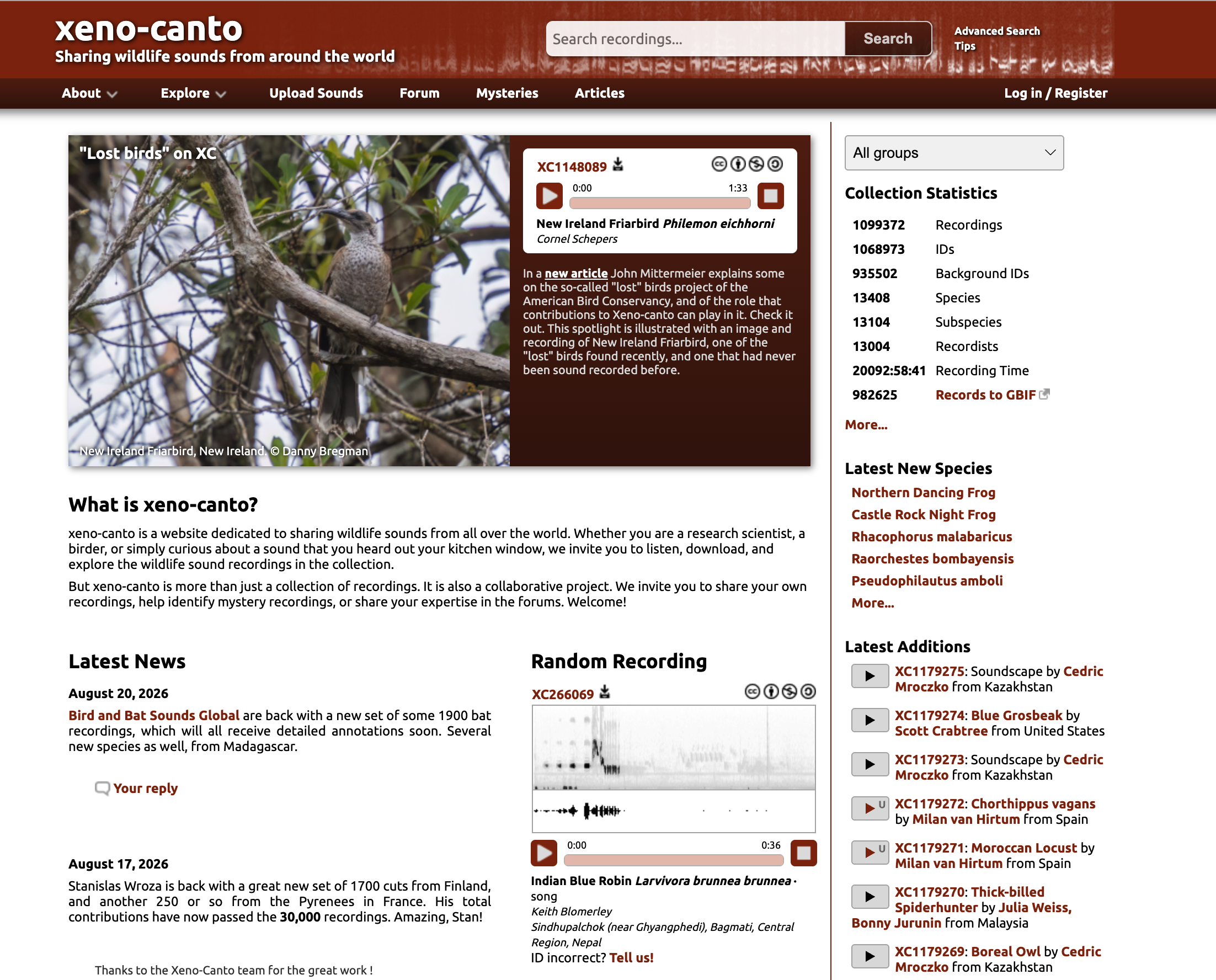
An editorial UI capture of the Xeno-Canto homepage (xeno-canto.org), highlighting the main audio search interface, an embedded sound player with an active time-frequency spectrogram graph, recent database additions, and global cataloguing metrics.
How Do You Use Xeno-Canto for Bird Sound Identification?
To identify bird sounds with Xeno-Canto, start by searching the archive with location filters to find local species' calls. Compare your recording with the spectrograms to check pitch, pacing, and harmonics. If you still can't identify a call, upload your audio to the mystery sound forum so the global community can help.
Deep-Dive Analysis: The Three Pillars of Bioacoustic Evidence
Identifying bird sounds relies on listening to raw, unedited audio. Xeno-Canto.org is the main open-access site for wildlife sounds, with over 1.09 million recordings from more than 13,000 species. Three main features make it a valuable tool for anyone serious about fieldwork:
Integrated Spectrogram Graphs: Each audio file comes with a time-frequency graph. Seeing the harmonics, frequency limits, and pacing helps you notice details you might miss just by listening.
Subspecific and Geographic Precision: The database lists recordings down to the subspecies, with exact location data. This lets users study how bird calls change in different regions.
Background Species Annotation: The community helps identify other species heard in the background of recordings. This builds a useful library for studying real soundscapes and overlapping bird calls.
| Metric / Feature | Archive Scope | Practical Field Benefit |
|---|---|---|
| Cataloged Audio | 1,090,000+ verified recordings | Direct side-by-side comparison of subtle call variations |
| Taxonomic Depth | 13,000+ species & subspecies | Analysis of regional vocal dialects and geographic clines |
| Data Pipeline | Exported directly to GBIF | Audio contributions support peer-reviewed conservation research |
| Community Board | Global volunteer network | Collaborative auditing of unidentified mystery audio snippets |
How to Integrate Xeno-Canto into Your Fieldwork Workflow
Use regional search filters on Xeno-Canto by entering a specific county or habitat coordinates. This helps you find local vocal dialects instead of just searching for species in general, making your fieldwork more focused.
Look at the time-frequency graphs on the pages for your target species. These spectrograms help you get used to pitch changes, repeated syllables, and the highest frequencies you might hear.
Listen to recordings with notes about other species in the background. This helps you practice telling your target calls apart from the noise of other birds.
If you have field recordings you are unsure about, upload them from your phone or recorder to the mystery sound section on the platform. Experts worldwide can help identify them.
Transforming Passive Listening into Ecological Evidence
Using an open audio archive changes the way you notice sounds in nature. Instead of guessing from memory, you can use shared recordings as real evidence. By adding your own field recordings to open databases, you help map biodiversity and track populations over time.
You can find more natural history tools and field guides in the resources section.
By M. Hunt