

Arctic waders: why conservation must follow the whole journey
A feeding problem on a West African shore can begin months earlier in Siberia. Following that connection reveals why migratory birds need protection across countries, habitats and seasons.
By Mark Hunt
A Knot can survive its first journey south from the Arctic and still carry a disadvantage from the summer in which it hatched. Research on birds breeding in Siberia found that young from early-snowmelt summers had shorter bills. Months later, on their West African wintering grounds, bill length affected which food they could reach.[1]
The finding poses a difficult conservation problem. If a bird struggles to feed in one country because of conditions it experienced in another, where should conservation efforts begin?
A shorter bill on a winter mudflat
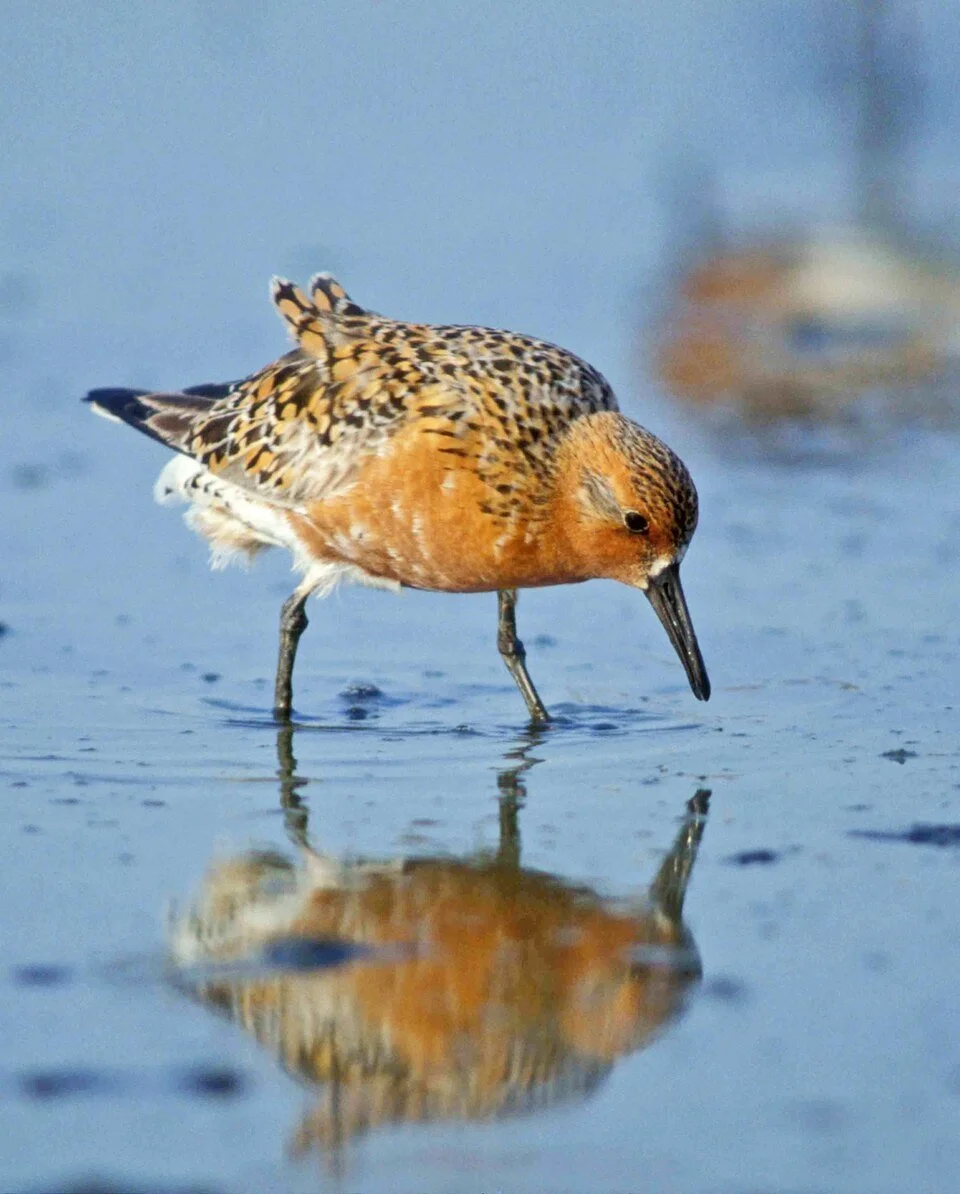
A Knot on the Dutch Wadden Sea. The photograph illustrates the species and feeding habitat; it does not show the Siberian population studied in the article. Photo: Jan van de Kam, CC BY 2.5, via Wikimedia Commons. Resized and optimised by Radius & Flyway.
In a study published in 2016, Jan van Gils and colleagues examined Knots breeding in northern Siberia and wintering at Banc d'Arguin in Mauritania. Young birds were smaller and had shorter bills after summers with earlier snowmelt. The researchers proposed that inadequate food during growth helped explain the difference.[1]
On the wintering grounds, shorter-billed birds ate fewer deeply buried shellfish and more shallow underground seagrass stems. Their shorter reach restricted access to an important food source, and these birds had lower survival.[1]
To understand the feeding difficulty in Mauritania, the researchers had to look beyond the winter mudflat, back to the season when the birds were growing.
When spring food arrives earlier
Arctic wader chicks feed on insects and other small animals, including spiders. Their growth depends on finding enough of this food during the short breeding season. Earlier snowmelt can change when it becomes available.[2]
If the food season advances faster than the birds' breeding dates, chicks may hatch after food abundance has peaked. Scientists call this a timing mismatch. It is a potential problem, but the date of the peak alone cannot tell us how much food remains.
Research on Arctic shorebirds in Alaska illustrates the difficulty. Earlier snowmelt was associated with greater mismatches, yet the size of the mismatch was a poor guide to food availability. Weather after snowmelt helped determine how much food chicks could find. An early thaw did not provide a reliable forecast of the feeding conditions that followed.[2]
Sanderlings show why the whole food season matters
A study of Sanderlings in north-east Greenland followed changes over 17 years. The emergence of their small invertebrate prey advanced, while the birds' hatching dates did not. Increasingly, chicks hatched after food had reached its greatest abundance.[3]
Yet that growing mismatch did not explain poorer chick growth. The amount of food and the length of time it remained abundant were more informative. Chicks grew better when the period of plentiful food was broad. Missing a brief surge and hatching during a long period of abundance are very different situations.
There was another complication. Nests were more likely to lose their eggs to predators early in the season. The researchers suggested that this could favour later nesting, even where food was appearing earlier.[3]
Breeding earlier therefore involves more than matching an insect calendar. Eggs must survive long enough to hatch, and food must remain available while chicks grow. The balance between those requirements can differ between places and years.
Britain's part in the journey
The same need to understand a bird's origins applies on the Wash. The Knots in the Siberian study belong to a population known as canutus. Most Knots wintering in Britain belong to islandica, which breeds in Greenland and Arctic Canada. These are subspecies: populations within the same species, with different breeding ranges and migration routes. Siberian canutus birds also pass through Britain in autumn.[4]
The research does not establish that Norfolk's wintering Knots are developing shorter bills through the same process. But the distinction makes the international connection tangible. The future of a winter flock on the Wash also depends on what happens in Greenland and Canada. The birds spend different parts of their lives under the care of different countries.
Conservation across borders
This is why migratory bird conservation works at the scale of a flyway: the network of breeding grounds, migration stopovers and wintering areas used by a population. The Convention on Migratory Species calls for countries to protect and strengthen networks of places where birds can breed, feed and rest.[5]
Each place has a different job. Breeding habitat must support eggs and growing chicks. Stopovers must provide opportunities to rest and feed between flights. Wintering grounds must sustain birds for the months they spend there, and protecting those places requires countries to share research and coordinate action along the route.[5]
What action looks like
For governments, the practical work is to protect and restore the chain of places each population needs: Arctic breeding habitat, safe stopovers and productive wintering mudflats. That means managing protected sites well, monitoring bird numbers and food conditions, sharing evidence between countries, and ensuring that new infrastructure does not sever an important route or reduce a bird's ability to adapt.[5]
Individual birders cannot protect a flyway on their own, but regular, complete records can help reveal changes in arrival dates, numbers and distribution. Submitting observations through schemes such as BTO BirdTrack gives them value beyond a personal list, especially when the same site is recorded through the year.[6]
The same cross-border problem affects far more than waders. Geese, swallows, raptors and seabirds all depend on a sequence of habitats in different countries. Climate change adds another layer of uncertainty: snowmelt, insect emergence, migration weather, and wetland conditions can change at different rates.[7]
The central research gap is therefore not simply whether spring is becoming earlier. We need to know which populations are losing breeding success or survival, at which stage this occurs, and whether good habitat elsewhere can reduce the effect. That requires long-term work linking conditions on breeding grounds to tracking, resightings and survival later in the year.
The Knot study adds a harder lesson. Even where winter food is present, a bird may arrive less able to exploit it. Protecting a mudflat cannot reverse poor growth during an Arctic summer. Equally, tackling the causes of Arctic warming cannot replace the feeding habitat that birds need now. Local habitat protection and climate action address different parts of the same bird's life.
The Sanderling findings show why that work needs patient research. An earlier insect season does not always mean hungry chicks, and breeding earlier can bring other risks. Conservation needs to identify where survival or breeding success is declining, rather than assume every population faces the same problem.
A young Knot feeding in Mauritania has already crossed thousands of miles, but its first summer can still affect each probe into the mud. Its prospects depend on decisions made far beyond that shoreline. For a migratory bird, successful protection has to last through the year and extend across the countries it visits.
Sources
Van Gils, J. A. and colleagues (2016). Body shrinkage due to Arctic warming reduces red knot fitness in tropical wintering range. Science, 352, 819-821. DOI: 10.1126/science.aad6351. The explanation involving inadequate food during early growth is the researchers' proposed mechanism.
Saalfeld, S. T. and colleagues (2019). Phenological mismatch in Arctic-breeding shorebirds: impact of snowmelt and unpredictable weather conditions on food availability and chick growth. Ecology and Evolution, 9, 6693-6707. DOI: 10.1002/ece3.5248.
Reneerkens, J. and colleagues (2016). Effects of food abundance and early clutch predation on reproductive timing in a high Arctic shorebird exposed to advancements in arthropod abundance. Ecology and Evolution, 6, 7375-7386. DOI: 10.1002/ece3.2361.
British Trust for Ornithology. Knot: BirdFacts. Population origins and seasonal occurrence in Britain.
Convention on Migratory Species. Flyway site networks and habitat protection. International framework for conserving connected breeding, feeding and resting habitats.
British Trust for Ornithology. BirdTrack. Citizen-science recording for bird conservation.
Convention on Migratory Species. Climate change and migratory species. Review of climate impacts and conservation responses.
Information checked: 25 September 2026
Continue reading